
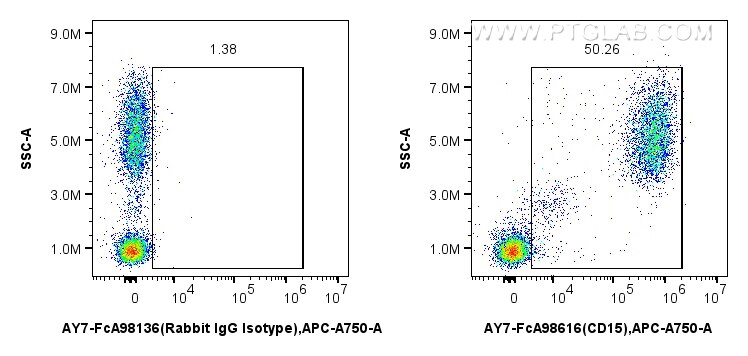
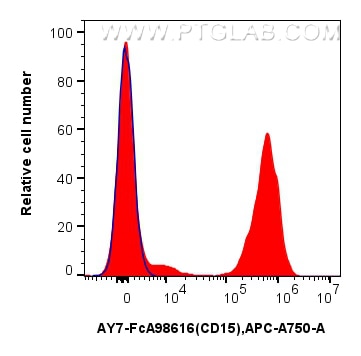

Tested Applications
| Positive FC detected in | human peripheral blood leukocytes |
Recommended dilution
| Application | Dilution |
|---|---|
| Flow Cytometry (FC) | FC : 5 ul per 10^6 cells in a 100 ul suspension |
| This reagent has been pre-titrated and tested for flow cytometric analysis. The suggested use of this reagent is 5 ul per 10^6 cells in a 100 µl suspension or 5 ul per 100 µl of whole blood. | |
| Sample-dependent, Check data in validation data gallery. | |
Product Information
AY7-FcA98616 targets CD15 in FC applications and shows reactivity with human samples.
| Tested Reactivity | human |
| Host / Isotype | Rabbit / IgG |
| Class | Recombinant |
| Type | Antibody |
| Immunogen |
unknow Predict reactive species |
| Full Name | CD15 |
| Gene Symbol | |
| Gene ID (NCBI) | |
| RRID | AB_3746717 |
| Conjugate | APC-Cyanine7 Fluorescent Dye |
| Excitation/Emission Maxima Wavelengths | 650 nm / 778 nm |
| Excitation Laser | Red Laser (633 nm) |
| Form | Liquid |
| Purification Method | Protein A purification |
| Storage Buffer | PBS with 0.09% sodium azide and 0.5% BSA, pH 7.3. |
| Storage Conditions | Store at 2-8°C. Avoid exposure to light. Stable for one year after shipment. |
Background Information
CD15, also known as stage-specific embryonic antigen-1 (SSEA-1) or Lewis X (LeX), is a cell surface glycan consisting of a trisaccharide with the structure Galβ1-4[Fucα1-3]GlcNAc (PMID: 18953356). CD15 is expressed on most terminally differentiated myeloid cells, including neutrophils, eosinophils, monocytes, macrophages, mast cells, and Langerhans cells. It has also been shown to be expressed on stem cells and progenitors in the embryonic and adult nervous system, Hodgkin's lymphoma cells, and cells from a variety of solid cancers (PMID: 19185848). CD15 acts as a ligand for selectins in transendothelial migration and is involved in phagocytosis and chemotaxis (PMID: 1362195).
Protocols
| Product Specific Protocols | |
|---|---|
| FC protocol for APC-Cyanine7 CD15 antibody AY7-FcA98616 | Download protocol |
| Standard Protocols | |
|---|---|
| Click here to view our Standard Protocols |



