



Tested Applications
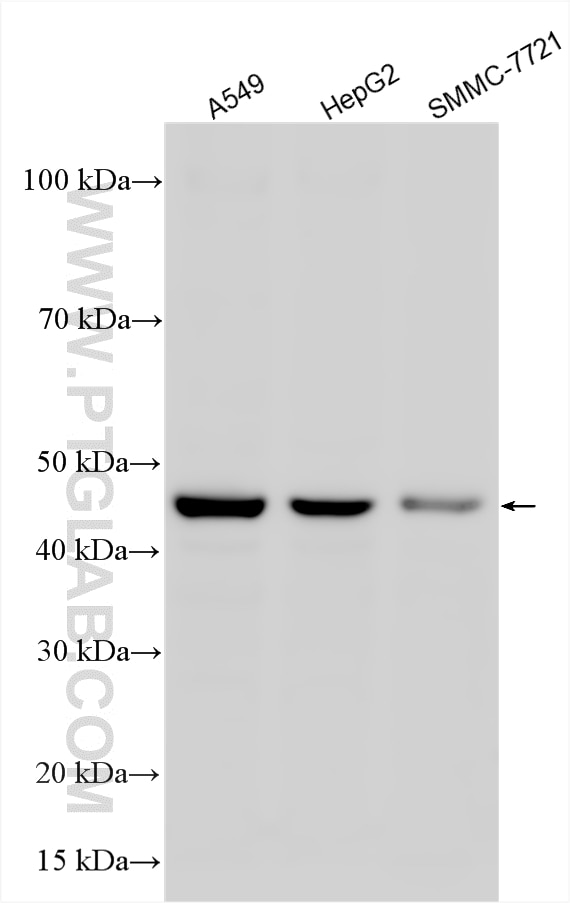
| Positive WB detected in | A549 cells, mouse kidney tissue, HepG2 cells |
| Positive IHC detected in | human lung cancer tissue Note: suggested antigen retrieval with TE buffer pH 9.0; (*) Alternatively, antigen retrieval may be performed with citrate buffer pH 6.0 |
Recommended dilution
| Application | Dilution |
|---|---|
| Western Blot (WB) | WB : 1:1000-1:6000 |
| Immunohistochemistry (IHC) | IHC : 1:100-1:400 |
| It is recommended that this reagent should be titrated in each testing system to obtain optimal results. | |
| Sample-dependent, Check data in validation data gallery. | |
Product Information
26824-1-AP targets CPA4 in WB, IHC, ELISA applications and shows reactivity with human, mouse samples.
| Tested Reactivity | human, mouse |
| Cited Reactivity | human, mouse |
| Host / Isotype | Rabbit / IgG |
| Class | Polyclonal |
| Type | Antibody |
| Immunogen |
CatNo: Ag25327 Product name: Recombinant human CPA4 protein Source: e coli.-derived, PET30a Tag: 6*His Domain: 316-384 aa of BC052289 Sequence: YPYGYSVKKAPDAEELDKVARLAAKALASVSGTEYQVGPTCTTVYPASGSSIDWAYDNGIKFAFTFELR Predict reactive species |
| Full Name | carboxypeptidase A4 |
| Calculated Molecular Weight | 421 aa, 47 kDa |
| Observed Molecular Weight | 44 kDa, 150 kDa |
| GenBank Accession Number | BC052289 |
| Gene Symbol | CPA4 |
| Gene ID (NCBI) | 51200 |
| RRID | AB_2880648 |
| Conjugate | Unconjugated |
| Form | Liquid |
| Purification Method | Antigen affinity purification |
| UNIPROT ID | Q9UI42 |
| Storage Buffer | PBS with 0.02% sodium azide and 50% glycerol, pH 7.3. |
| Storage Conditions | Store at -20°C. Stable for one year after shipment. Aliquoting is unnecessary for -20oC storage. 20ul sizes contain 0.1% BSA. |
Background Information
Carboxypeptidase A4 (CPA4), a member of the metallocarboxypeptidase family, is a zinc-containing exopeptidase that catalyzes the release of carboxy-terminal amino acids. CPA4 was previously shown to play a crucial role in cell growth and differentiation by modulating or inactivating peptide hormone activity (PMID: 27904708). CPA4 expression is increased in multiple cancer tissues, including tissues from patients with pancreatic cancer, gastric cancer, esophageal squamous cell carcinoma, and lung cancer, and may serve as a potential diagnostic and prognostic marker (PMID: 31397502, 32922037).
Protocols
| Product Specific Protocols | |
|---|---|
| IHC protocol for CPA4 antibody 26824-1-AP | Download protocol |
| WB protocol for CPA4 antibody 26824-1-AP | Download protocol |
| Standard Protocols | |
|---|---|
| Click here to view our Standard Protocols |
Publications
What published studies show
The CPA4 Polyclonal antibody (Cat# 26824-1-AP) has 8 total citations. These appear in journals including Cell Death & Disease, Science Signaling, European Journal of Pharmacology, European Journal of Medical Research, Journal of Cellular and Molecular Medicine, Acta Biochimica Biophysica Sinica, PeerJ, and Antiviral Research. The associated research fields span cancer biology (endometrial, renal cell, breast, and glioblastoma cancers), pyroptosis and AKT signaling, angiogenesis/VEGF signaling, DNA methylation in recurrent miscarriage, and antiviral mechanisms. Applications cited include Western blot and immunohistochemistry.
| Species | Application | Title |
|---|---|---|
Cell Death Dis Carboxypeptidase A4 negatively regulates HGS-ETR1/2-induced pyroptosis by forming a positive feedback loop with the AKT signalling pathway | ||
Sci Signal Hypoxic cancer-associated fibroblasts increase NCBP2-AS2/HIAR to promote endothelial sprouting through enhanced VEGF signaling. | ||
Eur J Pharmacol Mitochondrial dysfunction and senescence accompany glioblastoma cell death triggered by a putative metabolic inhibitor. | ||
Eur J Med Res CPA4 overexpression correlates with poor prognosis and tumor progression in endometrial cancer | ||
J Cell Mol Med CPA4 as a biomarker promotes the proliferation, migration and metastasis of clear cell renal cell carcinoma cells | ||
Acta Biochim Biophys Sin (Shanghai) Angiopoietin-1 promotes triple-negative breast cancer cell proliferation by upregulating carboxypeptidase A4 |



