
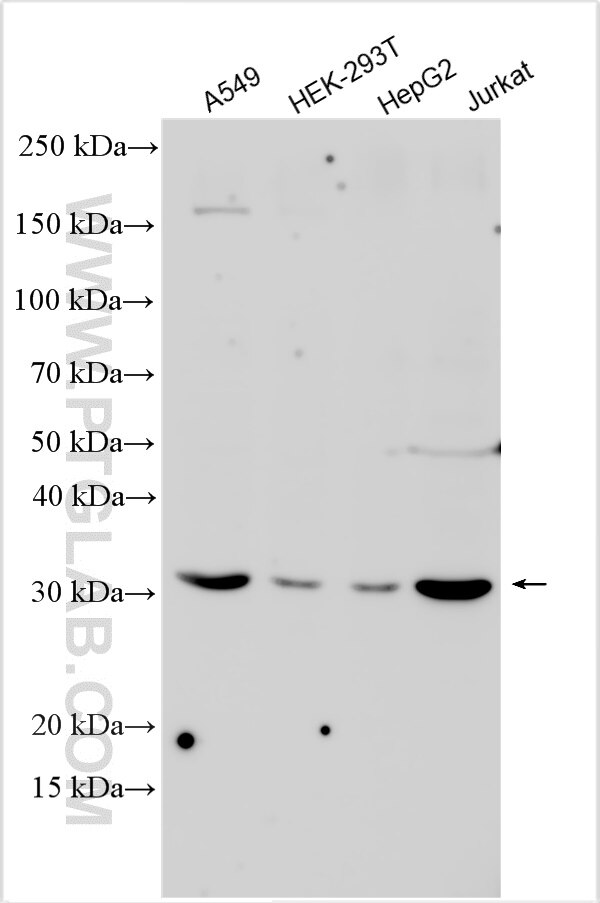



Tested Applications
| Positive WB detected in | A549 cells, HEK-293T cells, HepG2 cells, Jurkat cells |
| Positive IHC detected in | human hepatocellular carcinoma Note: suggested antigen retrieval with TE buffer pH 9.0; (*) Alternatively, antigen retrieval may be performed with citrate buffer pH 6.0 |
Recommended dilution
| Application | Dilution |
|---|---|
| Western Blot (WB) | WB : 1:500-1:3000 |
| Immunohistochemistry (IHC) | IHC : 1:50-1:500 |
| It is recommended that this reagent should be titrated in each testing system to obtain optimal results. | |
| Sample-dependent, Check data in validation data gallery. | |
Product Information
14845-1-AP targets CRLS1-Specific in WB, IHC, IF, ELISA applications and shows reactivity with human samples.
| Tested Reactivity | human |
| Cited Reactivity | human, mouse, rat |
| Host / Isotype | Rabbit / IgG |
| Class | Polyclonal |
| Type | Antibody |
| Immunogen |
Peptide Predict reactive species |
| Full Name | cardiolipin synthase 1 |
| Calculated Molecular Weight | 33 kDa |
| Observed Molecular Weight | 32 kDa |
| GenBank Accession Number | NM_019095 |
| Gene Symbol | CRLS1 |
| Gene ID (NCBI) | 54675 |
| RRID | AB_2085336 |
| Conjugate | Unconjugated |
| Form | Liquid |
| Purification Method | Antigen affinity purification |
| UNIPROT ID | Q9UJA2 |
| Storage Buffer | PBS with 0.02% sodium azide and 50% glycerol, pH 7.3. |
| Storage Conditions | Store at -20°C. Stable for one year after shipment. Aliquoting is unnecessary for -20oC storage. 20ul sizes contain 0.1% BSA. |
Background Information
Cardiolipin (CL) is a mitochondrial-specific double negatively charged phospholipid which is intricately involved in regulating bioenergetic efficiency. In eukaryotes, CL is synthesized by cardiolipin synthase (CRLS1 or CLS1) which catalyzes the reversible phosphatidyl group transfer from one phosphatidylglycerol molecule to another to form CL and glycerol. Recently it has been reported that transgenic expression of CRLS1 accelerates cardiolipin remodeling, improves mitochondrial function, modulates mitochondrial signaling, and attenuates mitochondrial dysfunction during diabetes, thereby identifying CRLS1 as a novel therapeutic target to attenuate mitochondrial dysfunction in diabetic myocardium. The predicted molecular weight of CRLS1 is around 32-35 kDa, while a 50 kDa protein with CRLS1 activity had been observed in liver isolation, which may represent an isoform of CRLS1 (20652826).
Protocols
| Product Specific Protocols | |
|---|---|
| IHC protocol for CRLS1-Specific antibody 14845-1-AP | Download protocol |
| WB protocol for CRLS1-Specific antibody 14845-1-AP | Download protocol |
| Standard Protocols | |
|---|---|
| Click here to view our Standard Protocols |
Publications
What published studies show
The anti-Cardiolipin antibody (Cat# 14845-1-AP) has 15 citations across journals including EMBO Journal, FASEB Journal, Journal of Biological Chemistry, Neural Regeneration Research, Frontiers in Immunology, European Journal of Pharmacology, International Journal of Molecular Sciences, Biochimica et Biophysica Acta, and others. Research fields span mitochondrial biology, cardiac/lipid metabolism, neuroprotection, cancer, PANoptosis/immunology, and metabolic disease. All applications were Western blot (one also IF).
| Species | Application | Title |
|---|---|---|
Neural Regen Res Neuroprotective effects of Alda-1 mitigate spinal cord injury in mice: involvement of Alda-1-induced ALDH2 activation-mediated suppression of reactive aldehyde mechanisms. | ||
EMBO J Cristae formation is a mechanical buckling event controlled by the inner mitochondrial membrane lipidome
| ||
Front Immunol Anti-alcoholism drug disulfiram inhibits PANoptosis by blocking mitochondrial permeabilization in macrophages.
| ||
Eur J Pharmacol Berberine rescues PANoptosis-Driven hemophagocytic lymphohistiocytosis via cardiolipin-mediated mitochondrial stabilization.
| ||
Int J Mol Sci Exercise and Doxorubicin Modify Markers of Iron Overload and Cardiolipin Deficiency in Cardiac Mitochondria | ||
J Nutr Biochem Deficiency of β-carotene oxygenase 2 induces mitochondrial fragmentation and activates the STING-IRF3 pathway in the mouse hypothalamus. |
Reviews
What customers say
Both reviewers rated this antibody 5 stars, praising its performance in Western Blot on mouse tissue at a 1:1000 dilution. Each described the result as producing a "very good, clear band," indicating strong specificity and signal quality. The consistent positive feedback across two different lots suggests reliable batch-to-batch reproducibility for WB applications in mouse samples.
The reviews below have been submitted by verified Proteintech customers who received an incentive for providing their feedback.
siiting (Verified Customer) (03-20-2022) | very good , clear band
|
siiting (Verified Customer) (03-18-2022) | very good , clear band
|



