





Tested Applications
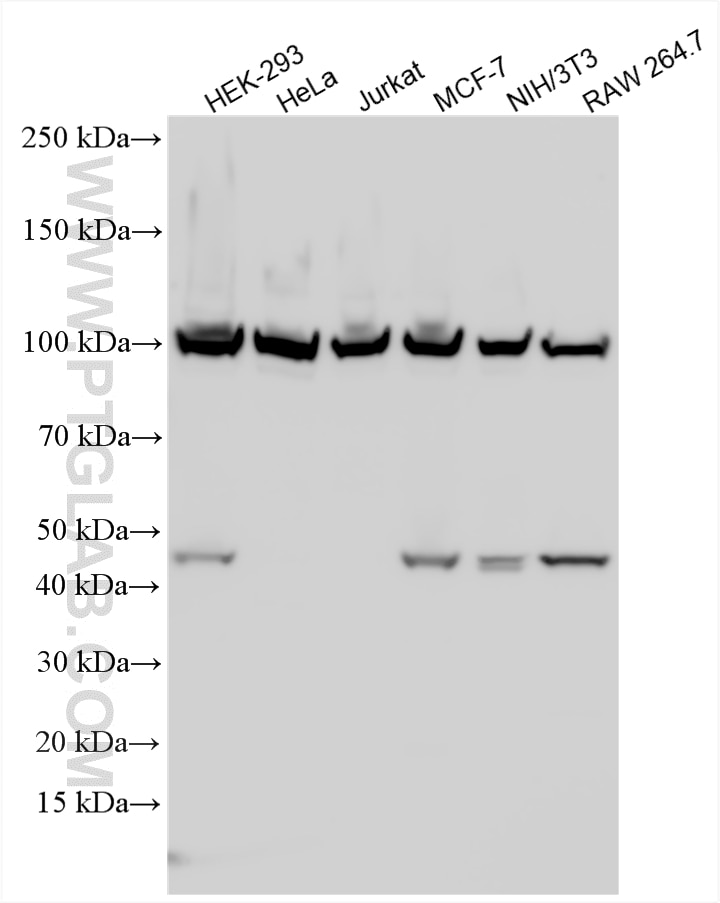
| Positive WB detected in | HEK-293 cells, mouse testis tissue, Jurkat cells, Ramos cells, HeLa cells, MCF-7 cells, NIH/3T3 cells, RAW 264.7 cells |
| Positive IP detected in | HEK-293 cells |
| Positive IHC detected in | human placenta tissue, mouse testis tissue Note: suggested antigen retrieval with TE buffer pH 9.0; (*) Alternatively, antigen retrieval may be performed with citrate buffer pH 6.0 |
Recommended dilution
| Application | Dilution |
|---|---|
| Western Blot (WB) | WB : 1:1000-1:4000 |
| Immunoprecipitation (IP) | IP : 0.5-4.0 ug for 1.0-3.0 mg of total protein lysate |
| Immunohistochemistry (IHC) | IHC : 1:50-1:500 |
| It is recommended that this reagent should be titrated in each testing system to obtain optimal results. | |
| Sample-dependent, Check data in validation data gallery. | |
Product Information
22219-1-AP targets CSE1L in WB, IHC, IF, IP, ELISA applications and shows reactivity with human, mouse samples.
| Tested Reactivity | human, mouse |
| Cited Reactivity | human, mouse |
| Host / Isotype | Rabbit / IgG |
| Class | Polyclonal |
| Type | Antibody |
| Immunogen |
CatNo: Ag17556 Product name: Recombinant human CSE1L protein Source: e coli.-derived, PGEX-4T Tag: GST Domain: 627-971 aa of BC109313 Sequence: RITCKANPAAVVNFEEALFLVFTEILQNDVQEFIPYVFQVMSLLLETHKNDIPSSYMALFPHLLQPVLWERTGNIPALVRLLQAFLERGSNTIASAAADKIPGLLGVFQKLIASKANDHQGFYLLNSIIEHMPPESVDQYRKQIFILLFQRLQNSKTTKFIKSFLVFINLYCIKYGALALQEIFDGIQPKMFGMVLEKIIIPEIQKVSGNVEKKICAVGITKLLTECPPMMDTEYTKLWTPLLQSLIGLFELPEDDTIPDEEHFIDIEDTPGYQTAFSQLAFAGKKEHDPVGQMVNNPKIHLAQSLHKLSTACPGRVPSMVSTSLNAEALQYLQGYLQAASVTLL Predict reactive species |
| Full Name | CSE1 chromosome segregation 1-like (yeast) |
| Calculated Molecular Weight | 971 aa, 110 kDa |
| Observed Molecular Weight | 100-110 kDa |
| GenBank Accession Number | BC109313 |
| Gene Symbol | CSE1L |
| Gene ID (NCBI) | 1434 |
| RRID | AB_10950892 |
| Conjugate | Unconjugated |
| Form | Liquid |
| Purification Method | Antigen affinity purification |
| UNIPROT ID | P55060 |
| Storage Buffer | PBS with 0.02% sodium azide and 50% glycerol, pH 7.3. |
| Storage Conditions | Store at -20°C. Stable for one year after shipment. Aliquoting is unnecessary for -20oC storage. 20ul sizes contain 0.1% BSA. |
Background Information
CSE1L (Chromosome Segregation 1-Like) is located on 20q13.13, and encodes a 971-amino-acid protein. It associates with microtubules and mitotic spindles, and is also considered to have a role in tumor progression. The CSE1L protein includes a nuclear localization signal allowing for transport into the nucleus via the importin-alpha/beta heterodimer. In addition, CSE1L plays roles in cell proliferation and apoptosis.
Protocols
| Product Specific Protocols | |
|---|---|
| IHC protocol for CSE1L antibody 22219-1-AP | Download protocol |
| IP protocol for CSE1L antibody 22219-1-AP | Download protocol |
| WB protocol for CSE1L antibody 22219-1-AP | Download protocol |
| Standard Protocols | |
|---|---|
| Click here to view our Standard Protocols |
Publications
What published studies show
The CSE1L Polyclonal antibody (Cat# 22219-1-AP) has 13 citations published in journals including Nature Immunology, Nature Communications, Cell Reports, International Journal of Biological Macromolecules, International Journal of Oncology, Frontiers in Immunology, Molecular Medicine Reports, Scientific Reports, Cancers, Journal of Biological Chemistry, Journal of Alzheimer's Disease, and Journal of Cancer. Research fields span innate immunity, cancer genomics, gastric/colorectal/ovarian/breast/pancreatic cancer, osteosarcoma, cardiovascular biology, circadian rhythm, and Alzheimer's disease.
| Species | Application | Title |
|---|---|---|
Nat Immunol A protein-interaction network of interferon-stimulated genes extends the innate immune system landscape. | ||
Nat Commun Genome-wide enhancer-gene regulatory maps link causal variants to target genes underlying human cancer risk | ||
Int J Biol Macromol CSE1L regulates gastric cancer progression via molecular crosstalk with TRIP13.
| ||
Cell Rep Efficient generation of isogenic primary human myeloid cells using CRISPR-Cas9 ribonucleoproteins. | ||
Int J Oncol Butyrate supplementation regulates expression of chromosome segregation 1‑like protein to reverse the genetic distortion caused by p53 mutations in colorectal cancer.
| ||
Front Immunol Multi-omics analysis and experiments uncover the link between cancer intrinsic drivers, stemness, and immunotherapy in ovarian cancer with validation in a pan-cancer census |





