
Recombinant Canine IL-6 protein (rFc Tag)
Species
Canine
Purity
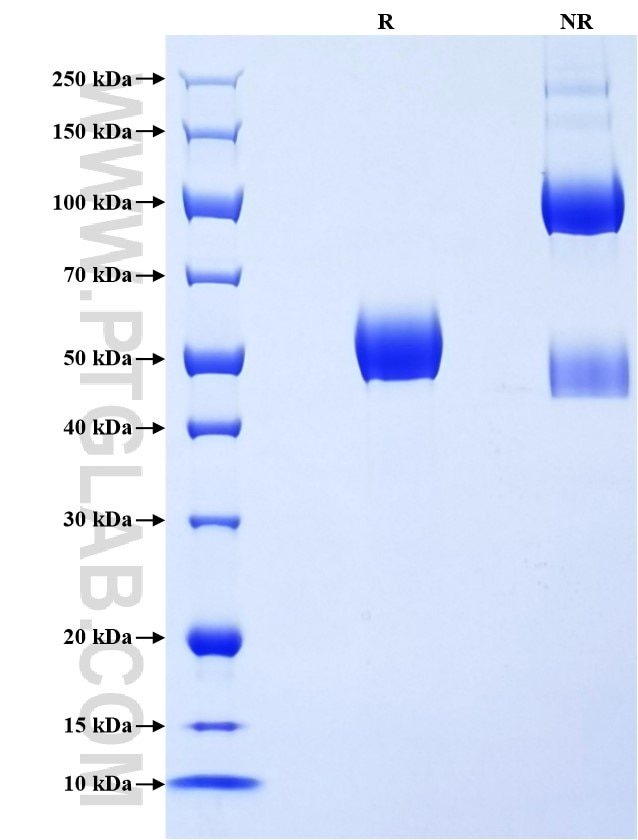
>90 %, SDS-PAGE
Tag
rFc Tag
Activity
not tested
Cat no : Eg4554
Validation Data Gallery
Product Information
| Purity | >90 %, SDS-PAGE |
| Endotoxin | <0.1 EU/μg protein, LAL method |
| Activity |
Not tested |
| Expression | HEK293-derived Canine IL-6 protein Phe21-Met207 (Accession# P41323) with a rabbit IgG Fc tag at the N-terminus. |
| GeneID | 403985 |
| Accession | P41323 |
| PredictedSize | 48.1 kDa |
| SDS-PAGE | 48-60 kDa, reducing (R) conditions |
| Formulation | Lyophilized from 0.22 μm filtered solution in PBS, pH 7.4. Normally 5% trehalose and 5% mannitol are added as protectants before lyophilization. |
| Reconstitution | Briefly centrifuge the tube before opening. Reconstitute at 0.1-0.5 mg/mL in sterile water. |
| Storage Conditions |
It is recommended that the protein be aliquoted for optimal storage. Avoid repeated freeze-thaw cycles.
|
| Shipping | The product is shipped at ambient temperature. Upon receipt, store it immediately at the recommended temperature. |
Background
Interleukin-6 (IL-6) is an interleukin that acts as both a pro- and anti-inflammatory cytokine. IL-6 protein is secreted by a variety of cell types, including T cells and macrophages, as a phosphorylated and variably glycosylated molecule. IL-6 plays an essential role in the terminal differentiation of B cells into Ig-secreting cells involved in lymphocyte and monocyte differentiation. It induces the growth of myeloma and plasmacytoma and the differentiation of neurons and acts on B cells, T cells, hepatocytes, haematopoietic progenitor cells and cells of the CNS. IL-6 is also considered a myokine, a cytokine produced by muscle that is increased in response to muscle contraction. IL-6 has been shown to interact with the interleukin-6 receptor and glycoprotein 130. In addition, IL-6 has been implicated in haematopoiesis, bone metabolism and cancer progression, and has been defined as essential in directing the transition from innate to acquired immunity.
References:
1.Aliyu M. et al. (2022) Int Immunopharmacol. 111:109130.
2.Grebenciucova E. et al. (2023) Front Immunol. 14:1255533.
3.Tanaka T. et al. (2016) Adv Exp Med Biol. 941:79-88.