
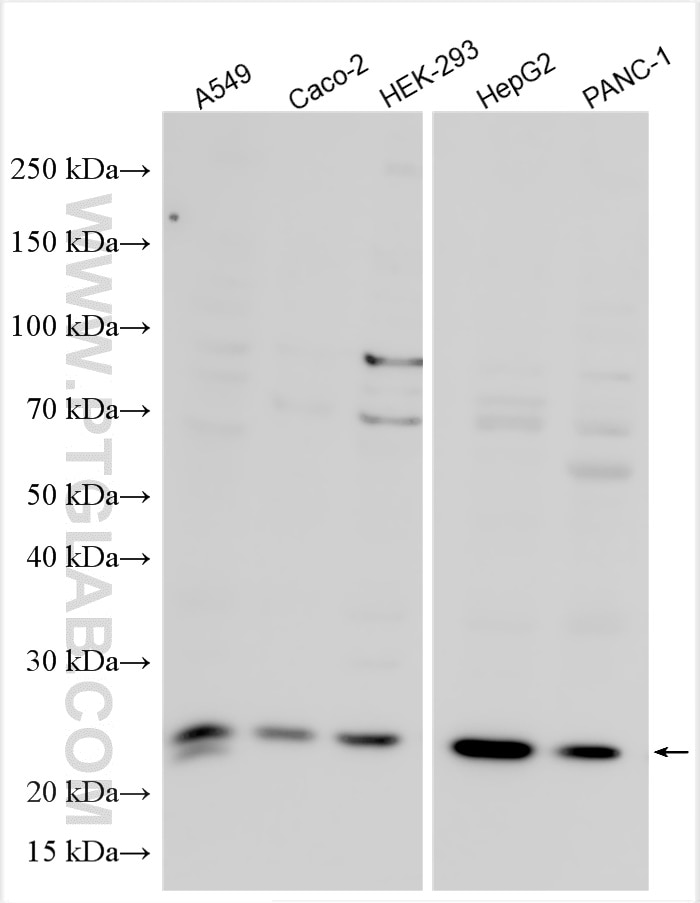
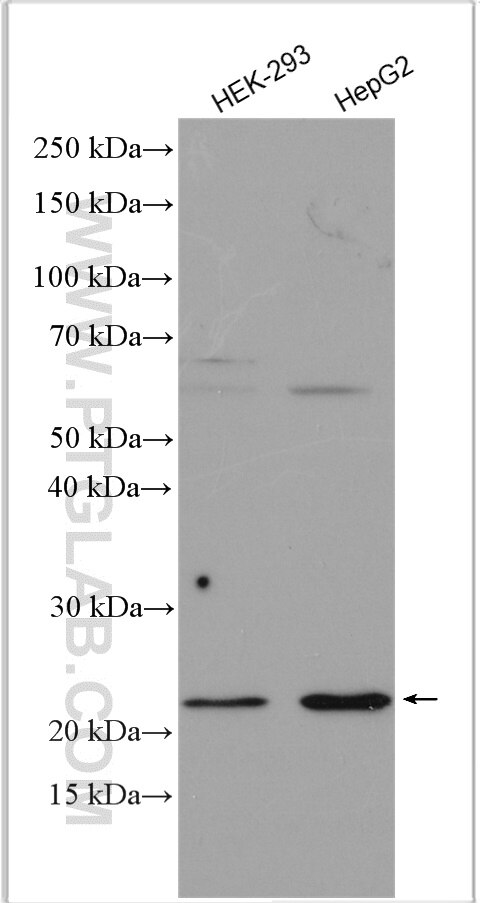

Tested Applications
| Positive WB detected in | A549 cells, HEK-293 cells, Caco-2 cells, HT-29 cells, HepG2 cells, PANC-1 cells |
Recommended dilution
| Application | Dilution |
|---|---|
| Western Blot (WB) | WB : 1:500-1:2000 |
| It is recommended that this reagent should be titrated in each testing system to obtain optimal results. | |
| Sample-dependent, Check data in validation data gallery. | |
Product Information
26912-1-AP targets Claudin 2 in WB, IHC, IF, ELISA applications and shows reactivity with human samples.
| Tested Reactivity | human |
| Cited Reactivity | human, mouse, rat, chicken |
| Host / Isotype | Rabbit / IgG |
| Class | Polyclonal |
| Type | Antibody |
| Immunogen |
CatNo: Ag25527 Product name: Recombinant human CLDN2 protein Source: e coli.-derived, PGEX-4T Tag: GST Domain: 184-230 aa of BC014424 Sequence: SCSSQRNRSNYYDAYQAQPLATRSSPRPGQPPKVKSEFNSYSLTGYV Predict reactive species |
| Full Name | claudin 2 |
| Calculated Molecular Weight | 25 kDa |
| Observed Molecular Weight | 25 kDa |
| GenBank Accession Number | BC014424 |
| Gene Symbol | Claudin 2 |
| Gene ID (NCBI) | 9075 |
| RRID | AB_2918115 |
| Conjugate | Unconjugated |
| Form | Liquid |
| Purification Method | Antigen affinity purification |
| UNIPROT ID | P57739 |
| Storage Buffer | PBS with 0.02% sodium azide and 50% glycerol, pH 7.3. |
| Storage Conditions | Store at -20°C. Stable for one year after shipment. Aliquoting is unnecessary for -20oC storage. 20ul sizes contain 0.1% BSA. |
Background Information
Claudin 2, also named as SP82, belongs to the claudin family. Claudin 2 is a tetraspan membrane protein consisting of two extracellular domains (ECL1 and ECL2), a small intracellular loop connecting the second and third transmembrane sections and short intracellular N and C terminal portions. Claudin 2 is a cation-selective channel forming TJ protein expressed in leaky epithelia. Claudin 2 is a 230 amino acid transmembrane protein, with a calculated molecular mass of 25 kDa (PMID: 31726679)
Protocols
| Product Specific Protocols | |
|---|---|
| WB protocol for Claudin 2 antibody 26912-1-AP | Download protocol |
| Standard Protocols | |
|---|---|
| Click here to view our Standard Protocols |
Publications
What published studies show
Claudin 2 Polyclonal antibody (Cat# 26912-1-AP) has 26 citations published in journals including Nature Communications, Advanced Science, Pharmacological Research, Cancer Letters, Cell Death Discovery, World Journal of Gastroenterology, Cell & Molecular Life Sciences, and others. Research fields span intestinal barrier function, gut microbiota dysbiosis, inflammatory bowel disease and colitis, liver disease, renal cell carcinoma, hepatocellular carcinoma, pre-diabetes, asthma, and epithelial-mesenchymal transition in tumor metastasis.
| Species | Application | Title |
|---|---|---|
Nat Commun VRAC coordinates the trade-off between nutrient absorption and antimicrobial defense in enterocytes against inflammation. | ||
Adv Sci (Weinh) Dihydroartemisinin Modulates Enteric Glial Cell Heterogeneity to Alleviate Colitis | ||
Pharmacol Res Gut microbiota-driven metabolic alterations reveal the distinct pathogenicity of chemotherapy-induced cachexia in gastric cancer | ||
Cancer Lett Arid1a deficiency promotes metabolic dysfunction-associated steatohepatitis and hepatocellular carcinoma by disrupting the FXR-gut microbiota-bile acid axis | ||
Phytomedicine Integrated analysis of transcriptomics and network pharmacology reveals the therapeutic mechanism of cedrol in IBD. | ||
Cell Death Discov HSP90AA1 restrains clear cell renal cell carcinoma progression by promoting CADM1 expression and suppressing the PI3K-AKT pathway through interaction with FBXO7. |



