





Tested Applications
| Positive WB detected in | MCF-7 cells, HepG2 cells, Jurkat cells, NIH/3T3 cells, HSC-T6 cells, PC-12 cells, mouse brain tissue, rat brain tissue |
| Positive IP detected in | HepG2 cells |
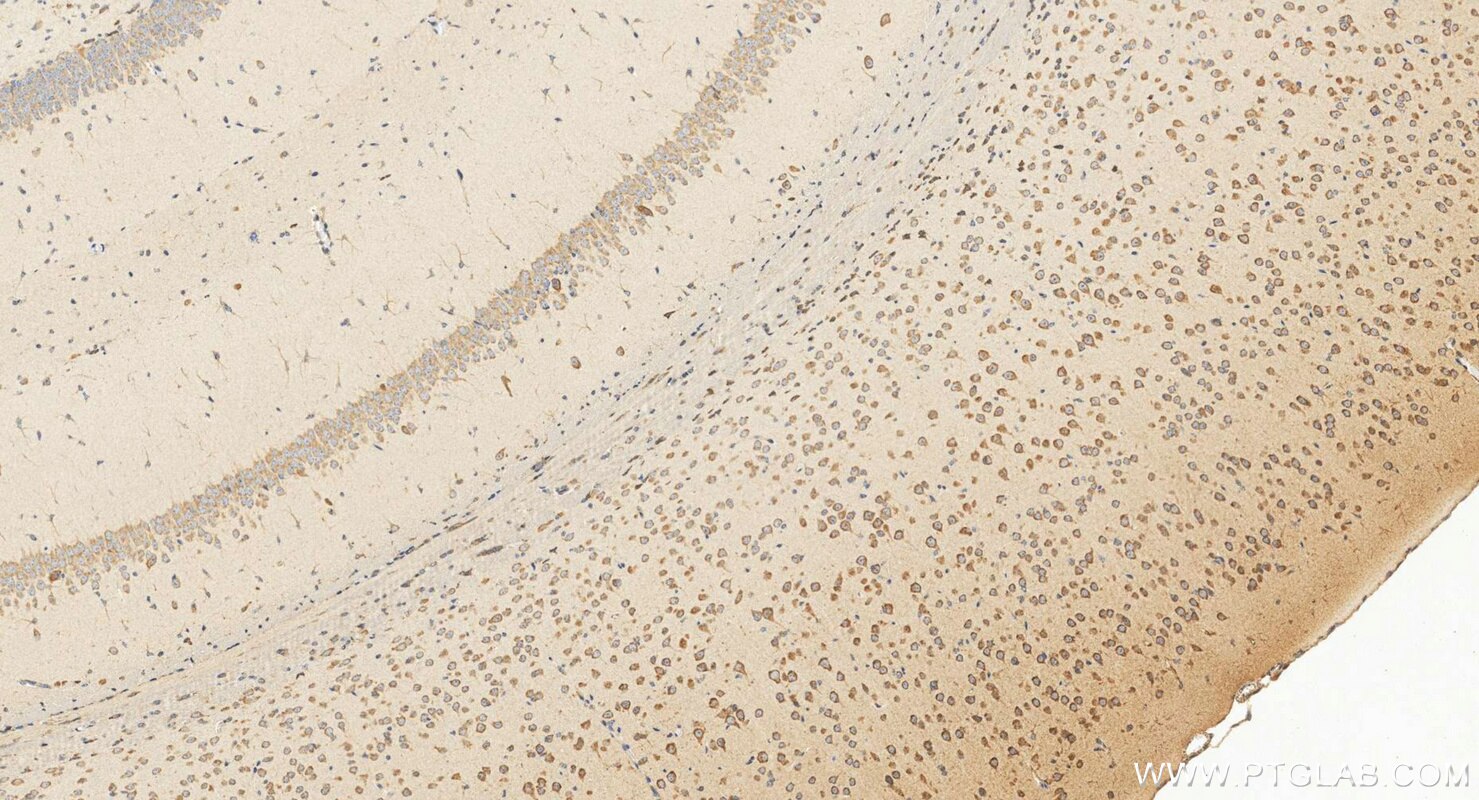
| Positive IHC detected in | rat colon tissue, mouse brain tissue Note: suggested antigen retrieval with TE buffer pH 9.0; (*) Alternatively, antigen retrieval may be performed with citrate buffer pH 6.0 |
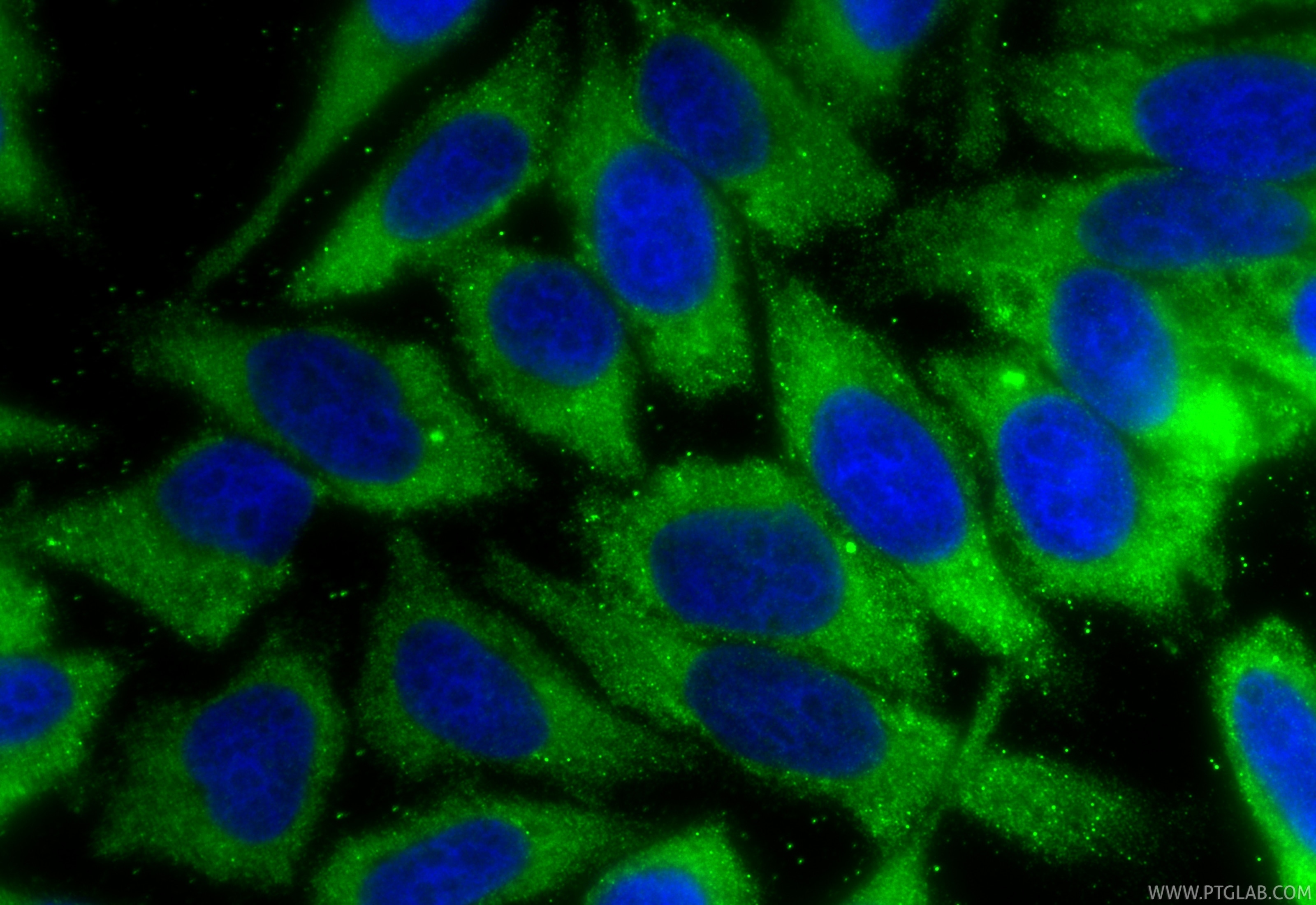
| Positive IF/ICC detected in | HepG2 cells |
| Positive FC (Intra) detected in | MCF-7 cells |
Recommended dilution
| Application | Dilution |
|---|---|
| Western Blot (WB) | WB : 1:5000-1:50000 |
| Immunoprecipitation (IP) | IP : 0.5-4.0 ug for 1.0-3.0 mg of total protein lysate |
| Immunohistochemistry (IHC) | IHC : 1:50-1:500 |
| Immunofluorescence (IF)/ICC | IF/ICC : 1:50-1:500 |
| Flow Cytometry (FC) (INTRA) | FC (INTRA) : 0.40 ug per 10^6 cells in a 100 µl suspension |
| It is recommended that this reagent should be titrated in each testing system to obtain optimal results. | |
| Sample-dependent, Check data in validation data gallery. | |
Product Information
11170-1-AP targets EIF2S1 in WB, IHC, IF/ICC, FC (Intra), IP, ELISA applications and shows reactivity with human, mouse, rat samples.
| Tested Reactivity | human, mouse, rat |
| Cited Reactivity | human, mouse, rat, pig, monkey, chicken, hamster |
| Host / Isotype | Rabbit / IgG |
| Class | Polyclonal |
| Type | Antibody |
| Immunogen |
CatNo: Ag1645 Product name: Recombinant human EIF2S1 protein Source: e coli.-derived, PGEX-4T Tag: GST Domain: 1-315 aa of BC002513 Sequence: MPGLSCRFYQHKFPEVEDVVMVNVRSIAEMGAYVSLLEYNNIEGMILLSELSRRRIRSINKLIRIGRNECVVVIRVDKEKGYIDLSKRRVSPEEAIKCEDKFTKSKTVYSILRHVAEVLEYTKDEQLESLFQRTAWVFDDKYKRPGYGAYDAFKHAVSDPSILDSLDLNEDEREVLINNINRRLTPQAVKIRADIEVACYGYEGIDAVKEALRAGLNCSTENMPIKINLIAPPRYVMTTTTLERTEGLSVLSQAMAVIKEKIEEKRGVFNVQMEPKVVTDTDETELARQMERLERENAEVDGDDDAEEMEAKAED Predict reactive species |
| Full Name | eukaryotic translation initiation factor 2, subunit 1 alpha, 35kDa |
| Calculated Molecular Weight | 36 kDa |
| Observed Molecular Weight | 36 kDa |
| GenBank Accession Number | BC002513 |
| Gene Symbol | EIF2S1 |
| Gene ID (NCBI) | 1965 |
| RRID | AB_2096489 |
| Conjugate | Unconjugated |
| Form | Liquid |
| Purification Method | Antigen affinity purification |
| UNIPROT ID | P05198 |
| Storage Buffer | PBS with 0.02% sodium azide and 50% glycerol, pH 7.3. |
| Storage Conditions | Store at -20°C. Stable for one year after shipment. Aliquoting is unnecessary for -20oC storage. 20ul sizes contain 0.1% BSA. |
Background Information
EIF2S1 is one subunit of the translation initiation factor EIF2, which catalyzes the first regulated step of protein synthesis initiation, promoting the binding of the initiator tRNA to 40S ribosomal subunits. This complex binds to a 40S ribosomal subunit, followed by mRNA binding to form a 43S preinitiation complex. Junction of the 60S ribosomal subunit to form the 80S initiation complex is preceded by hydrolysis of the GTP bound to eIF-2 and release of an eIF-2-GDP binary complex. In order for eIF-2 to recycle and catalyze another round of initiation, the GDP bound to eIF-2 must exchange with GTP by way of a reaction catalyzed by eIF-2B. EIF2A (Gene ID: 83939) and EIF2S1 (Gene ID: 1965) share the EIF2A symbol/alias in common. EIF2S1 is the alpha subunit of the eIF2 translation initiation complex. Although both of these proteins function in binding initiator tRNA to the 40S ribosomal subunit, the EIF2A protein does so in a codon-dependent manner, whereas eIF2 complex requires GTP.
Protocols
| Product Specific Protocols | |
|---|---|
| FC protocol for EIF2S1 antibody 11170-1-AP | Download protocol |
| IF protocol for EIF2S1 antibody 11170-1-AP | Download protocol |
| IHC protocol for EIF2S1 antibody 11170-1-AP | Download protocol |
| IP protocol for EIF2S1 antibody 11170-1-AP | Download protocol |
| WB protocol for EIF2S1 antibody 11170-1-AP | Download protocol |
| Standard Protocols | |
|---|---|
| Click here to view our Standard Protocols |
Publications
What published studies show
The EIF2S1 Polyclonal antibody (Cat# 11170-1-AP) has 174 citations. These appear in journals including Nature Communications, Nature Cancer, Molecular Cell, Science Advances, Cell Reports Medicine, Autophagy, Redox Biology, Cell Death & Disease, Journal of Neuroinflammation, Oncogene, and Journal of Biological Chemistry, among others. Research fields span endoplasmic reticulum stress, the integrated stress response, stress granules, autophagy, ferroptosis, cancer biology, neuroinflammation, diabetes, viral replication, and metabolic regulation.
| Species | Application | Title |
|---|---|---|
J Hematol Oncol METTL16 promotes liver cancer stem cell self-renewal via controlling ribosome biogenesis and mRNA translation | ||
Mol Cancer Exosomal circSHKBP1 promotes gastric cancer progression via regulating the miR-582-3p/HUR/VEGF axis and suppressing HSP90 degradation. | ||
Bioact Mater Novel neutrophil extracellular trap-related mechanisms in diabetic wounds inspire a promising treatment strategy with hypoxia-challenged small extracellular vesicles | ||
Autophagy Inhibition of USP14 influences alphaherpesvirus proliferation by degrading viral VP16 protein via ER stress-triggered selective autophagy. | ||
Reviews
What customers say
Both reviewers used this antibody for Western Blot and reported positive results. One user tested it at 1:1000 on HCT116 cells and confirmed a clear band at the expected size, though they noted the signal diminished after a few reuses. The other user achieved good performance at 1:2000 with 20 µg of protein from mesenchymal stem cells. Overall, the antibody is well-received for WB applications, with the main caveat being limited reusability.
The reviews below have been submitted by verified Proteintech customers who received an incentive for providing their feedback.
Morgane (Verified Customer) (09-15-2025) | Works well and shows band at expected size but cannot be reused many times. Signal decreases after a couple uses
 |
Udesh (Verified Customer) (06-17-2025) | Worked well in stem cells 20ug protein at 1:2000 dilution
|








