
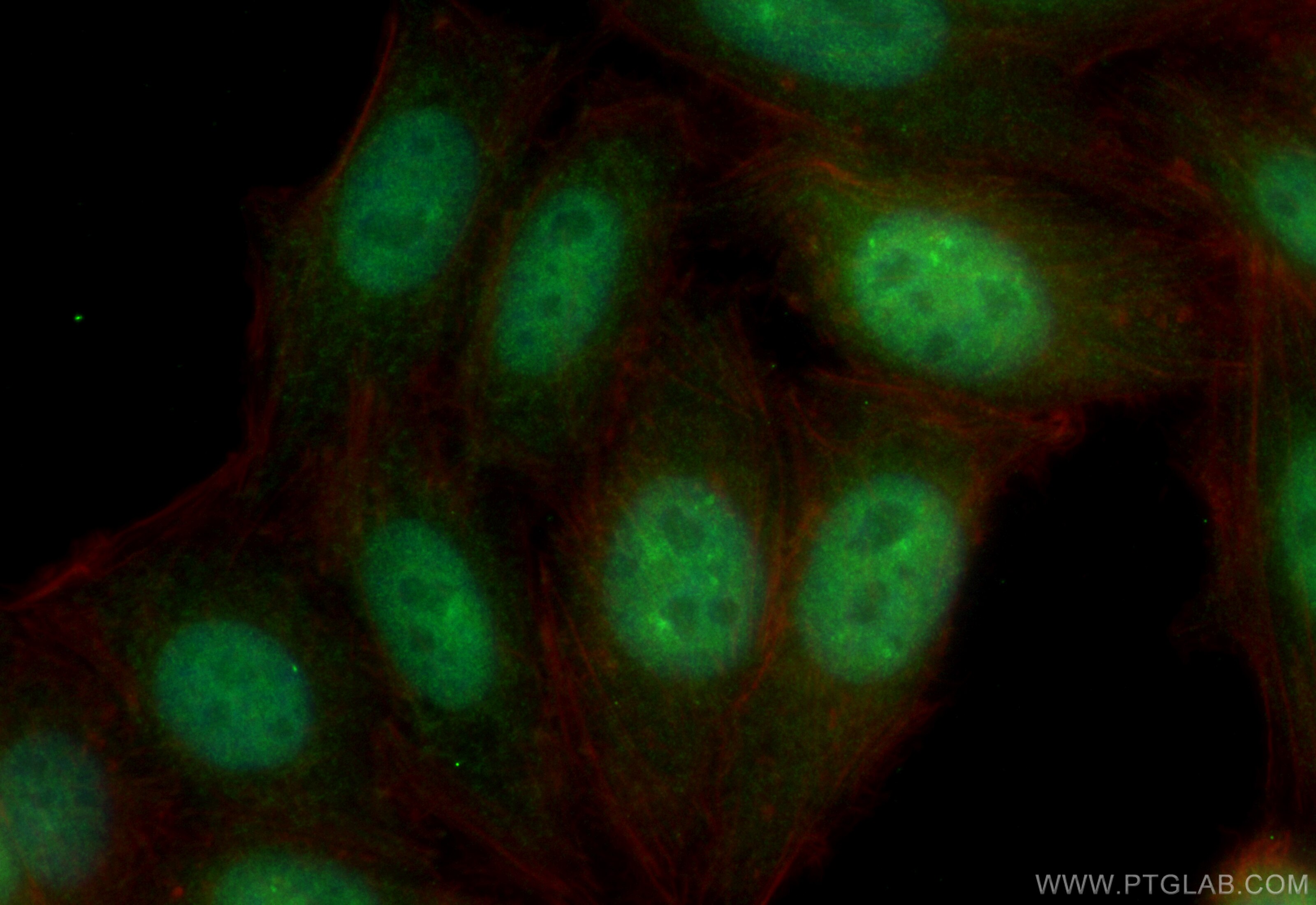

Tested Applications
| Positive IF/ICC detected in | HepG2 cells |
Recommended dilution
| Application | Dilution |
|---|---|
| Immunofluorescence (IF)/ICC | IF/ICC : 1:50-1:500 |
| It is recommended that this reagent should be titrated in each testing system to obtain optimal results. | |
| Sample-dependent, Check data in validation data gallery. | |
Product Information
CL488-84346-2 targets EXOSC6 in IF/ICC applications and shows reactivity with human samples.
| Tested Reactivity | human |
| Host / Isotype | Rabbit / IgG |
| Class | Recombinant |
| Type | Antibody |
| Immunogen |
CatNo: Ag33513 Product name: Recombinant human EXOSC6 protein Source: e coli.-derived, PGEX-4T Tag: GST Domain: 1-272 aa of NM_058219 Sequence: MPGDHRRIRGPEESQPPQLYAADEEEAPGTRDPTRLRPVYARAGLLSQAKGSAYLEAGGTKVLCAVSGPRQAEGGERGGGPAGAGGEAPAALRGRLLCDFRRAPFAGRRRRAPPGGCEERELALALQEALEPAVRLGRYPRAQLEVSALLLEDGGSALAAALTAAALALADAGVEMYDLVVGCGLSLAPGPAPTWLLDPTRLEEERAAAGLTVALMPVLNQVAGLLGSGEGGLTESWAEAVRLGLEGCQRLYPVLQQSLVRAARRRGAAAQP Predict reactive species |
| Full Name | exosome component 6 |
| Calculated Molecular Weight | 28kd |
| Observed Molecular Weight | 28-32 kDa |
| GenBank Accession Number | NM_058219 |
| Gene Symbol | EXOSC6 |
| Gene ID (NCBI) | 118460 |
| RRID | AB_3747538 |
| Conjugate | CoraLite® Plus 488 Fluorescent Dye |
| Excitation/Emission Maxima Wavelengths | 493 nm / 522 nm |
| Excitation Laser | Blue laser (488 nm) |
| Form | Liquid |
| Purification Method | Protein A purification |
| UNIPROT ID | Q5RKV6 |
| Storage Buffer | PBS with 50% glycerol, 0.05% Proclin300, 0.5% BSA, pH 7.3. |
| Storage Conditions | Store at -20°C. Avoid exposure to light. Stable for one year after shipment. Aliquoting is unnecessary for -20oC storage. |
Background Information
EXOSC6 (exosome component 6), also known as p11 or MTR3. The calculated molecular weight of EXOSC6 is 28 kDa. And it has low tissue specificity. The gene product constitutes one of the subunits of the multisubunit particle called exosome, which mediates mRNA degradation. It is also a component of the RNA exosome complex (PMID: 29906447). The composition of human exosome is similar to its yeast counterpart. EXOSC6 is homologous to the yeast Mtr3 protein. Its exact function is not known, however, it has been shown using a cell-free RNA decay system that the exosome is required for rapid degradation of unstable mRNAs containing AU-rich elements (AREs), but not for poly(A) shortening. The exosome does not recognize ARE-containing mRNAs on its own, but requires ARE-binding proteins that could interact with the exosome and recruit it to unstable mRNAs, thereby promoting their rapid degradation.
Protocols
| Product Specific Protocols | |
|---|---|
| IF protocol for CL Plus 488 EXOSC6 antibody CL488-84346-2 | Download protocol |
| Standard Protocols | |
|---|---|
| Click here to view our Standard Protocols |


