
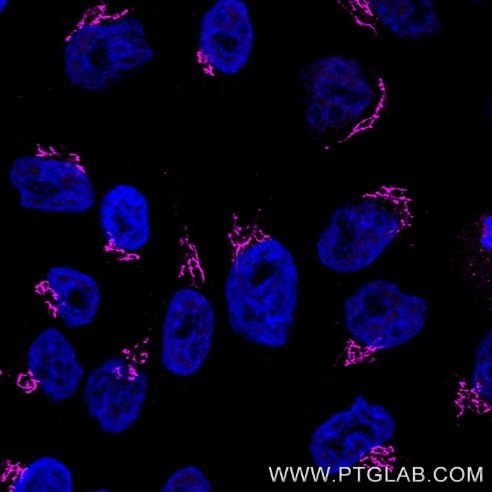
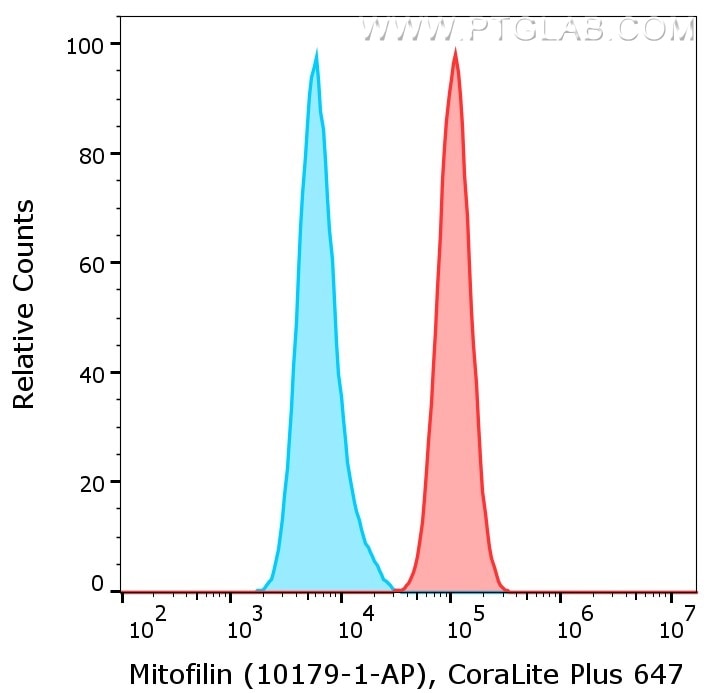
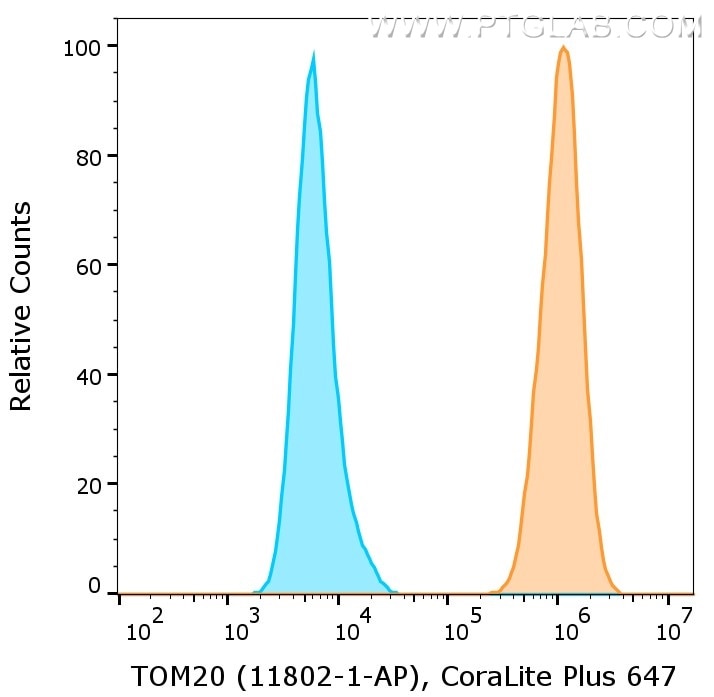
Product Information
| Product name | FlexAble 2.0 CoraLite® Plus 647 Antibody Labeling Kit for Rabbit IgG |
| Assay type | Antibody labeling |
| Tested applications | IF, FC, WB |
| Species Reactivity | Rabbit IgG |
| Antibody amount per labeling reaction | 0.5 µg antibody |
| Conjugate | CoraLite® Plus 647 |
| Excitation/Emission maxima wavelengths | 654 nm / 674 nm |
Kit Components
| Component | 10rxns | 50rxns | 200rxns |
|---|---|---|---|
| FlexBuffer | 100ul | 500ul | 2000ul |
| FlexLinker 2.0 CoraLite® Plus 647 for Rabbit IgG | 10ul | 50ul | 200ul |
| FlexQuencher for Rabbit IgG | 20ul | 100ul | 400ul |
Ship Condition
shipped on blue iceStorage Condition
Store for 1 year at -20°C or for 6 months at +4°C upon receipt. Avoid exposure to lightFAQ
Q: What is the difference between FlexAble and FlexAble 2.0 products?
A: FlexAble 2.0 has been improved to allow for more dyes per FlexLinker than the previous version of the kit. This results in an increased signal per antibody.
Q: What are the FlexLinker, FlexQuencher and FlexBuffer?
A: The FlexLinker is a small polypeptide to which dyes are covalently conjugated that can label unconjugated primary antibodies. The FlexQuencher is an Fc-containing fragment that neutralizes the excess FlexLinker. The FlexBuffer is a PBS-based buffer.
Q: What is the largest quantity I can label?
A: With a standard kit size (50 reactions), you can label 25 µg of one antibody or up to 50 different antibodies. You can easily scale up the antibody amount per labeling approach.
Q: What is the lowest concentration of my primary antibody that I can use?
A: Our protocol uses 0.5 µg of primary antibody in 7 µL, which ends up at 0.07 mg/mL. If the concentration of your antibody is lower, you can also use a larger volume than 7 µL.
Q: Can I label primary antibodies stored in BSA, glycerol, Tris buffer and/or preservatives?
A: Yes, FlexAble Antibody Labeling Kits have been validated with carriers and amine buffers. Neither BSA nor amine buffers, in any chosen concentration, interfere with the labeling. 50% glycerol as well as preservatives like sodium azide are also compatible with the kit.
Q: How many different primary antibodies can I label with one kit?
A: You can label up to 50 different antibodies with our FlexAble 50 rxn Kit, and up to 10 antibodies with our FlexAble 10 rxn Kit.
Q: Will I observe cross-reactivity/leaking when I use two FlexAble-labeled antibodies from the same species during multiplexing?
A: FlexAble labels primary antibodies with a high affinity FlexLinker. Dissociation of FlexLinker from one antibody and association to another antibody is rare. If you observe leaking, we recommend adding more FlexQuencher to remove unbound FlexLinker, or you can try sequential staining of the labeled antibodies.
Documentation
| SDS |
|---|
| KFA503-SDS-FlexAble 2.0 CoraLite Plus 647 Antibody Labeling Kit |
| Protocol |
|---|
| Protocol-FlexAble and FlexAble 2.0 Antibody Labeling Kits |
| Customer testimonials |
|---|
| Léa Pechtimaldjian on Advancing 3D Vascular Imaging with FlexAble Technology |
| White papers |
|---|
| Efficient Hybridoma Screening with FlexAble Antibody Labeling Kits |
Publications
| Application | Title |
|---|---|
Cancer Cell A self-amplifying nerve-fibroblast circuit drives colorectal cancer progression. | |
Nat Immunol Monocyte infiltration induces CNS arginine catabolism to fuel neuroinflammation. | |
Acta Pharm Sin B Glutamine synthetase in astrocytes of the caudate and putamen is responsible for locomotor sensitization after nicotine exposure. | |
Adv Sci (Weinh) MAM-Localized MANF Counteracts Microinflammatory Stress to Attenuate Mitochondrial Dysfunction and Cataractogenesis in High Myopia. | |
Dev Cell EPLINα controls integrin recycling from Rab21 endosomes to drive breast cancer cell migration. | |
Cell Rep PATZ1 condensation adjacent to PML nuclear bodies suppresses HBoV transcription as an intrinsic antiviral defense. |
Reviews
The reviews below have been submitted by verified Proteintech customers who received an incentive for providing their feedback.
FH Beatriz (Verified Customer) (09-08-2026) | The kit worked very well. I tested it using a Ki-67 primary antibody that had already been validated in this cell line, and the labelling was successful even when using less than the recommended 0.5 µg of primary antibody.
|
FH Lin (Verified Customer) (05-14-2026) | It is good to use it labelling primary antibody.
|
FH Sameena (Verified Customer) (02-05-2026) | The product is excellent and highest quality
|
FH SAMEENA (Verified Customer) (01-03-2026) | was able to succesfully lsbel and internalize the labeled antibody.
|
FH Delphine (Verified Customer) (11-26-2025) | When the antibody works well in normal labelling, the labelling is really nice. However, when the antibody is weak, the labelling is poor compare to the primary and secondary methods. For all antibodies, the background signal is not negligible. However, It is one of the best options to tag your primary antibody with fluorescent tag.
|
FH MALLIKARJUNA (Verified Customer) (10-20-2025) | It is one of the best options to tag your primary antibody with fluorescent tag. It works really well. Awesome product.
|
FH Anchit (Verified Customer) (10-02-2025) | Stains well
|
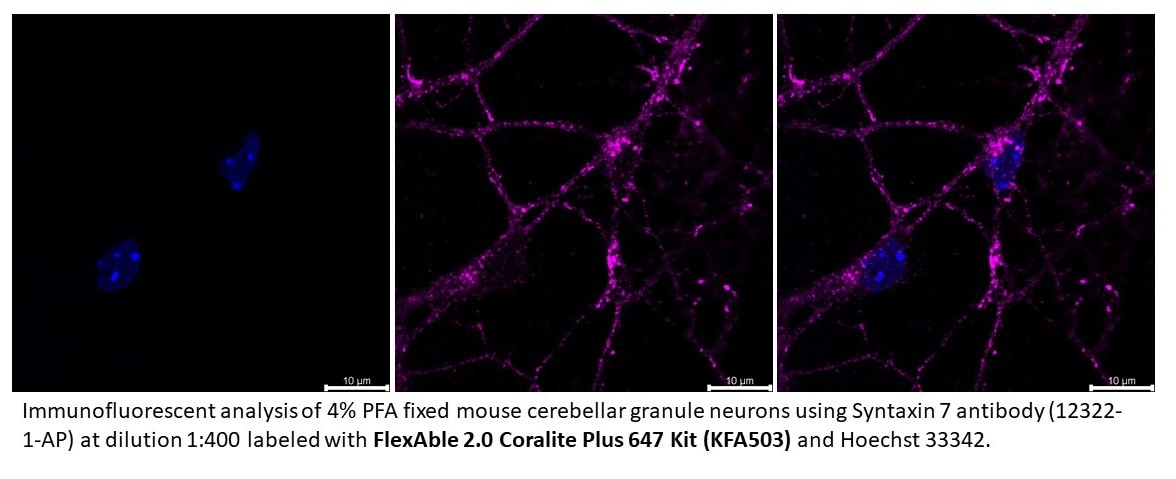
FH Olga (Verified Customer) (09-22-2025) | Very effective quick labeling - just followed protocol, without any modification. Labeled antibody against the endogenous protein. However, it depends on the affinity of the primary antibody labeled - and on the level of target protein expression. For some endogenous proteins the signal is not intensive enough, had to use secondary antibodies.
 |
FH Jacob (Verified Customer) (06-23-2025) | FlexAble worked great for us. The protocol is way quicker and more flexible than secondary antibody labeling. We labelled a FLAG tag primary antibody and the localization turned out as expected. Will definitely be using again in the future.
|
FH Rachel (Verified Customer) (05-09-2025) | I tested all rabbit fluorophores and only the rabbit 647 worked. Unclear if the rabbit 555 worked because cells expressed endogenous RFP. 488 and 750 did not work. 750 might be due to primary, 488 primary always works with traditional secondary antibodies. Needed to incubate Flex rxn for 30 min for better staining.
|















Able™