
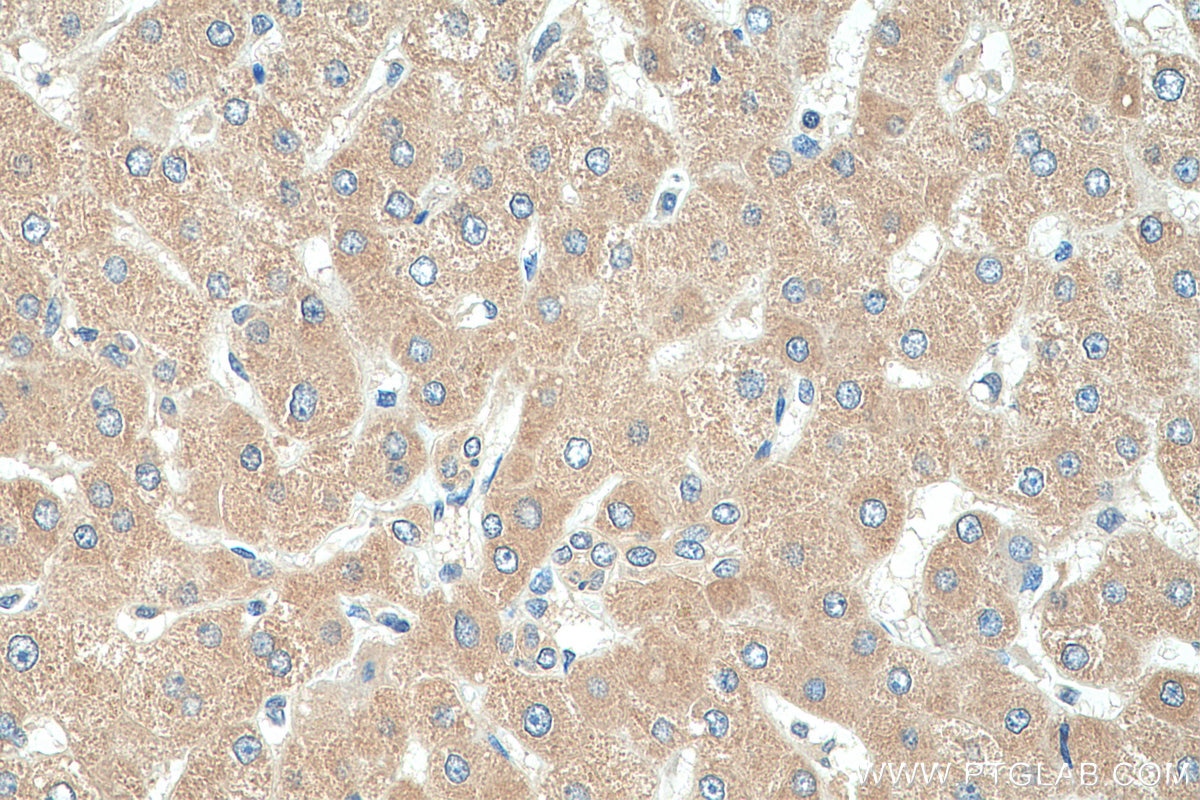
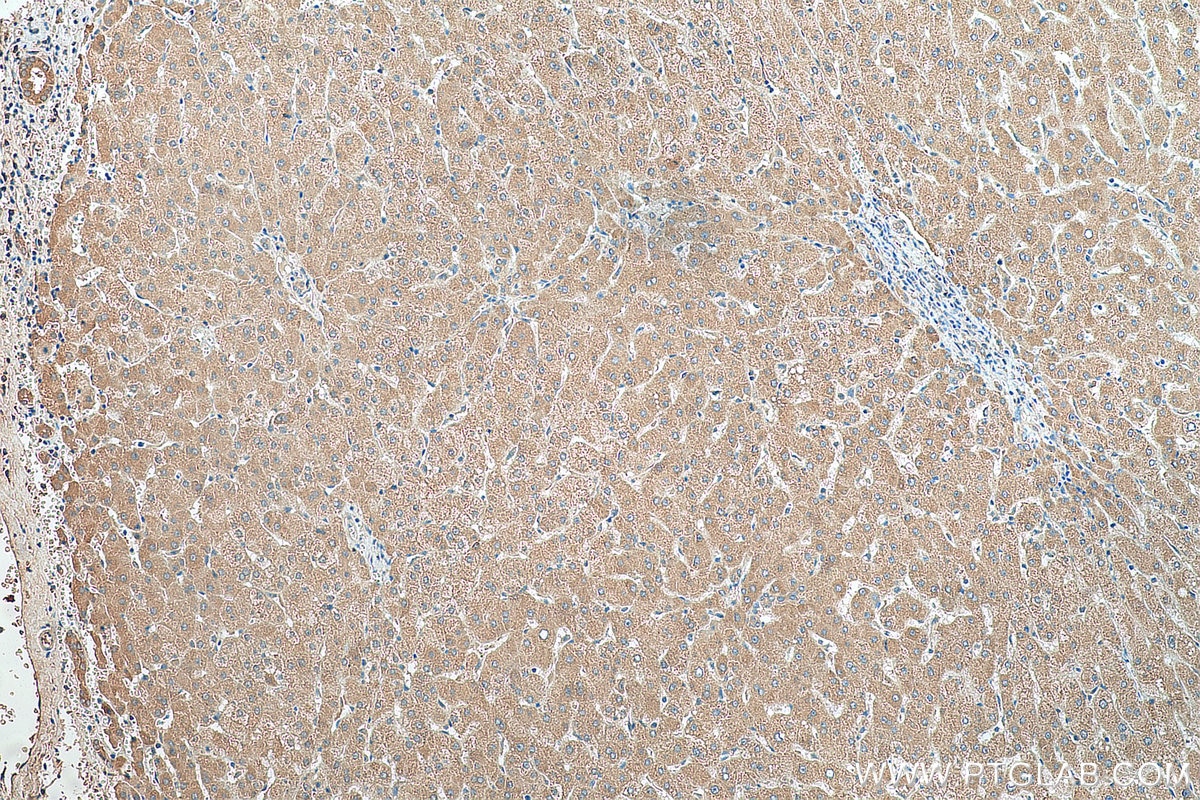
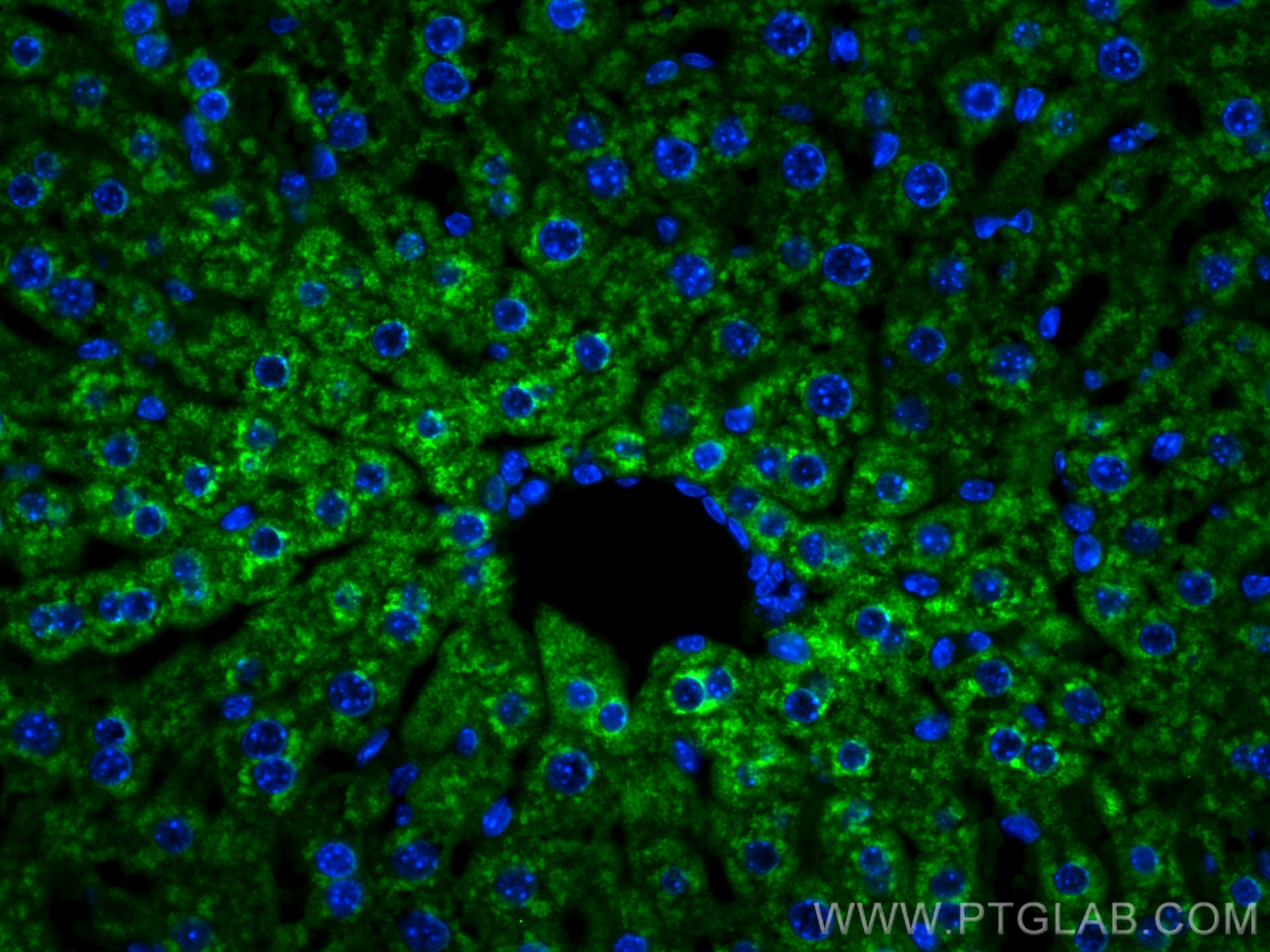

Tested Applications
| Positive IHC detected in | human liver tissue Note: suggested antigen retrieval with TE buffer pH 9.0; (*) Alternatively, antigen retrieval may be performed with citrate buffer pH 6.0 |
| Positive IF-P detected in | mouse liver tissue |
Recommended dilution
| Application | Dilution |
|---|---|
| Immunohistochemistry (IHC) | IHC : 1:50-1:500 |
| Immunofluorescence (IF)-P | IF-P : 1:50-1:500 |
| It is recommended that this reagent should be titrated in each testing system to obtain optimal results. | |
| Sample-dependent, Check data in validation data gallery. | |
Product Information
22169-1-AP targets G6PC in IHC, IF-P, ELISA applications and shows reactivity with human, mouse samples.
| Tested Reactivity | human, mouse |
| Cited Reactivity | human, mouse, rat |
| Host / Isotype | Rabbit / IgG |
| Class | Polyclonal |
| Type | Antibody |
| Immunogen |
CatNo: Ag17839 Product name: Recombinant human G6PC protein Source: e coli.-derived, PGEX-4T Tag: GST Domain: 1-60 aa of BC130478 Sequence: MEEGMNVLHDFGIQSTHYLQVNYQDSQDWFILVSVIADLRNAFYVLFPIWFHLQEAVGIK Predict reactive species |
| Full Name | glucose-6-phosphatase, catalytic subunit |
| Calculated Molecular Weight | 357 aa, 40 kDa |
| GenBank Accession Number | BC130478 |
| Gene Symbol | G6PC |
| Gene ID (NCBI) | 2538 |
| RRID | AB_2879015 |
| Conjugate | Unconjugated |
| Form | Liquid |
| Purification Method | Antigen affinity purification |
| UNIPROT ID | P35575 |
| Storage Buffer | PBS with 0.02% sodium azide and 50% glycerol, pH 7.3. |
| Storage Conditions | Store at -20°C. Stable for one year after shipment. Aliquoting is unnecessary for -20oC storage. 20ul sizes contain 0.1% BSA. |
Background Information
Glucose-6-phosphatase-α (G6PC) is a key enzyme in glucose homeostasis that catalyzes the hydrolysis of glucose-6-phosphate to glucose and phosphate in the terminal step of gluconeogenesis and glycogenolysis. G6PC activity is restricted to the liver , the kidney cortex and the small intestine and confers on these three organs the capacity to release glucose into the systemic circulation (PMID: 21983240).The encoded enzyme is anchored to the ER by nine transmembrane helices with the amino (N)-terminus in the lumen and the carboxyl (C)-terminus in the cytoplasm (PMID: 15542400).
Protocols
| Product Specific Protocols | |
|---|---|
| IF protocol for G6PC antibody 22169-1-AP | Download protocol |
| IHC protocol for G6PC antibody 22169-1-AP | Download protocol |
| Standard Protocols | |
|---|---|
| Click here to view our Standard Protocols |
Publications
What published studies show
The G6PC polyclonal antibody (Cat# 22169-1-AP) has accumulated 48 citations. Publications appear in journals including Nature Communications, Cell Metabolism, Molecular Cell, Metabolism, Cell Reports, Journal of Biological Chemistry, Endocrinology, Cancer Letters, and Pharmacological Research. Associated research fields encompass hepatic gluconeogenesis, insulin resistance, type 2 diabetes, NAFLD, glucose and lipid metabolism, and multiple cancer types including hepatocellular, breast, ovarian, gastric, and cervical carcinoma.
| Species | Application | Title |
|---|---|---|
Cell Metab Circulating glycerate predicts resilience to fructose-induced hepatic steatosis | ||
Nat Commun Transcriptional coactivation by EHMT2 restricts glucocorticoid-induced insulin resistance in a study with male mice | ||
Metabolism TOX3 deficiency mitigates hyperglycemia by suppressing hepatic gluconeogenesis through FoxO1 | ||
Mol Cell Histone phosphorylation integrates the hepatic glucagon-PKA-CREB gluconeogenesis program in response to fasting | ||
Cancer Lett The NQO1/PKLR axis promotes lymph node metastasis and breast cancer progression by modulating glycolytic reprogramming. |




