
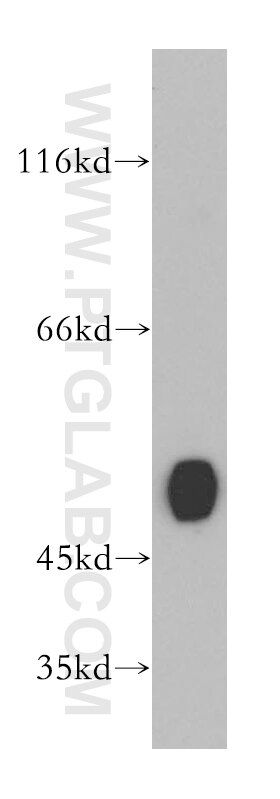
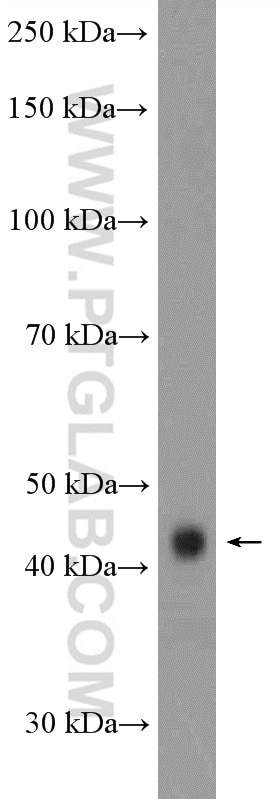
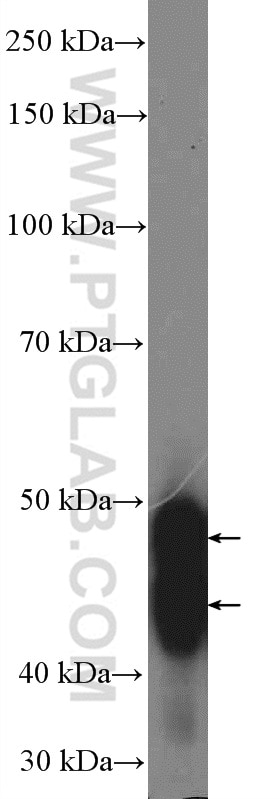
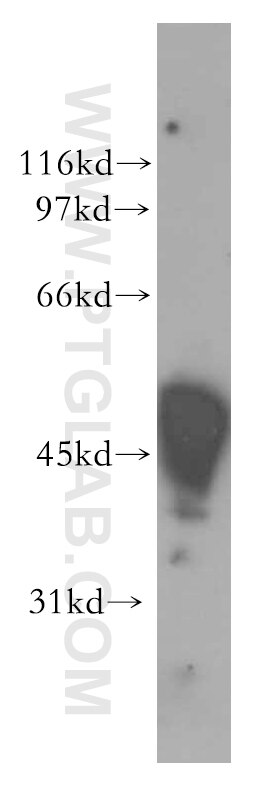

Tested Applications
| Positive WB detected in | mouse kidney tissue, human kidney tissue, rat kidney tissue, rat pancreas tissue |
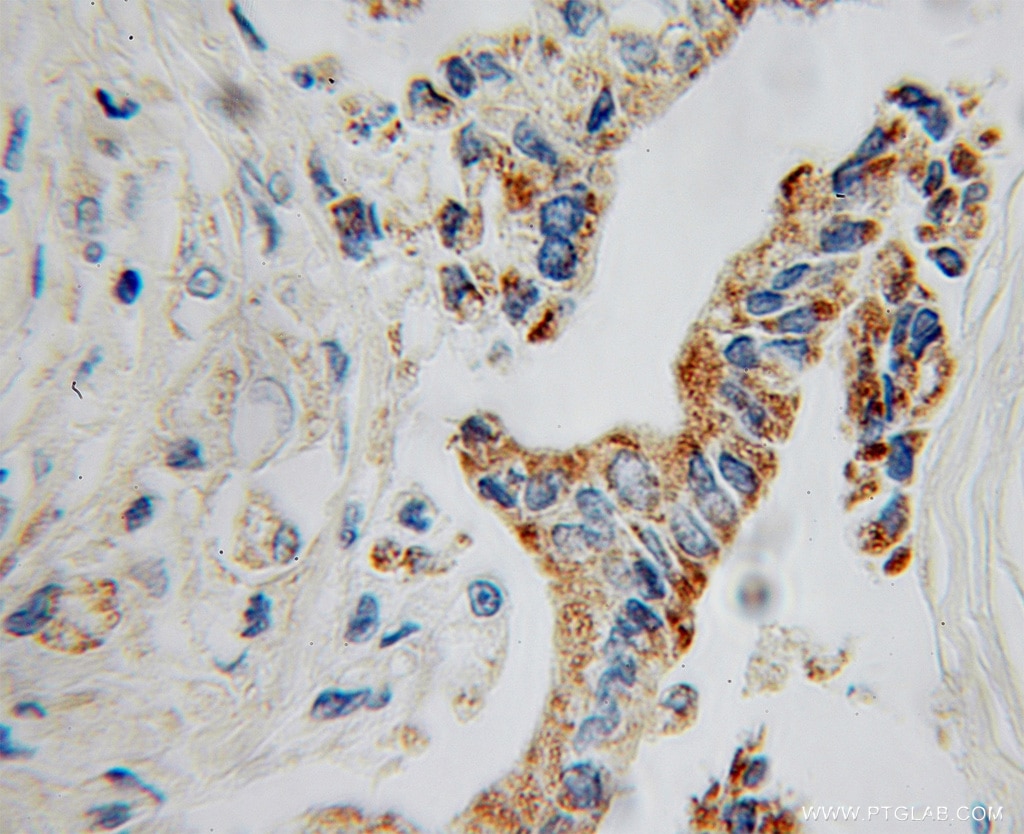
| Positive IHC detected in | human pancreas cancer tissue Note: suggested antigen retrieval with TE buffer pH 9.0; (*) Alternatively, antigen retrieval may be performed with citrate buffer pH 6.0 |
Recommended dilution
| Application | Dilution |
|---|---|
| Western Blot (WB) | WB : 1:500-1:3000 |
| Immunohistochemistry (IHC) | IHC : 1:20-1:200 |
| It is recommended that this reagent should be titrated in each testing system to obtain optimal results. | |
| Sample-dependent, Check data in validation data gallery. | |
Product Information
12801-1-AP targets GATM in WB, IHC, IF, ELISA applications and shows reactivity with human, mouse, rat samples.
| Tested Reactivity | human, mouse, rat |
| Cited Reactivity | human, mouse |
| Host / Isotype | Rabbit / IgG |
| Class | Polyclonal |
| Type | Antibody |
| Immunogen |
CatNo: Ag3754 Product name: Recombinant human GATM protein Source: e coli.-derived, PET28a Tag: 6*His Domain: 74-423 aa of BC004141 Sequence: PLEEVIVGRAENACVPPFTIEVKANTYEKYWPFYQKQGGHYFPKDHLKKAVAEIEEMCNILKTEGVTVRRPDPIDWSLKYKTPDFESTGLYSAMPRDILIVVGNEIIEAPMAWRSRFFEYRAYRSIIKDYFHRGAKWTTAPKPTMADELYNQDYPIHSVEDRHKLAAQGKFVTTEFEPCFDAADFIRAGRDIFAQRSQVTNYLGIEWMRRHLAPDYRVHIISFKDPNPMHIDATFNIIGPGIVLSNPDRPCHQIDLFKKAGWTIITPPTPIIPDDHPLWMSSKWLSMNVLMLDEKRVMVDANEVPIQKMFEKLGITTIKVNIRNANSLGGGFHCWTCDVRRRGTLQSYLD Predict reactive species |
| Full Name | glycine amidinotransferase (L-arginine:glycine amidinotransferase) |
| Calculated Molecular Weight | 423 aa, 48 kDa |
| Observed Molecular Weight | 48 kDa |
| GenBank Accession Number | BC004141 |
| Gene Symbol | GATM |
| Gene ID (NCBI) | 2628 |
| RRID | AB_2109060 |
| Conjugate | Unconjugated |
| Form | Liquid |
| Purification Method | Antigen affinity purification |
| UNIPROT ID | P50440 |
| Storage Buffer | PBS with 0.02% sodium azide and 50% glycerol, pH 7.3. |
| Storage Conditions | Store at -20°C. Stable for one year after shipment. Aliquoting is unnecessary for -20oC storage. 20ul sizes contain 0.1% BSA. |
Background Information
GATM, also known as AGAT, produces ornithine and guanidinoacetate (GAA) from arginine and glycine, and is a key enzyme for creatine synthesis. GATM deficiency in early infancy causes neurodevelopmental delay. GATM is predominantly expressed in kidney and pancreas in adults. Decrease of GAMT proteins was observed in proximal tubule damage cases, which links GATM as a general marker for proximal tubule damage. Alternative splicing of GATM generates three isoforms with molecular weights between 44 kDa to 48 kDa.
Protocols
| Product Specific Protocols | |
|---|---|
| IHC protocol for GATM antibody 12801-1-AP | Download protocol |
| WB protocol for GATM antibody 12801-1-AP | Download protocol |
| Standard Protocols | |
|---|---|
| Click here to view our Standard Protocols |
Publications
What published studies show
The GATM Polyclonal antibody (Cat# 12801-1-AP) has 20 citations across 19 journals, including Nature, Cell Metab, Nat Commun, Sci Adv, and Acta Pharm Sin B. Research fields span ferroptosis, glioblastoma, arginine/creatine metabolism, acute myeloid leukemia, kidney injury, ovarian and cervical cancer, cholangiocarcinoma, cardioprotection, thermogenesis, macrophage polarization, thrombophilia, Fanconi syndrome, and tumor metastasis. Applications cited include WB, IHC, IF, and Indirect ELISA in human, mouse, and rat samples.
| Species | Application | Title |
|---|---|---|
Cell Metab Myeloid cell-derived creatine in the hypoxic niche promotes glioblastoma growth | ||
Cell Metab Lighting up arginine metabolism reveals its functional diversity in physiology and pathology | ||
Acta Pharm Sin B Spatial metabolomics highlights metabolic reprogramming in acute myeloid leukemia mice through creatine pathway | ||
Sci Adv Glioblastoma exploits ATP from leading-edge astrocytes to fuel its infiltrative growth revealed by spatially resolved chimeric analysis | ||
Int J Biol Macromol Role of GATM/creatine as energy reserves in the poll gland and rutting activities in male Bactrian camel |






