
Filter:

Able AI
What's the best dilution for GL7 in ?
Tested Applications
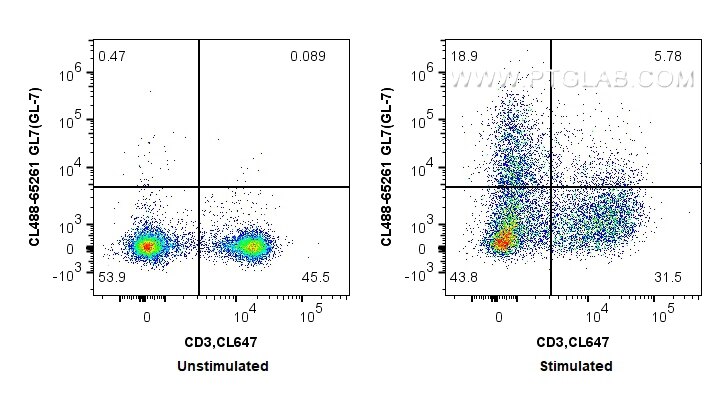
| Positive FC detected in | Anti-CD3/CD28 treated mouse splenocytes |
Recommended dilution
| Application | Dilution |
|---|---|
| Flow Cytometry (FC) | FC : 0.5 ug per 10^6 cells in 100 μl suspension |
| This reagent has been tested for flow cytometric analysis. It is recommended that this reagent should be titrated in each testing system to obtain optimal results. | |
| Sample-dependent, Check data in validation data gallery. | |
Product Information
CL488-65261 targets GL7 in FC applications and shows reactivity with Mouse samples.
| Tested Reactivity | Mouse |
| Cited Reactivity | mouse |
| Host / Isotype | Rat / IgM, kappa |
| Class | Monoclonal |
| Type | Antibody |
| Immunogen |
LPS activated DBA/J mouse B cells Predict reactive species |
| Full Name | lymphocyte antigen 77 |
| Gene Symbol | GL7 |
| Gene ID (NCBI) | 104230 |
| RRID | AB_3084186 |
| Conjugate | CoraLite® Plus 488 Fluorescent Dye |
| Excitation/Emission Maxima Wavelengths | 493 nm / 522 nm |
| Excitation Laser | Blue laser (488 nm) |
| Form | Liquid |
| Purification Method | Affinity purification |
| Storage Buffer | PBS with 0.09% sodium azide, pH 7.3. |
| Storage Conditions | Store at 2-8°C. Avoid exposure to light. Stable for one year after shipment. |
Protocols
| Product Specific Protocols | |
|---|---|
| FC protocol for CL Plus 488 GL7 antibody CL488-65261 | Download protocol |
| Standard Protocols | |
|---|---|
| Click here to view our Standard Protocols |
Publications
What published studies show
CL488-65261 is an Anti-Mouse GL7 (GL-7) monoclonal antibody. It has 1 total citation, published in Nature Communications (IF 18.1). The cited study investigates how DIS3 mutations enhance AID-driven translocations during B-cell activation, promoting transformation to multiple myeloma. The research field encompasses B-cell biology, genomic instability, and hematologic malignancy.
| Species | Application | Title |
|---|---|---|
Nat Commun DIS3 mutations enhance AID-driven translocations during B-cell activation, promoting transformation to multiple myeloma. |


