





Tested Applications
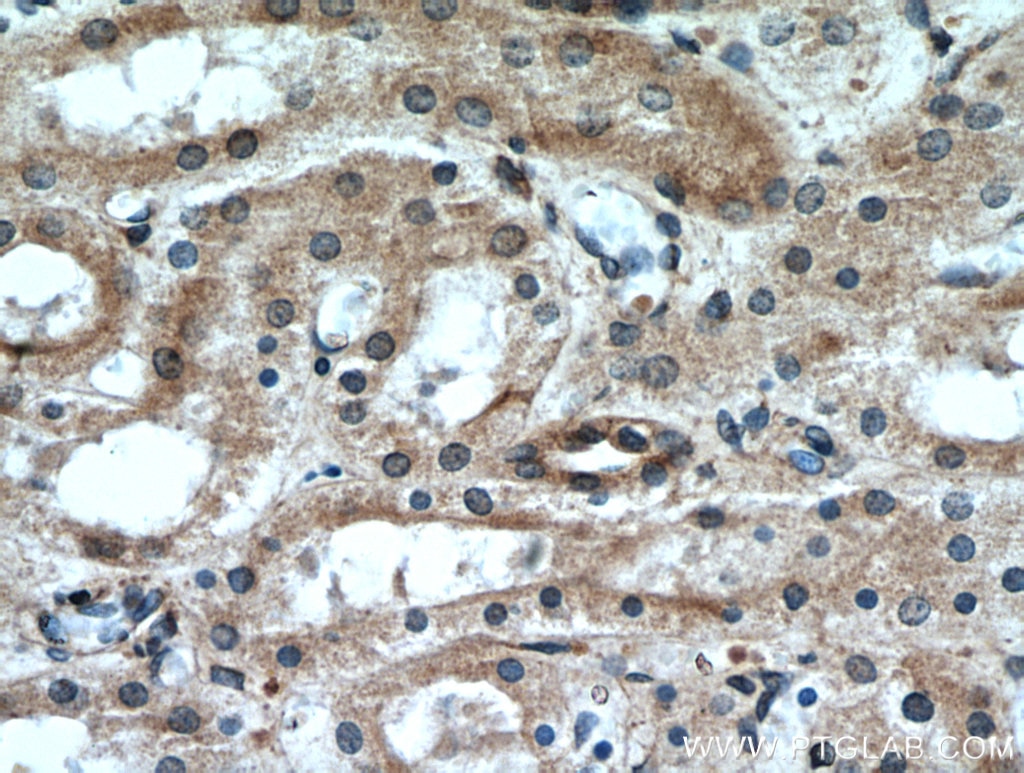
| Positive IHC detected in | mouse ovary tissue, human ovary tissue, human kidney tissue, mouse kidney tissue Note: suggested antigen retrieval with TE buffer pH 9.0; (*) Alternatively, antigen retrieval may be performed with citrate buffer pH 6.0 |
| Positive IF-P detected in | mouse kidney tissue, mouse ovary tissue |
Recommended dilution
| Application | Dilution |
|---|---|
| Immunohistochemistry (IHC) | IHC : 1:50-1:500 |
| Immunofluorescence (IF)-P | IF-P : 1:50-1:500 |
| It is recommended that this reagent should be titrated in each testing system to obtain optimal results. | |
| Sample-dependent, Check data in validation data gallery. | |
Product Information
13892-1-AP targets GREM2 in WB, IHC, IF-P, ELISA applications and shows reactivity with human, mouse samples.
| Tested Reactivity | human, mouse |
| Cited Reactivity | human, mouse |
| Host / Isotype | Rabbit / IgG |
| Class | Polyclonal |
| Type | Antibody |
| Immunogen |
CatNo: Ag4854 Product name: Recombinant human GREM2 protein Source: e coli.-derived, PGEX-4T Tag: GST Domain: 29-168 aa of BC046632 Sequence: AIHSPYKDGSSNNSERWQHQIKEVLASSQEALVVTERKYLKSDWCKTQPLRQTVSEEGCRSRTILNRFCYGQCNSFYIPRHVKKEEESFQSCAFCKPQRVTSVLVELECPGLDPPFRLKKIQKVKQCRCMSVNLSDSDKQ Predict reactive species |
| Full Name | gremlin 2, cysteine knot superfamily, homolog (Xenopus laevis) |
| Calculated Molecular Weight | 168 aa, 19 kDa |
| GenBank Accession Number | BC046632 |
| Gene Symbol | GREM2 |
| Gene ID (NCBI) | 64388 |
| RRID | AB_2877984 |
| Conjugate | Unconjugated |
| Form | Liquid |
| Purification Method | Antigen affinity purification |
| UNIPROT ID | Q9H772 |
| Storage Buffer | PBS with 0.02% sodium azide and 50% glycerol, pH 7.3. |
| Storage Conditions | Store at -20°C. Stable for one year after shipment. Aliquoting is unnecessary for -20oC storage. 20ul sizes contain 0.1% BSA. |
Protocols
| Product Specific Protocols | |
|---|---|
| IF protocol for GREM2 antibody 13892-1-AP | Download protocol |
| IHC protocol for GREM2 antibody 13892-1-AP | Download protocol |
| Standard Protocols | |
|---|---|
| Click here to view our Standard Protocols |
Publications
What published studies show
The GREM2 Polyclonal antibody (Cat# 13892-1-AP) has 7 citations published in Metabolism, Angiogenesis, American Journal of Pathology, Andrology, Hereditas, International Journal of Stem Cells, and Stem Cells Development. Research fields span NAFLD-associated fibrosis, aortic aneurysm, testicular calcification, spermatogenesis, postmenopausal osteoporosis, diabetic kidney disease, and BMP signaling in cardiac progenitor cells. Applications include WB, IHC, and IF, primarily in mouse and human samples.
| Species | Application | Title |
|---|---|---|
Metabolism SGLT2 inhibitor empagliflozin downregulates miRNA-34a-5p and targets GREM2 to inactivate hepatic stellate cells and ameliorate non-alcoholic fatty liver disease-associated fibrosis | ||
Angiogenesis Site-specific genetic and functional signatures of aortic endothelial cells at aneurysm predilection sites in healthy and AngII ApoE-/- mice | ||
Am J Pathol The Onset of Heat-Induced Testicular Calcification in Mice: Involvement of the Telomeric Locus on Chromosome 1. | ||
Andrology Genetic factors derived from the MRL/MpJ mouse function to maintain the integrity of spermatogenesis after heat exposure. | ||
Int J Stem Cells Mesenchymal Stem Cells Mediated Suppression of GREM2 Inhibits Renal Epithelial-Mesenchymal Transition and Attenuates the Progression of Diabetic Kidney Disease | ||
Hereditas Overexpression of miR-671-3p alleviates postmenopausal osteoporosis by targeting GREM2 to activate BMP2/SMAD signaling pathway |





