
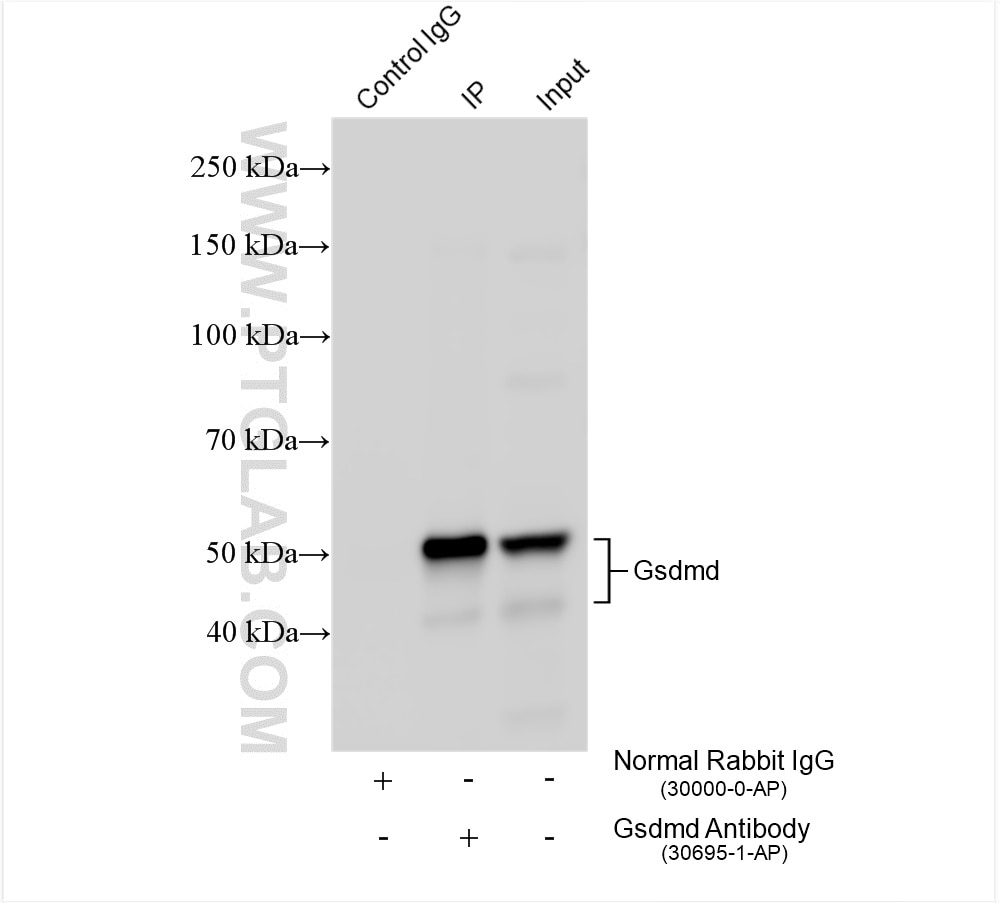

Tested Applications
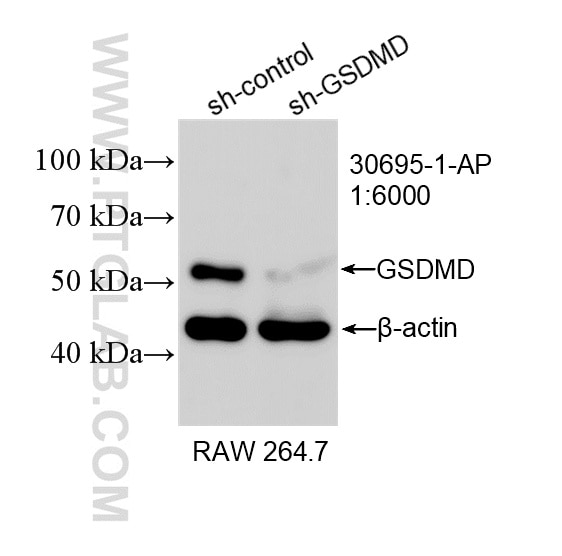
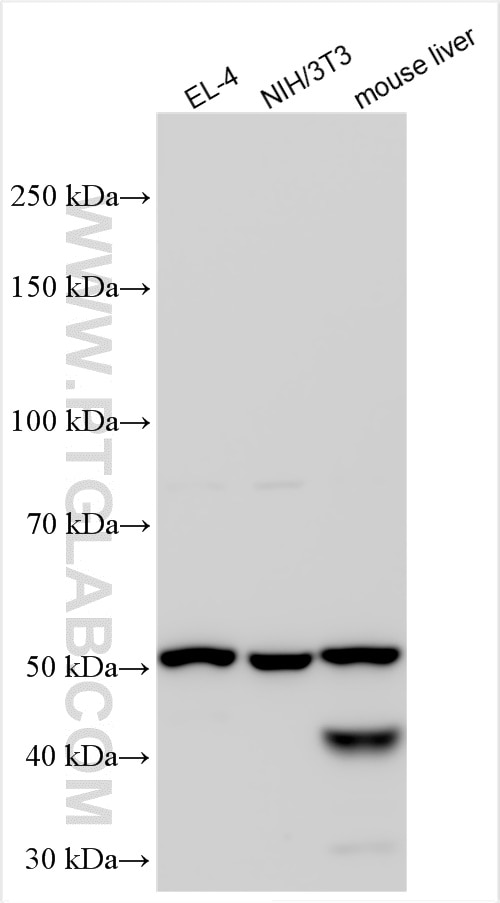
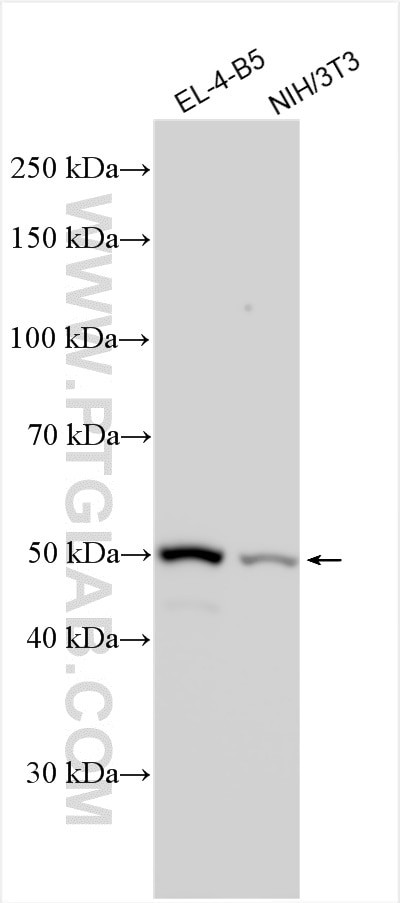
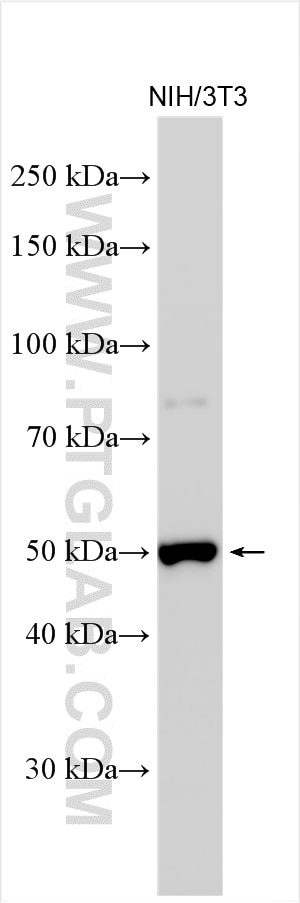
| Positive WB detected in | EL-4 cells, EL-4-B5 cells, NIH/3T3 cells, RAW 264.7 cells, mouse liver tissue |
| Positive IP detected in | RAW 264.7 cells |
Recommended dilution
| Application | Dilution |
|---|---|
| Western Blot (WB) | WB : 1:2000-1:12000 |
| Immunoprecipitation (IP) | IP : 0.5-4.0 ug for 1.0-3.0 mg of total protein lysate |
| It is recommended that this reagent should be titrated in each testing system to obtain optimal results. | |
| Sample-dependent, Check data in validation data gallery. | |
Product Information
30695-1-AP targets GSDMD in WB, IF, IP, ELISA applications and shows reactivity with mouse samples.
| Tested Reactivity | mouse |
| Cited Reactivity | human, mouse |
| Host / Isotype | Rabbit / IgG |
| Class | Polyclonal |
| Type | Antibody |
| Immunogen |
CatNo: Ag33609 Product name: Recombinant mouse Gsdmd protein Source: e coli.-derived, PET28a Tag: 6*His Domain: 199-487 aa of BC029813 Sequence: GHQSRKKMVTIPAGSILAFRVAQLLIGSKWDILLVSDEKQRTFEPSSGDRKAVGQRHHGLNVLAALCSIGKQLSLLSDGIDEEELIEAADFQGLYAEVKACSSELESLEMELRQQILVNIGKILQDQPSMEALEASLGQGLCSGGQVEPLDGPAGCILECLVLDSGELVPELAAPIFYLLGALAVLSETQQQLLAKALETTVLSKQLELVKHVLEQSTPWQEQSSVSLPTVLLGDCWDEKNPTWVLLEECGLRLQVESPQVHWEPTSLIPTSALYASLFLLSSLGQKPC* Predict reactive species |
| Full Name | gasdermin D |
| Calculated Molecular Weight | 53 kDa |
| Observed Molecular Weight | 50-53 kDa, 43 kDa |
| GenBank Accession Number | BC029813 |
| Gene Symbol | Gsdmd |
| Gene ID (NCBI) | 69146 |
| RRID | AB_3086391 |
| Conjugate | Unconjugated |
| Form | Liquid |
| Purification Method | Antigen affinity purification |
| UNIPROT ID | Q9D8T2 |
| Storage Buffer | PBS with 0.02% sodium azide and 50% glycerol, pH 7.3. |
| Storage Conditions | Store at -20°C. Stable for one year after shipment. Aliquoting is unnecessary for -20oC storage. 20ul sizes contain 0.1% BSA. |
Background Information
GSDMD is a 53 kDa cytosolic protein and a member of the gasdermin protein family, which features 6 members in humans (GSDMA, -B, -C, -D, -E and -F. GSDMD was identified as the executioner of inflammasome-associated pyroptosis. Caspase-1, -11, or -4 cleave GSDMD after an aspartate residue within a central linker domain (D275 in humans and D276 in mice) to generate a 31-kDa N-terminal GSDMD fragment (GSDMD-NT) and a 22-kDa C-terminal fragment (GSDMD-CT). In addition to the canonical 31/22 kDa cleavage products, a 43 kDa fragment has been observed under specific experimental or pathological conditions. The generation of the 43 kDa fragment was observed upon caspase-3 and -7 activation during apoptosis. This antibody can detect 53 kDa full-length GSDMD and 43 kDa fragment as described in the literature (PMID: 28392147, PMID: 28979266).
Protocols
| Product Specific Protocols | |
|---|---|
| IP protocol for GSDMD antibody 30695-1-AP | Download protocol |
| WB protocol for GSDMD antibody 30695-1-AP | Download protocol |
| Standard Protocols | |
|---|---|
| Click here to view our Standard Protocols |
Publications
What published studies show
The GSDMD Polyclonal antibody (Cat# 30695-1-AP) has 24 citations spanning 23 journals, including J Adv Res, Redox Biology, Biomaterials, Journal of Controlled Release, ACS Applied Materials & Interfaces, and Frontiers in Immunology. Research fields predominantly cover pyroptosis, NLRP3 inflammasome activation, PANoptosis, neuroinflammation, cancer immunotherapy, osteoarthritis, ischemic stroke, atherosclerosis, and myocardial injury. Applications cited include WB and IF in mouse and human models.
| Species | Application | Title |
|---|---|---|
J Adv Res Ginsenoside Rh1 ameliorates polystyrene nanoplastics-caused vascular injury by regulating HSP70 to suppress endoplasmic reticulum stress and pyroptosis. | ||
Redox Biol PHGDH-dependent serine metabolism in astrocytes: A key regulator of oxidative stress and pyroptosis in cerebral ischemia-reperfusion injury. | ||
J Nanobiotechnology HIFU postoperative hypoxia-activated metal-organic frameworks modulate the tumor microenvironment to augment immunotherapy. | ||
J Nanobiotechnology An injectable dihydroartemisinin nanocomposite hydrogel for dual-targeting PANoptosis and inflammation to treat osteoarthritis. | ||
Biomaterials A novel nano-biocomposite synergistically activates PANoptosis and cGAS-STING for precise cancer immunotherapy. | ||
J Control Release Dual-targeted nano-inhibitors of pyroptosis for synergistic therapy of traumatic brain injury. |






