
Recombinant Human B7-H6 protein (rFc Tag) (HPLC verified)
Species
Human
Purity
>90 %, SDS-PAGE
>90 %, SEC-HPLC
Tag
rFc Tag
Activity
not tested
Cat no : Eg2568
Validation Data Gallery
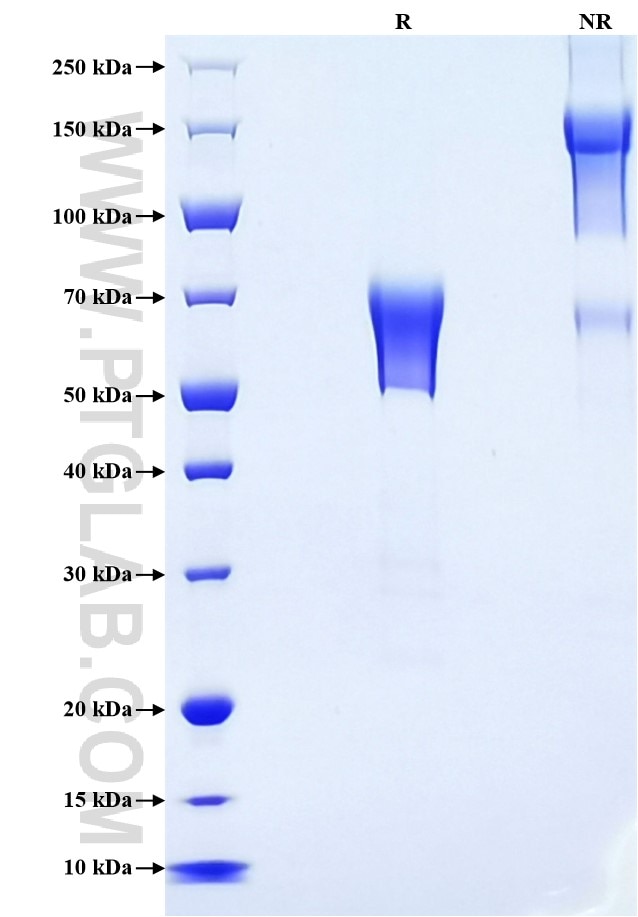
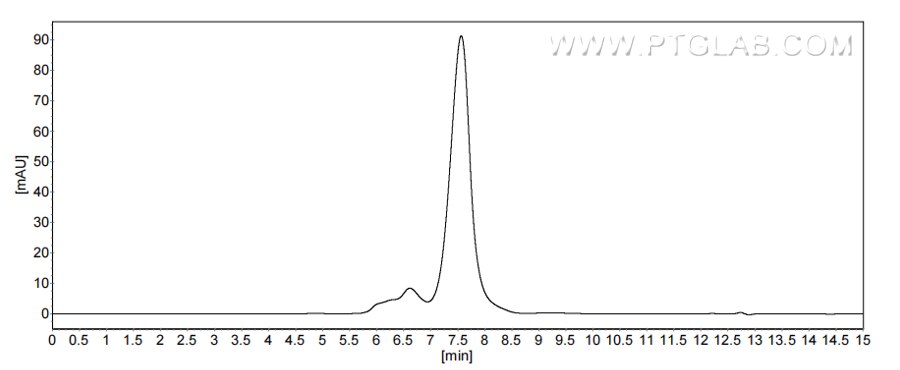
Product Information
| Purity | >90 %, SDS-PAGE >90 %, SEC-HPLC |
| Endotoxin | <0.1 EU/μg protein, LAL method |
| Activity |
Not tested |
| Expression | HEK293-derived Human B7-H6 protein Asp25-Ser262 (Accession# Q68D85) with a rabbit IgG Fc tag at the C-terminus. |
| GeneID | 374383 |
| Accession | Q68D85 |
| PredictedSize | 53.0 kDa |
| SDS-PAGE | 50-70 kDa, reducing (R) conditions |
| Formulation | Lyophilized from 0.22 μm filtered solution in PBS, pH 7.4. Normally 5% trehalose and 5% mannitol are added as protectants before lyophilization. |
| Reconstitution | Briefly centrifuge the tube before opening. Reconstitute at 0.1-0.5 mg/mL in sterile water. |
| Storage Conditions |
It is recommended that the protein be aliquoted for optimal storage. Avoid repeated freeze-thaw cycles.
|
| Shipping | The product is shipped at ambient temperature. Upon receipt, store it immediately at the recommended temperature. |
Background
B7-H6, also known as NCR3LG1, is a member of the B7 family of immunoreceptors. It is a 454-aa-long type I transmembrane protein consisting of an extracellular region, a transmembrane segment, and a cytoplasmic domain which contains an immunoreceptor tyrosine-based inhibitory motif (ITIM), an SH2-binding domain, and an SH3-binding motif. B7-H6 triggers NKp30-mediated activation of human NK cells. It has been reported that B7H6 is expressed in various types of tumor cells and plays a prominent role in natural killer cell immunosurveillance. The apparent molecular weight of B7-H6 is larger than the calculated molecular weight of 51 kDa due to glycosylation.
References:
1. Cameron S Brandt. et al. (2009). J Exp Med. 206(7):1495-503.
2. Alaleh Mohammadi. et al. (2022). Life Sci.304:120709.
3. Ying Chen. et al. (2018). Pathol Oncol Res.4(4):717-721.