
Recombinant Human CCL3L1 protein (rFc Tag)
Species
Human
Purity
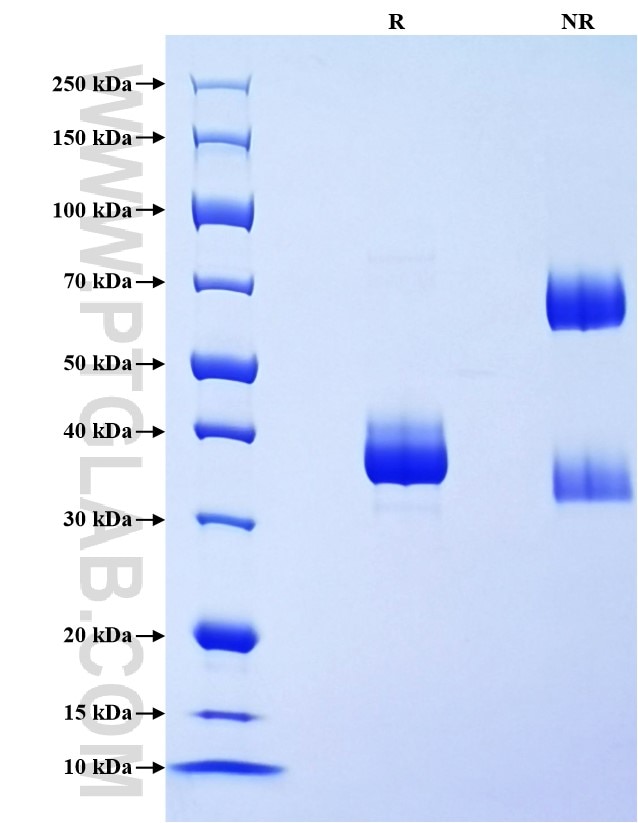
>90 %, SDS-PAGE
Tag
rFc Tag
Activity
not tested
Cat no : Eg5088
Validation Data Gallery
Product Information
| Purity | >90 %, SDS-PAGE |
| Endotoxin | <0.1 EU/μg protein, LAL method |
| Activity |
Not tested |
| Expression | HEK293-derived Human CCL3L1 protein Ala24-Ala93 (Accession# P16619) with a rabbit IgG Fc tag at the N-terminus. |
| GeneID | 6349 |
| Accession | P16619 |
| PredictedSize | 35.0 kDa |
| SDS-PAGE | 35-40 kDa, reducing (R) conditions |
| Formulation | Lyophilized from 0.22 μm filtered solution in PBS, pH 7.4. Normally 5% trehalose and 5% mannitol are added as protectants before lyophilization. |
| Reconstitution | Briefly centrifuge the tube before opening. Reconstitute at 0.1-0.5 mg/mL in sterile water. |
| Storage Conditions |
It is recommended that the protein be aliquoted for optimal storage. Avoid repeated freeze-thaw cycles.
|
| Shipping | The product is shipped at ambient temperature. Upon receipt, store it immediately at the recommended temperature. |
Background
CCL3L1 is one of several cytokine genes that are clustered on the q-arm of chromosome 17. Cytokines are a family of secreted proteins that function in inflammatory and immunoregulatory processes. The protein encoded by this gene binds to several chemokine receptors, including chemokine binding protein 2 and chemokine (C-C motif) receptor 5 (CCR5). CCR5 is a co-receptor for HIV, and binding of this protein to CCR5 inhibits HIV entry. The copy number of this gene varies among individuals, where most individuals have one to six copies, and a minority of individuals have zero or more than six copies. There are conflicting reports about copy number variation of this gene and its correlation to disease susceptibility.
References:
1. Gonzalez E, et al. (2005). Science. 307(5714):1434-40.
2. McKinney C, et al. (2008). Ann Rheum Dis. 67(3):409-13.
3. Ahuja SK, er al. (2008). Nat Med. 14(4):413-20.