
Recombinant Human CD70 protein (hFc Tag)
Species
Human
Purity
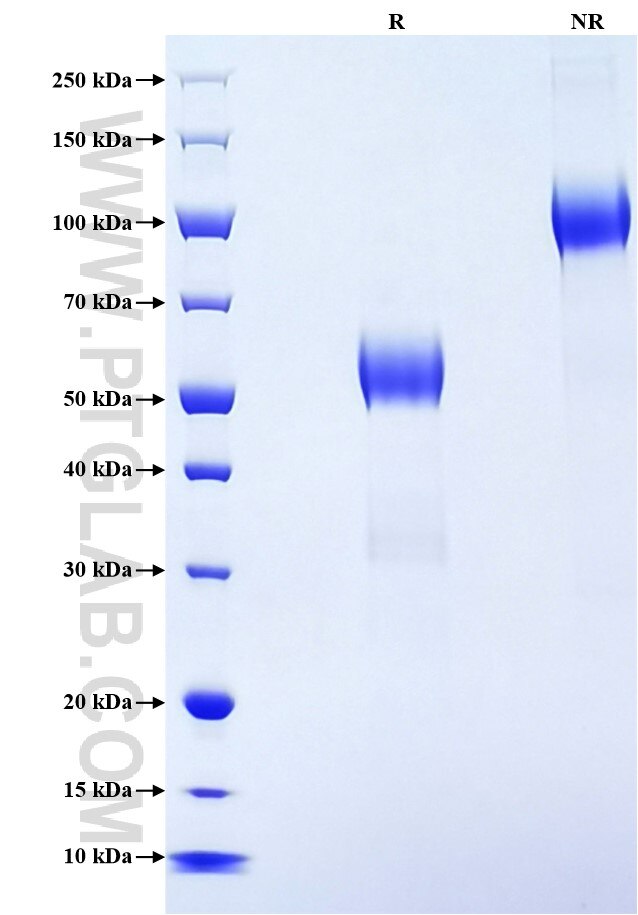
>90 %, SDS-PAGE
Tag
hFc Tag
Activity
not tested
Cat no : Eg0355
Validation Data Gallery
Product Information
| Purity | >90 %, SDS-PAGE |
| Endotoxin | <0.1 EU/μg protein, LAL method |
| Activity |
Not tested |
| Expression | HEK293-derived Human CD70 protein Gln39-Pro193 (Accession# P32970-1) with a human IgG1 Fc tag at the N-terminus. |
| GeneID | 970 |
| Accession | P32970-1 |
| PredictedSize | 43.6 kDa |
| SDS-PAGE | 50-60 kDa, reducing (R) conditions |
| Formulation | Lyophilized from 0.22 μm filtered solution in PBS, pH 7.4. Normally 5% trehalose and 5% mannitol are added as protectants before lyophilization. |
| Reconstitution | Briefly centrifuge the tube before opening. Reconstitute at 0.1-0.5 mg/mL in sterile water. |
| Storage Conditions |
It is recommended that the protein be aliquoted for optimal storage. Avoid repeated freeze-thaw cycles.
|
| Shipping | The product is shipped at ambient temperature. Upon receipt, store it immediately at the recommended temperature. |
Background
CD70, also known as tumor necrosis factor ligand superfamily member 7 (TNFSF7) or CD27 ligand (CD27L), is a transmembrane protein that plays a significant role in the immune system. It is the unique ligand for CD27, a member of the tumor necrosis factor receptor (TNFR) family, and is transiently upregulated upon stimulation of immune cells. CD70 is expressed on lymphocytes and dendritic cells, and its expression can be regulated by activation signals received via toll-like receptors (TLRs), CD40, and the antigen receptor MHC II. It provides complex and not completely understood signaling for B cell development. CD70 is also expressed on various solid tumors and hematolymphoid malignancies, where it may contribute to a poor prognosis.
References:
1. Tal Flieswasser. et al.(2022) J Exp Clin Cancer Res. 2022 Jan 6;41(1):12.
2. J Jacobs. et al.(2015) Pharmacol Ther.155:1-10.
3. Koen van de Ven. et al. (2015) Immunotherapy. 2015;7(6):655-67.