
Recombinant Human CD72 protein (rFc Tag)
Species
Human
Purity
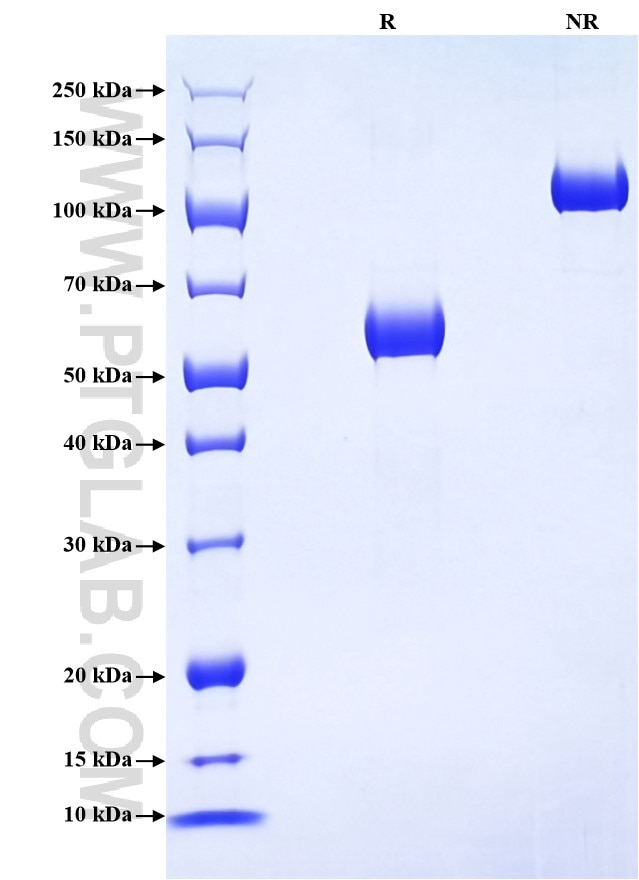
>90 %, SDS-PAGE
Tag
rFc Tag
Activity
not tested
Cat no : Eg1755
Validation Data Gallery
Product Information
| Purity | >90 %, SDS-PAGE |
| Endotoxin | <0.1 EU/μg protein, LAL method |
| Activity |
Not tested |
| Expression | HEK293-derived Human CD72 protein Arg117-Asp359 (Accession# P21854) with a rabbit IgG Fc tag at the C-terminus. |
| GeneID | 971 |
| Accession | P21854 |
| PredictedSize | 54.4 kDa |
| SDS-PAGE | 55-65 kDa, reducing (R) conditions |
| Formulation | Lyophilized from 0.22 μm filtered solution in PBS, pH 7.4. Normally 5% trehalose and 5% mannitol are added as protectants before lyophilization. |
| Reconstitution | Briefly centrifuge the tube before opening. Reconstitute at 0.1-0.5 mg/mL in sterile water. |
| Storage Conditions |
It is recommended that the protein be aliquoted for optimal storage. Avoid repeated freeze-thaw cycles.
|
| Shipping | The product is shipped at ambient temperature. Upon receipt, store it immediately at the recommended temperature. |
Background
CD72 is a type II transmembrane glycoprotein of 39-45 kDa and is expressed as a disulphide-linked homodimer. CD72 is a pan B-cell marker covering the full range of differentiation from the very early stages of B cells to mature surface Ig+ B cells. It is expressed in all stages of B cell development except plasma cells. CD72 is also expressed by dendritic cells, tissue macrophages in the red pulp of the spleen and von Kupffer cells in the liver. CD72 is the ligand for CD5. CD72 is a negative regulator of BCR signaling. Interaction of CD100 with CD72 strictly tunes the strength of BCR signals and is essential for maintaining immunological homeostasis as well as generating a proper immune response.
References:
1. H Van de Velde, et al. (1991) Nature. 351(6328):662-5.
2. R Schwarting, et al. (1992) Am J Hematol. 41(3):151-8.
3. G Massard, et al. (1996) Ann Thorac Surg. 61(1):252-8.
4. T Adachi, et al. (1998) J Immunol. 160(10):4662-5.
5. Atsushi Kumanogoh, et al. (2005) Int Immunol. 17(10):1277-82.