
Recombinant Human CDHR5 protein (rFc Tag)
Species
Human
Purity
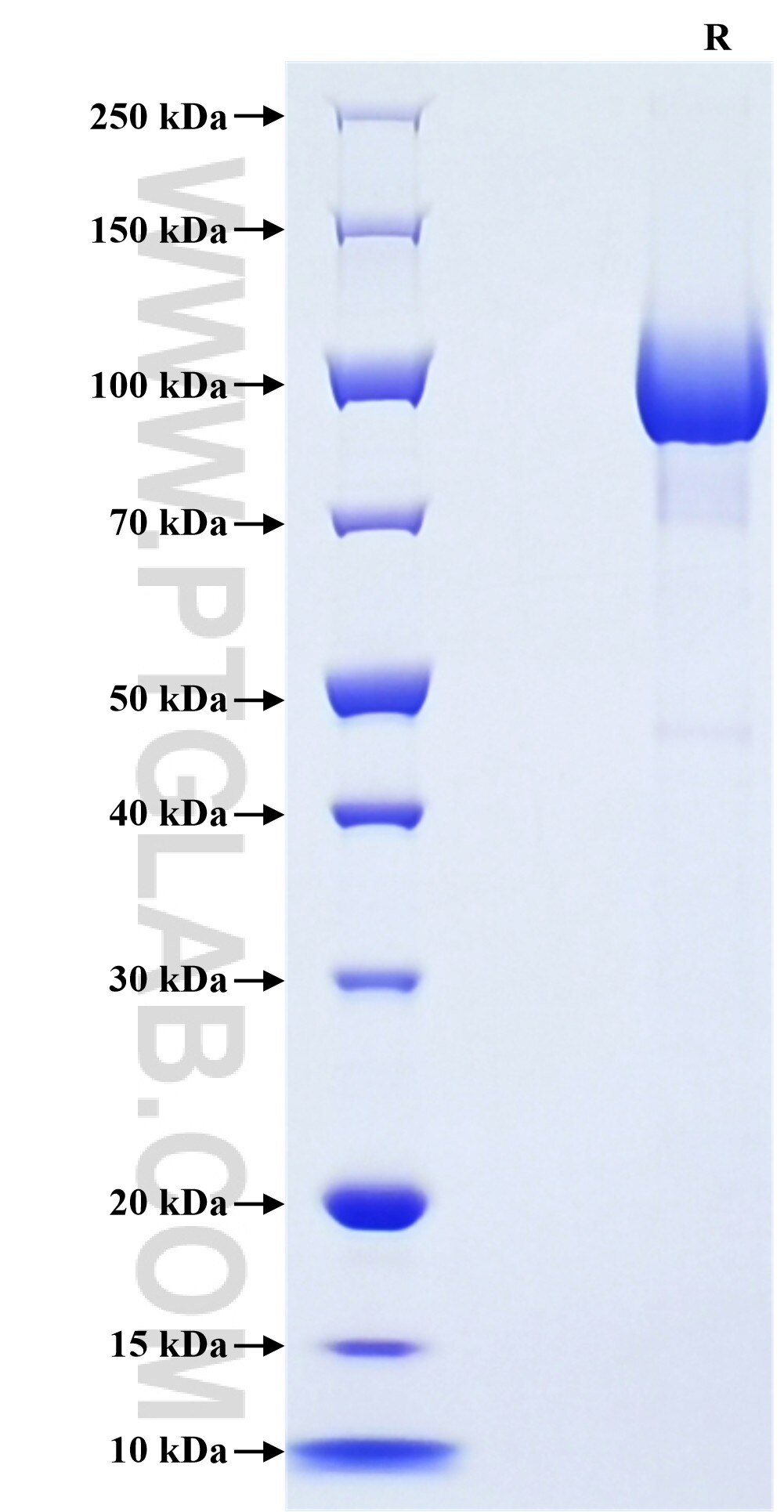
>90 %, SDS-PAGE
Tag
rFc Tag
Activity
not tested
Cat no : Eg5775
Validation Data Gallery
Product Information
| Purity | >90 %, SDS-PAGE |
| Endotoxin | <0.1 EU/μg protein, LAL method |
| Activity |
Not tested |
| Expression | HEK293-derived Human CDHR5 protein Gln26-Asp460 (Accession# Q9HBB8-1) with a rabbit IgG Fc tag at the C-terminus. |
| GeneID | 53841 |
| Accession | Q9HBB8-1 |
| PredictedSize | 73.3 kDa |
| SDS-PAGE | 88-120 kDa, reducing (R) conditions |
| Formulation | Lyophilized from 0.22 μm filtered solution in PBS, pH 7.4. Normally 5% trehalose and 5% mannitol are added as protectants before lyophilization. |
| Reconstitution | Briefly centrifuge the tube before opening. Reconstitute at 0.1-0.5 mg/mL in sterile water. |
| Storage Conditions |
It is recommended that the protein be aliquoted for optimal storage. Avoid repeated freeze-thaw cycles.
|
| Shipping | The product is shipped at ambient temperature. Upon receipt, store it immediately at the recommended temperature. |
Background
CDHR5 (Cadherin-Related Family Member 5), also known as MUCDHL (Mucin and Cadherin-Like) or MLP (Mucin-Like Protein), is a member of the cadherin superfamily characterized by multiple cadherin-like repeats and a mucin-like domain, which distinguishes it from classical cadherins. Structurally, CDHR5 is a transmembrane protein with an extracellular region containing several cadherin repeats that may mediate homophilic or heterophilic cell-cell adhesion, as well as a highly O-glycosylated mucin-like stalk that is thought to extend the adhesion domain away from the cell surface. CDHR5 is predominantly expressed in the gastrointestinal tract, particularly in the small intestine and colon, where it localizes to the brush border of enterocytes and functions in maintaining microvillar architecture and epithelial integrity.
References:
1.Crawley, Scott W et al. Cell vol. 157,2 (2014): 433-446.
2.Matoo, Samaneh et al. Biochemistry and cell biology = Biochimie et biologie cellulaire vol. 103 (2025): 1-11.