
Recombinant Human CLEC4D protein (His Tag)
Species
Human
Purity
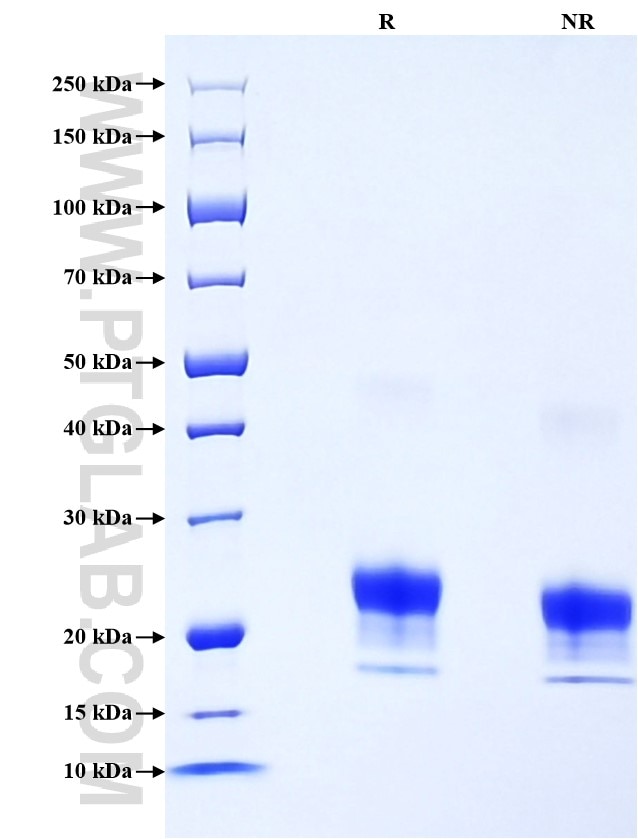
>90 %, SDS-PAGE
Tag
His Tag
Activity
not tested
Cat no : Eg1348
Validation Data Gallery
Product Information
| Purity | >90 %, SDS-PAGE |
| Endotoxin | <0.1 EU/μg protein, LAL method |
| Activity |
Not tested |
| Expression | HEK293-derived Human CLEC4D protein Gly52-Asn215 (Accession# Q8WXI8) with a His tag at the N-terminus. |
| GeneID | 338339 |
| Accession | Q8WXI8 |
| PredictedSize | 20.2 kDa |
| SDS-PAGE | 23-26 kDa, reducing (R) conditions |
| Formulation | Lyophilized from 0.22 μm filtered solution in PBS, pH 7.4. Normally 5% trehalose and 5% mannitol are added as protectants before lyophilization. |
| Reconstitution | Briefly centrifuge the tube before opening. Reconstitute at 0.1-0.5 mg/mL in sterile water. |
| Storage Conditions |
It is recommended that the protein be aliquoted for optimal storage. Avoid repeated freeze-thaw cycles.
|
| Shipping | The product is shipped at ambient temperature. Upon receipt, store it immediately at the recommended temperature. |
Background
CLEC4D, also called macrophage C‐type lectin (MCL), Dectin‐3, CLEC6, CLECSF8, is a member of the Dectin‐2 cluster of CTLRs, which also includes the related receptors Mincle and Dectin‐2. CLECSF8 is primarily expressed by peripheral blood neutrophils and monocytes and weakly by several subsets of peripheral blood dendritic cells. CLECSF8 can associate with FcRγ chain to trigger intracellular signaling, inducing phagocytosis, the respiratory burst, and the release of proinflammatory cytokines.
References:
1. Kerscher B. et al. (2016). Eur J Immunol. 46(2):381-9.
2. Graham LM. et al. (2012). J Biol Chem. 287(31):25964-74.
3. Miyake Y. et al. (2013). Immunity. 38(5):1050-62.
4. Wilson GJ. et al. (2015). Cell Host Microbe. 17(2):252-9.