
Recombinant Human CXCL5 protein (mFc Tag)
Species
Human
Purity
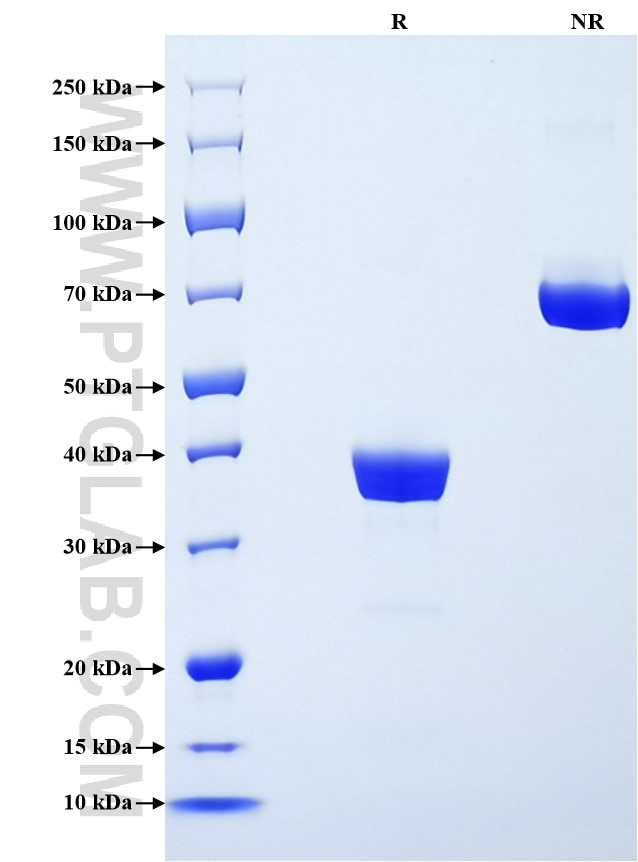
>90 %, SDS-PAGE
Tag
mFc Tag
Activity
not tested
Cat no : Eg4041
Validation Data Gallery
Product Information
| Purity | >90 %, SDS-PAGE |
| Endotoxin | <0.1 EU/μg protein, LAL method |
| Activity |
Not tested |
| Expression | HEK293-derived Human CXCL5 protein Ala37-Asn114 (Accession# P42830) with a mouse IgG Fc tag at the C-terminus. |
| GeneID | 6374 |
| Accession | P42830 |
| PredictedSize | 35.0 kDa |
| SDS-PAGE | 35-40 kDa, reducing (R) conditions |
| Formulation | Lyophilized from 0.22 μm filtered solution in PBS, pH 7.4. Normally 5% trehalose and 5% mannitol are added as protectants before lyophilization. |
| Reconstitution | Briefly centrifuge the tube before opening. Reconstitute at 0.1-0.5 mg/mL in sterile water. |
| Storage Conditions |
It is recommended that the protein be aliquoted for optimal storage. Avoid repeated freeze-thaw cycles.
|
| Shipping | The product is shipped at ambient temperature. Upon receipt, store it immediately at the recommended temperature. |
Background
CXCL5 is a member of the ELR+ CXC chemokine family, whose members contain a highly conserved three amino acid motif (ELR+) that promotes angiogenesis and is highly associated with aberrant angiogenesis. CXCL5 is an important chemokine secreted by immune cells, such as monocytes and T lymphocytes. Recent studies indicated that CXCL5 is aberrantly expressed in >14 different types of cancer, including hepatocellular carcinoma, prostate cancer, pancreatic cancer, and gastric cancer. Antibody neutralization of CXCL5 in experimental models of human non-small-cell lung cancer decreased tumor angiogenesis and metastasis.
References:
1. Robert M Strieter. et al. (2004) Semin Cancer Biol. 14(3):195-200.
2. R M Strieter. et al. (1995) J Biol Chem. 270(45):27348-57.
3. Morgan O'Hayre. et al. (2008 )Biochem J. 2008 Feb 1;409(3):635-49.
4. Gildas Lepennetier. et al. (2019)J Neuroinflammation. 16(1):219.
5. Wen Zhang. Et al. (2020)Cancer Commun (Lond). 40(2-3):69-80.