
Recombinant Human Hemopexin/HPX protein (rFc Tag)
Species
Human
Purity
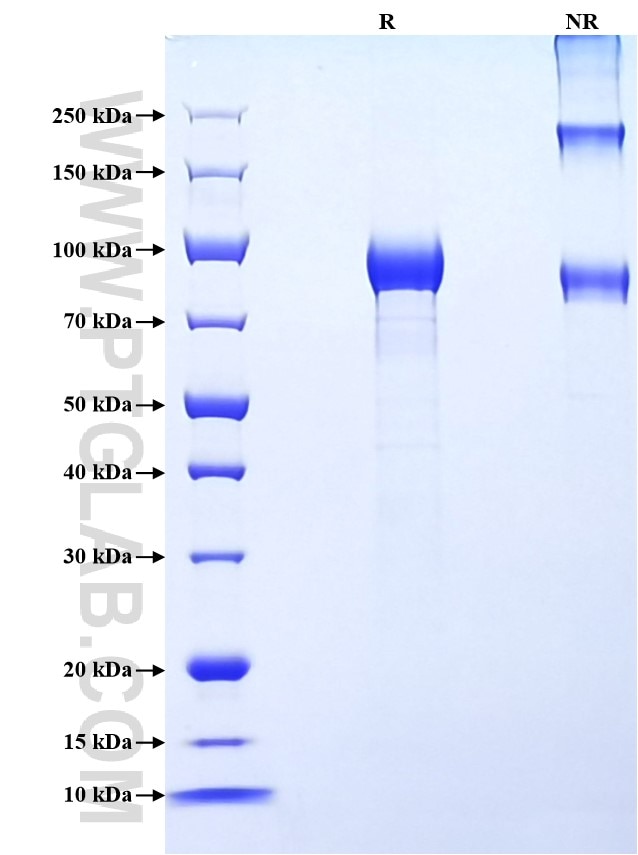
>90 %, SDS-PAGE
Tag
rFc Tag
Activity
not tested
Cat no : Eg3082
Validation Data Gallery
Product Information
| Purity | >90 %, SDS-PAGE |
| Endotoxin | <0.1 EU/μg protein, LAL method |
| Activity |
Not tested |
| Expression | HEK293-derived Human Hemopexin protein Thr24-His462 (Accession# P02790) with a rabbit IgG Fc tag at the C-terminus. |
| GeneID | 3263 |
| Accession | P02790 |
| PredictedSize | 75.3 kDa |
| SDS-PAGE | 90-100 kDa, reducing (R) conditions |
| Formulation | Lyophilized from 0.22 μm filtered solution in PBS, pH 7.4. Normally 5% trehalose and 5% mannitol are added as protectants before lyophilization. |
| Reconstitution | Briefly centrifuge the tube before opening. Reconstitute at 0.1-0.5 mg/mL in sterile water. |
| Storage Conditions |
It is recommended that the protein be aliquoted for optimal storage. Avoid repeated freeze-thaw cycles.
|
| Shipping | The product is shipped at ambient temperature. Upon receipt, store it immediately at the recommended temperature. |
Background
Hemopexin (HPX) is a liver-synthesized plasma glycoprotein consisting of a single 60 kDa peptide chain. HPX has a high-affinity heme-binding capacity, and its main physiological functions are to bind and transport toxic free heme, prevent heme-induced oxidative stress and loss of heme-bound iron, and to counteract heme toxicity caused by severe acute or chronic hemolysis. HPX is mainly expressed in the liver, central and peripheral nervous system, and has been closely associated with the pathology of many diseases, including acute or chronic hemolytic diseases, liver diseases, infectious diseases, etc. It is considered as a biomarker for assessing heme load in many hemolytic pathologies.
References:
1. Ashouri R, et al. (2021). Int J Mol Sci. 22(12):6408.
2. Li Y, et al. (2023). Front Immunol. 14:1274333.
3. Bogdanov P, et al. (2023). Diabetes. 72(12):1841-1852.
4. HvidbergV, et al. (2005). Blood. 106(7): 2572-2579.