
Recombinant Human Kallikrein 10 protein (mFc Tag)
Species
Human
Purity
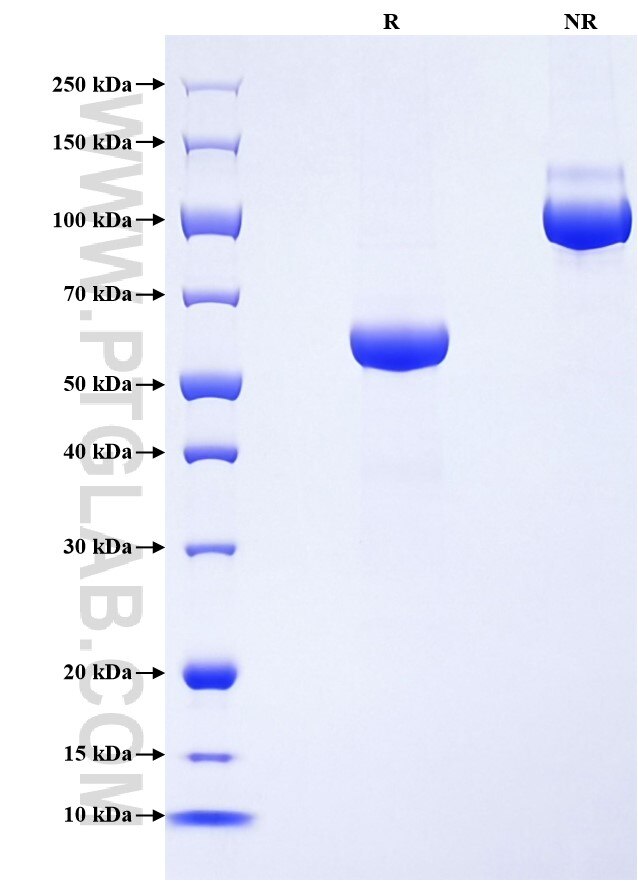
>90 %, SDS-PAGE
Tag
mFc Tag
Activity
not tested
Cat no : Eg3675
Validation Data Gallery
Product Information
| Purity | >90 %, SDS-PAGE |
| Endotoxin | <0.1 EU/μg protein, LAL method |
| Activity |
Not tested |
| Expression | HEK293-derived Human Kallikrein 10 protein Ala31-Asn276 (Accession# O43240) with a mouse IgG Fc tag at the N-terminus. |
| GeneID | 5655 |
| Accession | O43240 |
| PredictedSize | 54.7 kDa |
| SDS-PAGE | 53-65 kDa, reducing (R) conditions |
| Formulation | Lyophilized from 0.22 μm filtered solution in PBS, pH 7.4. Normally 5% trehalose and 5% mannitol are added as protectants before lyophilization. |
| Reconstitution | Briefly centrifuge the tube before opening. Reconstitute at 0.1-0.5 mg/mL in sterile water. |
| Storage Conditions |
It is recommended that the protein be aliquoted for optimal storage. Avoid repeated freeze-thaw cycles.
|
| Shipping | The product is shipped at ambient temperature. Upon receipt, store it immediately at the recommended temperature. |
Background
KLK10 is a secreted serine protease that is involved in various physiological processes and has potential as a diagnostic biomarker for ovarian cancer. Its expression is regulated by steroid hormones and is downregulated in testicular germ cell tumors and upregulated in ovarian cancer. KLK10 is expressed in various tissues, including the esophagus, skin, and others. It is particularly biased in the esophagus, skin, and other tissues. it is predicted to be secreted and is found in the extracellular space. Serum hK10, in combination with CA125, can improve the diagnostic sensitivity and specificity for ovarian cancer. KLK10 expression is decreased in human coronary arteries with advanced atherosclerotic plaques. KLK10 inhibits endothelial inflammation and protects the permeability barrier, ultimately reducing atherosclerosis. It is also a potential biomarker for ovarian cancer.
References:
1. Kato K, Noda T, et al. (2024) Cancer Sci. 115(5):1520-1535.
2. Zhang M, Jiang L, et al. (2024) Heliyon. 10(1):e24287.
3. Williams D, Mahmoud M, et al. (2022) Elife. 11:e72579.
4. Cheng W, Song Q, et al. (2024) Tob Induc Dis. 22.