
Recombinant Human MET protein (His Tag)
Species
Human
Purity
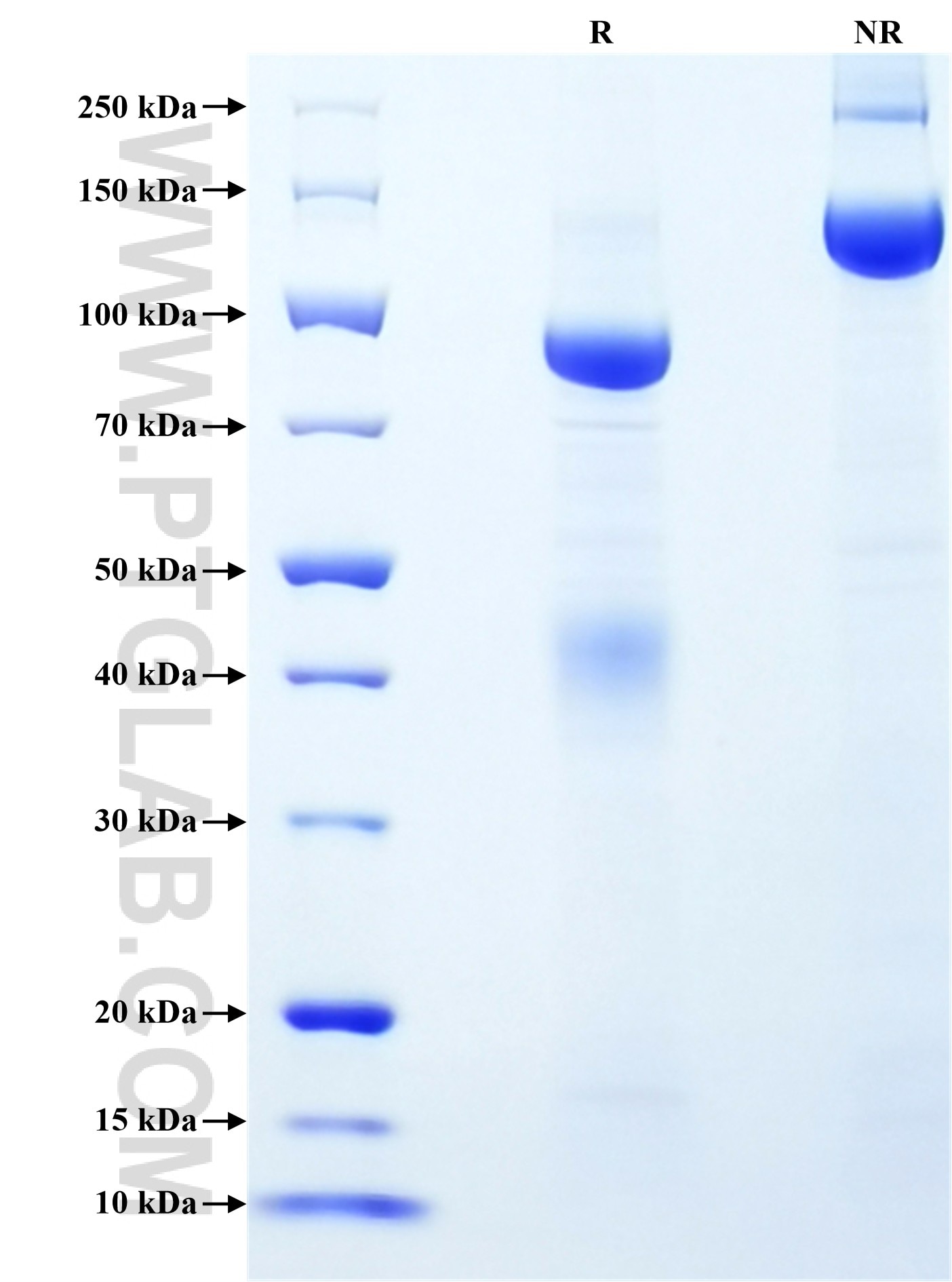
>90 %, SDS-PAGE
Tag
His Tag
Activity
not tested
Cat no : Eg0230
Validation Data Gallery
Product Information
| Purity | >90 %, SDS-PAGE |
| Endotoxin | <0.1 EU/μg protein, LAL method |
| Activity |
Not tested |
| Expression | HEK293-derived Human MET protein Glu25-Thr932 (Accession# P08581-1) with a His tag at the C-terminus. |
| GeneID | 4233 |
| Accession | P08581-1 |
| PredictedSize | 105.8 kDa |
| SDS-PAGE | 38-46 kDa and 80-95 kDa, reducing (R) conditions |
| Formulation | Lyophilized from 0.22 μm filtered solution in PBS, pH 7.4. Normally 5% trehalose and 5% mannitol are added as protectants before lyophilization. |
| Reconstitution | Briefly centrifuge the tube before opening. Reconstitute at 0.1-0.5 mg/mL in sterile water. |
| Storage Conditions |
It is recommended that the protein be aliquoted for optimal storage. Avoid repeated freeze-thaw cycles.
|
| Shipping | The product is shipped at ambient temperature. Upon receipt, store it immediately at the recommended temperature. |
Background
MET is a receptor tyrosine kinase that transduces signals from the extracellular matrix into the cytoplasm by binding to the HGF ligand. c-Met regulates many physiological processes including proliferation, scattering, morphogenesis, and survival. The primary single-chain precursor protein is post-translationally cleaved to produce the alpha and beta subunits, which are disulfide-linked to form the mature receptor. Overexpression and/or mutation of c-Met has been reported in various human malignancies, including lung cancer, breast cancer, head and neck cancer, gastric cancer, colorectal cancer, bladder cancer, uterine cervix carcinoma, esophageal carcinoma, c-Met could serve as an important therapeutic target.
References:
1. Ozawa, Yohei et al. BMC cancer vol. 15 451. 3 Jun. 2015.
2. Rosen, E M et al. The Journal of cell biology vol. 127,6 Pt 2 (1994): 1783-7.
3. Rashed, Wafaa M. Critical reviews in oncology/hematology vol. 131 (2018): 7-15.