
Recombinant Human MUC1/CA15-3 protein (hFc Tag)
Species
Human
Purity
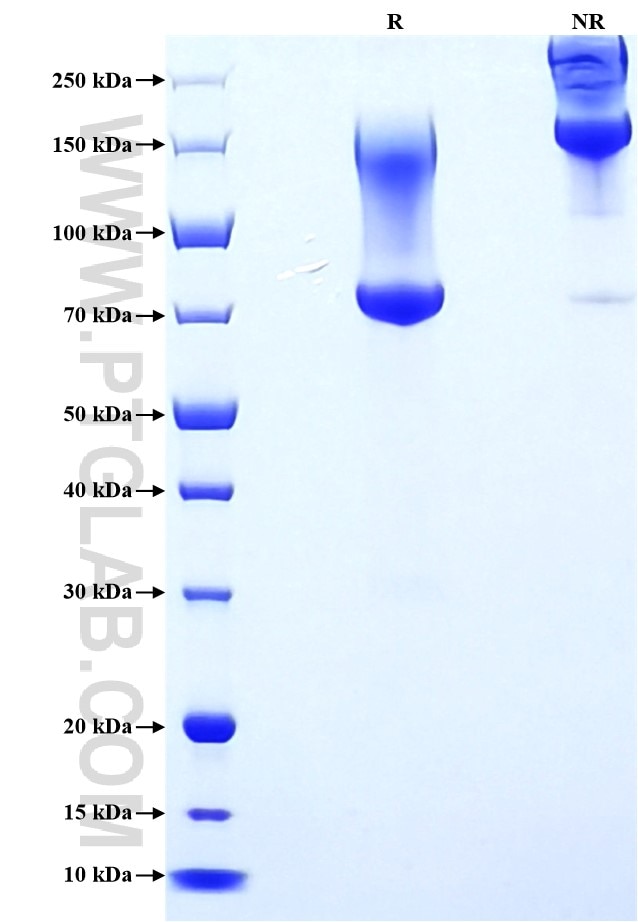
>90 %, SDS-PAGE
Tag
hFc Tag
Activity
not tested
Cat no : Eg1039
Validation Data Gallery
Product Information
| Purity | >90 %, SDS-PAGE |
| Endotoxin | <0.1 EU/μg protein, LAL method |
| Activity |
Not tested |
| Expression | HEK293-derived Human MUC1 protein Ser24-Ser380 (Accession# P15941-1) with a human IgG1 Fc tag at the C-terminus. |
| GeneID | 4582 |
| Accession | P15941-1 |
| PredictedSize | 61.2 kDa |
| SDS-PAGE | 70-80 kDa, reducing (R) conditions |
| Formulation | Lyophilized from 0.22 μm filtered solution in PBS, pH 7.4. Normally 5% trehalose and 5% mannitol are added as protectants before lyophilization. |
| Reconstitution | Briefly centrifuge the tube before opening. Reconstitute at 0.1-0.5 mg/mL in sterile water. |
| Storage Conditions |
It is recommended that the protein be aliquoted for optimal storage. Avoid repeated freeze-thaw cycles.
|
| Shipping | The product is shipped at ambient temperature. Upon receipt, store it immediately at the recommended temperature. |
Background
MUC1, also known as CA15-3, is a type I transmembrane glycoprotein expressed by various epithelial cells of the female reproductive tract, lung, breast, kidney, stomach, and pancreas. MUC1 is transcribed as a large precursor gene product, and upon translation, is cleaved in the endoplasmic reticulum, yielding two subunits: the large extracellular N-terminal subunit (MUC1-N, about 120-200 kDa) and the small cytoplasmic C-terminal subunit (MUC1-C, about 23-30 kDa). Among the known mucins, MUC1 is best studied and plays crucial roles in regulating many cellular properties, including cell proliferation, apoptosis, adhesion, and invasion. MUC1 is overexpressed in a wide range of human epithelial malignancies.
References:
1. S J Gendler, et al. (1995) Annu Rev Physiol. 57:607-34.
2. Pankaj K Singh, et al. (2006) Trends Cell Biol. 16(9):467-76.
3. Ming-Kwang Shyu, et al. (2008) Biol Reprod. 79(2):233-9.
4. Sritama Nath, et al. (2014) Trends Mol Med. 20(6):332-42.
5. Guang Wu, et al. (2018) Theranostics. 8(1):78-91.