
Recombinant Human PDI protein (rFc Tag)
Species
Human
Purity
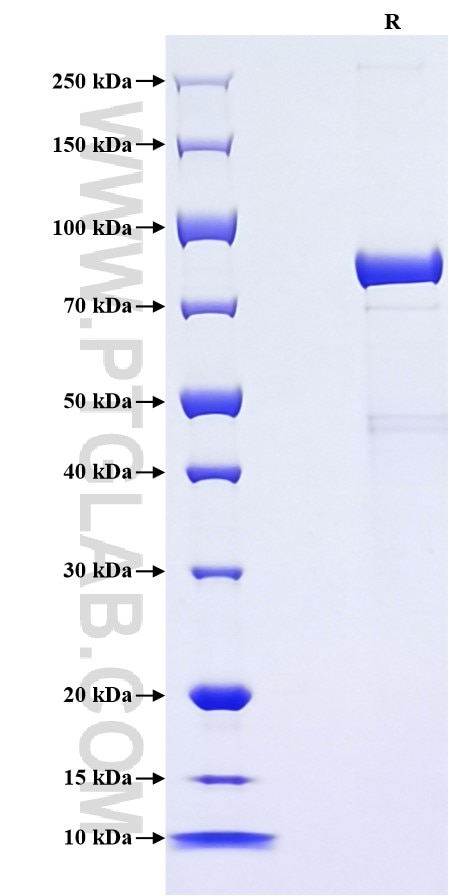
>90 %, SDS-PAGE
Tag
rFc Tag
Activity
not tested
Cat no : Eg3053
Validation Data Gallery
Product Information
| Purity | >90 %, SDS-PAGE |
| Endotoxin | <0.1 EU/μg protein, LAL method |
| Activity |
Not tested |
| Expression | HEK293-derived Human PDI protein Asp18-Leu508 (Accession# P07237) with a rabbit IgG Fc tag at the C-terminus. |
| GeneID | 5034 |
| Accession | P07237 |
| PredictedSize | 81.3 kDa |
| SDS-PAGE | 80-90 kDa, reducing (R) conditions |
| Formulation | Lyophilized from 0.22 μm filtered solution in PBS, pH 7.4. Normally 5% trehalose and 5% mannitol are added as protectants before lyophilization. |
| Reconstitution | Briefly centrifuge the tube before opening. Reconstitute at 0.1-0.5 mg/mL in sterile water. |
| Storage Conditions |
It is recommended that the protein be aliquoted for optimal storage. Avoid repeated freeze-thaw cycles.
|
| Shipping | The product is shipped at ambient temperature. Upon receipt, store it immediately at the recommended temperature. |
Background
P4HB (Prolyl 4-hydroxylase subunit beta) belongs to the disulfide bond isomerase family and is a highly abundant multifunctional enzyme responsible for hydroxylating prolyl residues in procollagen. It can catalyze the formation, breakage and rearrangement of disulfide bonds through two thioredoxin structural domains, which are important for maintaining the oxidative environment in the endoplasmic reticulum. P4HB dysregulation has been reported in neoplasms, diabetes mellitus, neurodegenerative diseases and cardiovascular disorders and its up-regulation in most of the tumors correlates with a poor prognosis, thus P4HB may serve as a potent target for a variety of cancers. (PMID: 38029391) P4HB serves as a novel target for UFMylation, and its UFMylation deficiency promotes P4HB protein degradation via the ubiquitin-proteasome pathway, which leads to impairment of mitochondrial function and exacerbates oxidative stress and ERS; Therefore, P4HB UFMylation may be a therapeutic target for liver mitochondrial function-related diseases. (PMID: 35753586)
References:
1. Feng D, et al. Aging Dis. 2023;15(6):2369-2380.
2. Gao X, et al. J Extracell Vesicles. 2021;10(5):e12060.
3. Zhu J, et al. Free Radic Biol Med. 2022;188:277-286.
4. Wu Y, et al. Oncol Lett. 2021;21(2):95.