
Recombinant Human ROR1 protein (His Tag)
Species
Human
Purity
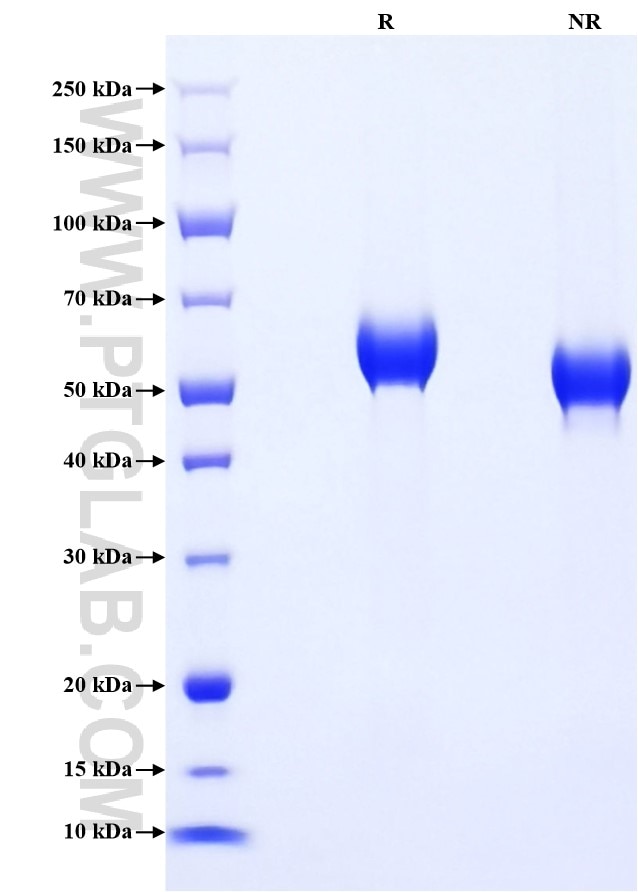
>90 %, SDS-PAGE
Tag
His Tag
Activity
not tested
Cat no : Eg1610
Validation Data Gallery
Product Information
| Purity | >90 %, SDS-PAGE |
| Endotoxin | <0.1 EU/μg protein, LAL method |
| Activity |
Not tested |
| Expression | HEK293-derived Human ROR1 protein Gln30-Glu403 (Accession# Q01973-1) with a His tag at the C-terminus. |
| GeneID | 4919 |
| Accession | Q01973-1 |
| PredictedSize | 43.1 kDa |
| SDS-PAGE | 50-65 kDa, reducing (R) conditions |
| Formulation | Lyophilized from 0.22 μm filtered solution in PBS, pH 7.4. Normally 5% trehalose and 5% mannitol are added as protectants before lyophilization. |
| Reconstitution | Briefly centrifuge the tube before opening. Reconstitute at 0.1-0.5 mg/mL in sterile water. |
| Storage Conditions |
It is recommended that the protein be aliquoted for optimal storage. Avoid repeated freeze-thaw cycles.
|
| Shipping | The product is shipped at ambient temperature. Upon receipt, store it immediately at the recommended temperature. |
Background
ROR1 is a member of the RTK family of orphan receptors related to muscle-specific kinase and Trk neurotrophin receptors. ROR1 is primarily expressed by neural crest cells during embryogenesis. High expression of ROR1 is reported in many types of malignancies and is thought to be involved in tumor growth, apoptosis, and epithelial-mesenchymal transition. The human ROR1 gene encodes a 937 amino acid protein with an Ig-like domain, a cysteine-rich domain, a kringle domain, a tyrosine kinase domain, and a proline-rich domain.
References:
1. P Masiakowski, et al. (1992) J Biol Chem. 267(36):26181-90.
2. Amir H Daneshmanesh, et al. (2008) Int J Cancer. 123(5):1190-5.
3. Nicholas Borcherding, et al. (2014) Protein Cell. 5(7):496-502.
4. Hyeyoon Chang, et al. (2015) Ann Diagn Pathol. 19(5):330-4.