
Recombinant Human TGFBR3L protein (rFc Tag)
Species
Human
Purity
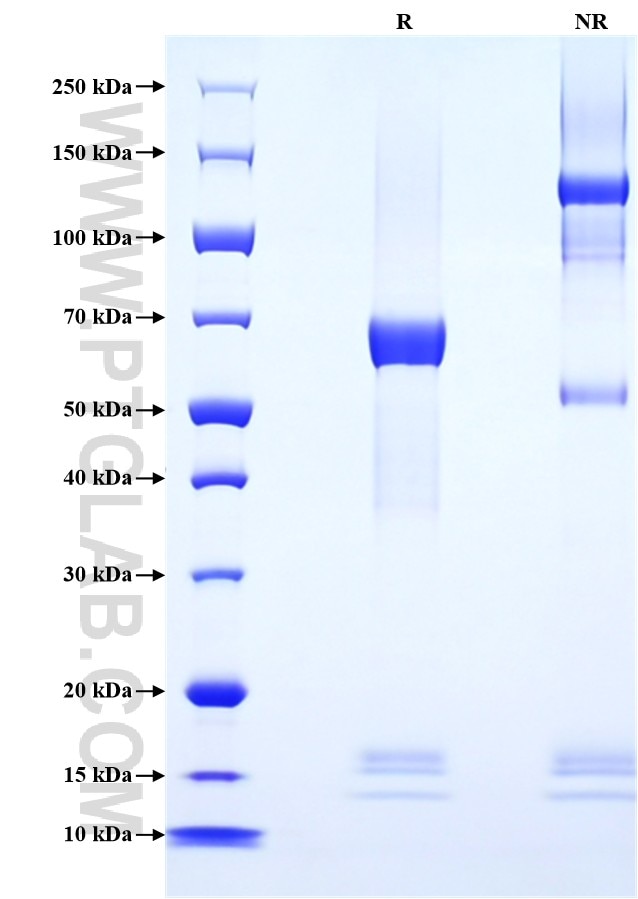
>90 %, SDS-PAGE
Tag
rFc Tag
Activity
not tested
Cat no : Eg4201
Validation Data Gallery
Product Information
| Purity | >90 %, SDS-PAGE |
| Endotoxin | <0.1 EU/μg protein, LAL method |
| Activity |
Not tested |
| Expression | HEK293-derived Human TGFBR3L protein Leu17-Pro244 (Accession# H3BV60-1) with a rabbit IgG Fc tag at the C-terminus. |
| GeneID | 100507588 |
| Accession | H3BV60-1 |
| PredictedSize | 50.3 kDa |
| SDS-PAGE | 60-70 kDa, reducing (R) conditions |
| Formulation | Lyophilized from 0.22 μm filtered solution in PBS, pH 7.4. Normally 5% trehalose and 5% mannitol are added as protectants before lyophilization. |
| Reconstitution | Briefly centrifuge the tube before opening. Reconstitute at 0.1-0.5 mg/mL in sterile water. |
| Storage Conditions |
It is recommended that the protein be aliquoted for optimal storage. Avoid repeated freeze-thaw cycles.
|
| Shipping | The product is shipped at ambient temperature. Upon receipt, store it immediately at the recommended temperature. |
Background
Transforming growth factor beta receptor 3 like (TGFBR3L) is a transmembrane protein selectively expressed in pituitary gonadotroph cells.TGFBR3L shows sequence similarity to transforming growth factor betareceptor 3 (TGFBR3), also called betaglycan, that has been detected in rodent pituitary gland and is suggested as an inhibin A co-receptor. TGFBR3L was shown to function as an inhibin B co-receptor in mice, as TGFBR3L knockout female mice presented a modest increase in FSH levels that was sufficient to enhance ovarian folliculogenesis and litter size.
References:
1.Cheung LYM.et al. (2018). Endocrinology 159.(12):3910-3924.
2.Fletcher PA.et al. (2019). Front Endocrinol (Lausanne).10:623.
3.Zhang S.et al. (2020). Nat Commun.11(1):5275.
4.Wang Y.et al. (2021). Sci Adv.7(51):eabl4391.
5.Bernard DJ.et al. (2020). Trends Endocrinol Metab.31(1):37-45.