
Recombinant Human TIM-3 protein (rFc Tag)
Species
Human
Purity
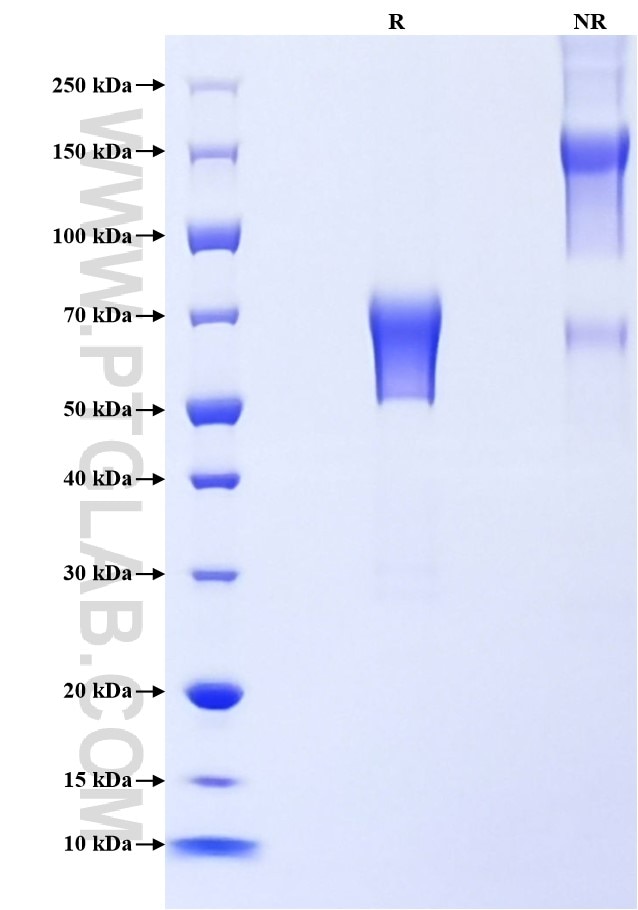
>90 %, SDS-PAGE
Tag
rFc Tag
Activity
not tested
Cat no : Eg3357
Validation Data Gallery
Product Information
| Purity | >90 %, SDS-PAGE |
| Endotoxin | <0.1 EU/μg protein, LAL method |
| Activity |
Not tested |
| Expression | HEK293-derived Human TIM-3 protein Ser22-Arg200 (Accession# Q8TDQ0-1) with a rabbit IgG Fc tag at the C-terminus |
| GeneID | 84868 |
| Accession | Q8TDQ0-1 |
| PredictedSize | 46.1 kDa |
| SDS-PAGE | 52-72 kDa, reducing (R) conditions |
| Formulation | Lyophilized from 0.22 μm filtered solution in PBS, pH 7.4. Normally 5% trehalose and 5% mannitol are added as protectants before lyophilization. |
| Reconstitution | Briefly centrifuge the tube before opening. Reconstitute at 0.1-0.5 mg/mL in sterile water. |
| Storage Conditions |
It is recommended that the protein be aliquoted for optimal storage. Avoid repeated freeze-thaw cycles.
|
| Shipping | The product is shipped at ambient temperature. Upon receipt, store it immediately at the recommended temperature. |
Background
TIM3, also known as HAVCR2, is a member of the recently discovered T cell Ig and mucin domain-containing molecule superfamily. TIM3 is a negative regulatory molecule that is important for T cell tolerance and has a crucial role in autoimmunity and T cell exhaustion during chronic viral infection. TIM3 is expressed by T-helper type 1 (Th1) cells, macrophage, monocyte, dendritic cells, CD8+ T cell and other lymphocyte subsets. Galectin-9 is a ligand for TIM3. TIM3-galectin-9 pathway negatively regulates T helper type 1 immunity. TIM3 is a 280-aa membrane protein with a calculated molecular weight of 33 kDa, the higher molecular weights between 50 and 70 kDa probably represent glycosylated TIM3.
References:
1. Isabel Sada-Ovalle. et al.(2012) Nat Immunol.6(12):1245-52.
2. Chen Zhu. et al.(2005) Nat Immunol. 6(12):1245-52.
3. Mi Jin Lee. et al.(2009) Immune Netw.9(2):58-63.
4. Philipp S van de Weyer. et al.(2006) Biochem Biophys Res Commun. 351(2):571-6.
5. J J McIntire. et al.(2001) Nat Immunol. 2(12):1109-16.