
Recombinant Human TIMP2 protein (hFc Tag)
Species
Human
Purity
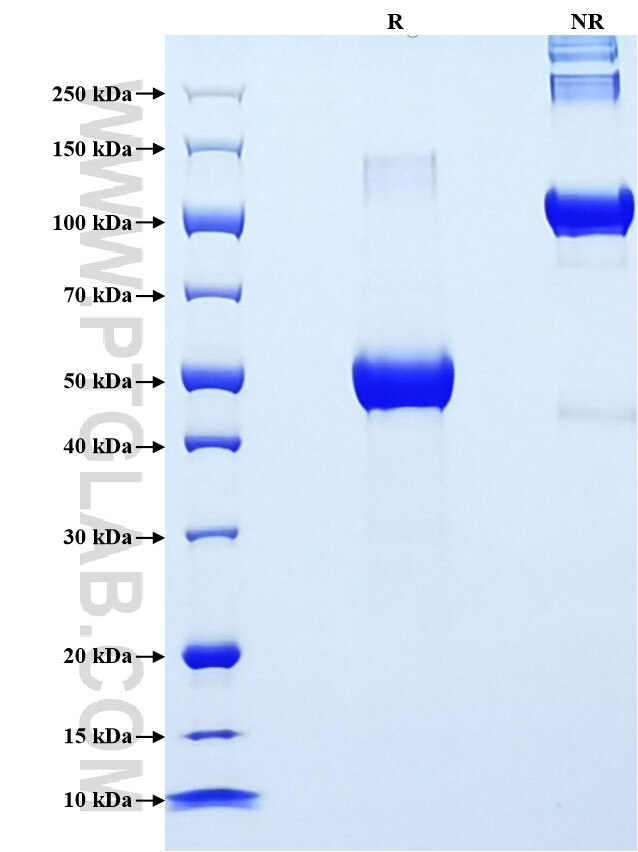
>90 %, SDS-PAGE
Tag
hFc Tag
Activity
not tested
Cat no : Eg0418
Validation Data Gallery
Product Information
| Purity | >90 %, SDS-PAGE |
| Endotoxin | <0.1 EU/μg protein, LAL method |
| Activity |
Not tested |
| Expression | HEK293-derived Human TIMP2 protein Cys27-Pro220 (Accession# P16035) with a human IgG1 Fc tag at the C-terminus. |
| GeneID | 7077 |
| Accession | P16035 |
| PredictedSize | 47.8 kDa |
| SDS-PAGE | 45-55 kDa, reducing (R) conditions |
| Formulation | Lyophilized from 0.22 μm filtered solution in PBS, pH 7.4. Normally 5% trehalose and 5% mannitol are added as protectants before lyophilization. |
| Reconstitution | Briefly centrifuge the tube before opening. Reconstitute at 0.1-0.5 mg/mL in sterile water. |
| Storage Conditions |
It is recommended that the protein be aliquoted for optimal storage. Avoid repeated freeze-thaw cycles.
|
| Shipping | The product is shipped at ambient temperature. Upon receipt, store it immediately at the recommended temperature. |
Background
TIMP2, a 21-kDa protein, is a member of the family of matrix metalloproteinase inhibitors, which contains four members (TIMP1, TIMP2, TIMP3, and TIMP4). Tissue inhibitors of metalloproteinases (TIMPs) are multifaceted molecules that exhibit properties beyond their classical proteinase inhibitory function. TIMP-2 is the only TIMP functioning as both an MMP inhibitor and an activator, because it can interact with membrane type 1 MMP and pro-MMP2 to facilitate the activation of pro-MMP2 to its active form. TIMP2 can regulate many physiological progression such as tumor growth, metastasis, and angiogenesis through matrix metalloproteinases (MMPs). TIMP2 knockout resulted in constitutive MMP9 activation abundantly and adverse MI remodeling in vivo.
References:
1. Stetler-StevensonWG.et al.(2008) Sci Signal.1(27):re6.
2. Hernandez-Barrantes S.et al. (2000).J Biol Chem.275(16):12080-9.
3. Seo DW.et al. (2003) Cell.114(2):171-80.
4. KandalamV.et al.(2010) Circ Res.106(4):796-808.