
Recombinant Human 4-1BBL/TNFSF9 protein (His Tag)
Species
Human
Purity
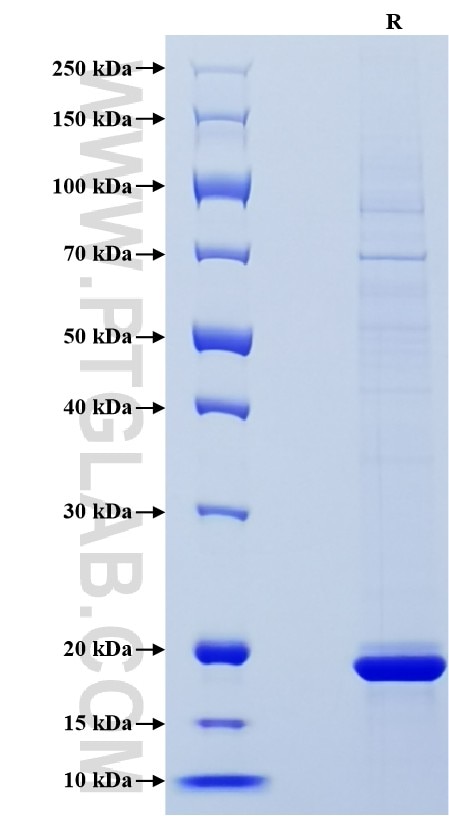
>90 %, SDS-PAGE
Tag
His Tag
Activity
not tested
Cat no : Eg0010
Validation Data Gallery
Product Information
| Purity | >90 %, SDS-PAGE |
| Endotoxin | <0.1 EU/μg protein, LAL method |
| Activity |
Not tested |
| Expression | HEK293-derived Human TNFSF9 protein Arg71-Glu254 (Accession# P41273) with a His tag at the N-terminus. |
| GeneID | 8744 |
| Accession | P41273 |
| PredictedSize | 20.5 kDa |
| SDS-PAGE | 18-20 kDa, reducing (R) conditions |
| Formulation | Lyophilized from 0.22 μm filtered solution in PBS, pH 7.4. Normally 5% trehalose and 5% mannitol are added as protectants before lyophilization. |
| Reconstitution | Briefly centrifuge the tube before opening. Reconstitute at 0.1-0.5 mg/mL in sterile water. |
| Storage Conditions |
It is recommended that the protein be aliquoted for optimal storage. Avoid repeated freeze-thaw cycles.
|
| Shipping | The product is shipped at ambient temperature. Upon receipt, store it immediately at the recommended temperature. |
Background
TNFSF9 (Tumor necrosis factor ligand superfamily member 9) is also known as 4-1BBL (4-1BB ligand) or CD137L. TNFSF9 is a type 2 transmembrane glycoprotein receptor that is found on APCs (antigen presenting cells). TNFSF9 is expressed on activated T Lymphocytes. The TNFSF9/4-1BB complex with the help of T-cell receptor signals can trigger the increase in CD28− T cells and inhibit tumor growth. The interaction between 4-1BB and TNFSF9 provides costimulatory signals to T cells, which can be used to cancer immunotherapy.
References:
1.Jacob Bukczynski. et al. (2003). Eur J Immunol. 33(2): 446-54.
2.Adam T C Cheuk. et al. (2004). Cancer Gene Ther. 11(3): 215-26.
3.Chao Wang. et al. (2009). Immunol Rev. 229(1): 192-215.
4.Dass S Vinay. et al. (2012). Mol Cancer Ther. 11(5): 1062-1070.
5.Cariad Chester. et al. (2018). Blood. 131(1): 49-57.