



Tested Applications
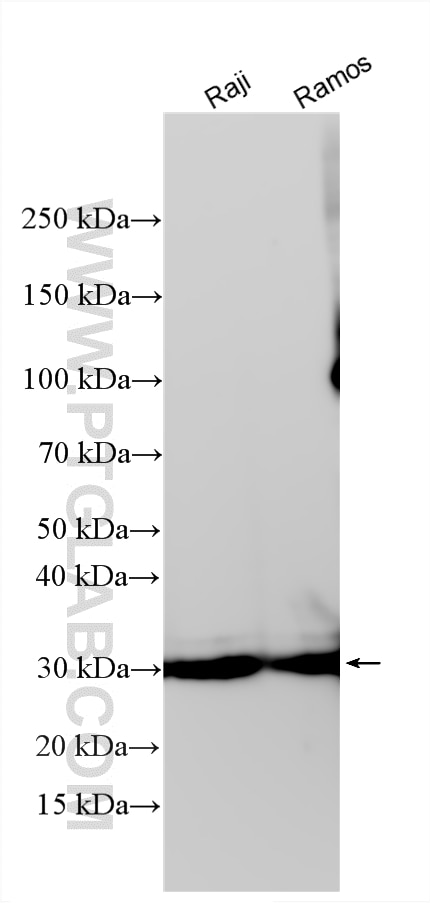
| Positive WB detected in | human plasma tissue, mouse skeletal muscle tissue, human liver tissue, human plasma, Raji cells |
| Positive IHC detected in | human spleen tissue, human heart tissue, human placenta tissue, human skin tissue, human testis tissue, mouse spleen tissue Note: suggested antigen retrieval with TE buffer pH 9.0; (*) Alternatively, antigen retrieval may be performed with citrate buffer pH 6.0 |
Recommended dilution
| Application | Dilution |
|---|---|
| Western Blot (WB) | WB : 1:500-1:2000 |
| Immunohistochemistry (IHC) | IHC : 1:20-1:200 |
| It is recommended that this reagent should be titrated in each testing system to obtain optimal results. | |
| Sample-dependent, Check data in validation data gallery. | |
Product Information
14678-1-AP targets Ig Kappa Light Chain in WB, IHC, IF, IP, CoIP, ChIP, RIP, ELISA applications and shows reactivity with human, mouse samples.
| Tested Reactivity | human, mouse |
| Cited Reactivity | human, mouse |
| Host / Isotype | Rabbit / IgG |
| Class | Polyclonal |
| Type | Antibody |
| Immunogen |
CatNo: Ag6389 Product name: Recombinant human IGK- protein Source: e coli.-derived, PGEX-4T Tag: GST Domain: 1-234 aa of BC030813 Sequence: MEAPAQLLFLLLLWLPDTTGEIVMTQSPATLSVSPGERATLSCRASQSVTSNLAWYQQTPGQSPRLVIYGASSRASGVPARFSGSGSGTEFTLTISSLQSEDFAVYYCQQYNKWPHTFGQGTKLDIKRTVAAPSVFIFPPSDEQLKSGTASVVCLLNNFYPREAKVQWKVDNALQSGNSQESVTEQDSKDSTYSLSSTLTLSKADYEKHKVYACEVTHQGLSSPVTKSFNRGEC Predict reactive species |
| Full Name | immunoglobulin kappa locus |
| Calculated Molecular Weight | 26 kDa |
| Observed Molecular Weight | 26 kDa |
| GenBank Accession Number | BC030813 |
| Gene Symbol | IgG Kappa Light Chain |
| Gene ID (NCBI) | 50802 |
| RRID | AB_1851235 |
| Conjugate | Unconjugated |
| Form | Liquid |
| Purification Method | Antigen affinity purification |
| Storage Buffer | PBS with 0.02% sodium azide and 50% glycerol, pH 7.3. |
| Storage Conditions | Store at -20°C. Stable for one year after shipment. Aliquoting is unnecessary for -20oC storage. 20ul sizes contain 0.1% BSA. |
Background Information
This antibody detects the light chain (Kappa) of human immunoglobulin.
Protocols
| Product Specific Protocols | |
|---|---|
| IHC protocol for Ig Kappa Light Chain antibody 14678-1-AP | Download protocol |
| WB protocol for Ig Kappa Light Chain antibody 14678-1-AP | Download protocol |
| Standard Protocols | |
|---|---|
| Click here to view our Standard Protocols |
Publications
What published studies show
The Ig Kappa Light Chain Polyclonal antibody (Cat# 14678-1-AP) has 24 citations. These appear in journals including Cancer Cell, Protein Cell, Nature Communications, Biomarker Research, Journal of Experimental & Clinical Cancer Research, EBioMedicine, Food Research International, Cell Mol Gastroenterol Hepatol, Ocular Surface, Cancer Gene Therapy, Translational Research, Cell Biology Toxicology, Noncoding RNA Research, Molecular Medicine Reports, Molecular & Cellular Biochemistry, FASEB Journal, PLoS Genetics, Journal of Immunology Research, Journal of Bone & Mineral Metabolism, PeerJ, Turkish Journal of Gastroenterology, Journal of Toxicological Sciences, and Heliyon. Research fields span oncology (colorectal, lung, liver, pancreatic, head & neck cancers), immunology, RNA/m6A modification, fibrosis, and inflammation.
| Species | Application | Title |
|---|---|---|
Cancer Cell CCL19-producing fibroblasts promote tertiary lymphoid structure formation enhancing anti-tumor IgG response in colorectal cancer liver metastasis | ||
Cancer Cell Spatial transcriptomics reveals tryptophan metabolism restricting maturation of intratumoral tertiary lymphoid structures | ||
Protein Cell Single-nucleus transcriptomics uncovers a geroprotective role of YAP in primate gingival aging | ||
Nat Commun A truncating mutation in the autophagy gene UVRAG drives inflammation and tumorigenesis in mice. | ||
J Exp Clin Cancer Res RNA N6-methyladenosine reader IGF2BP2 promotes lymphatic metastasis and epithelial-mesenchymal transition of head and neck squamous carcinoma cells via stabilizing slug mRNA in an m6A-dependent manner. |



