
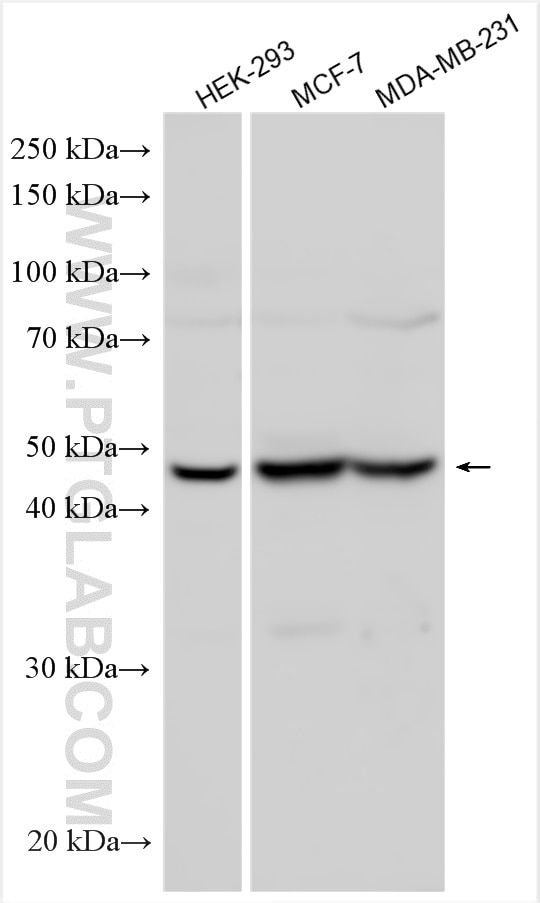
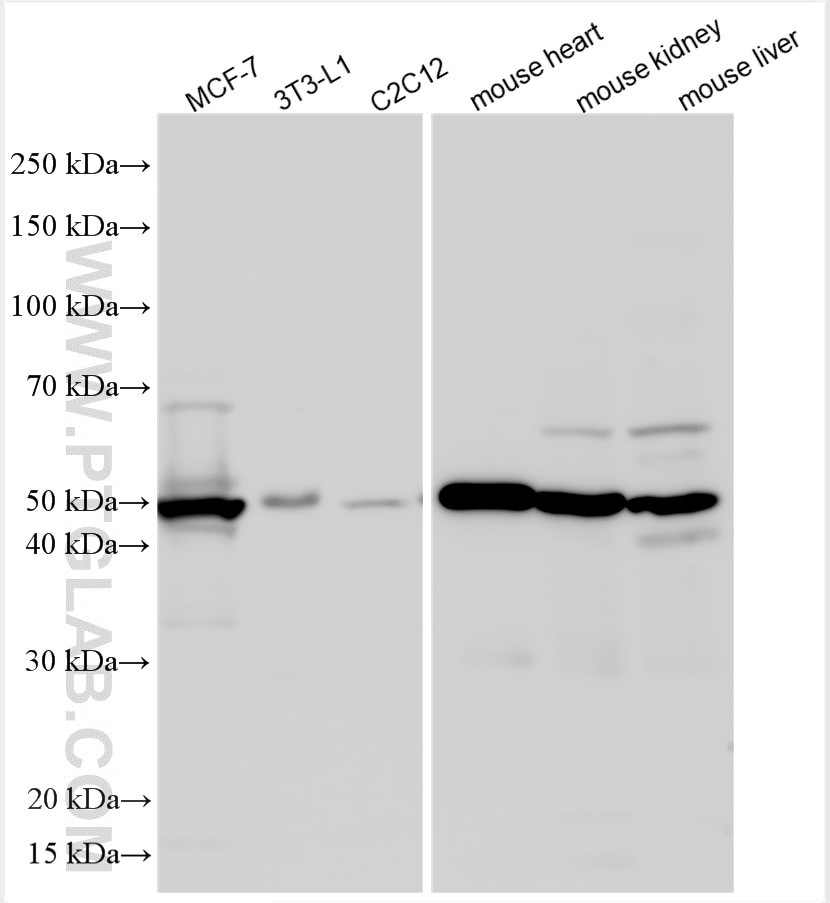

Tested Applications
| Positive WB detected in | MCF-7 cells, MDA-MB-231 cells, 3T3-L1 cells, C2C12 cells, mouse heart tissue, mouse kidney tissue, mouse liver tissue |
Recommended dilution
| Application | Dilution |
|---|---|
| Western Blot (WB) | WB : 1:500-1:2000 |
| It is recommended that this reagent should be titrated in each testing system to obtain optimal results. | |
| Sample-dependent, Check data in validation data gallery. | |
Product Information
13749-1-AP targets KLF15 in WB, IF, CoIP, ChIP, ELISA applications and shows reactivity with human, mouse samples.
| Tested Reactivity | human, mouse |
| Cited Reactivity | human, mouse, rat |
| Host / Isotype | Rabbit / IgG |
| Class | Polyclonal |
| Type | Antibody |
| Immunogen |
CatNo: Ag4690 Product name: Recombinant human KLF15 protein Source: e coli.-derived, PGEX-4T Tag: GST Domain: 1-416 aa of BC036733 Sequence: MVDHLLPVDENFSSPKCPVGYLGDRLVGRRAYHMLPSPVSEDDSDASSPCSCSSPDSQALCSCYGGGLGTESQDSILDFLLSQATLGSGGGSGSSIGASSGPVAWGPWRRAAAPVKGEHFCLPEFPLGDPDDVPRPFQPTLEEIEEFLEENMEPGVKEVPEGNSKDLDACSQLSAGPHKSHLHPGSSGRERCSPPPGGASAGGAQGPGGGPTPDGPIPVLLQIQPVPVKQESGTGPASPGQAPENVKVAQLLVNIQGQTFALVPQVVPSSNLNLPSKFVRIAPVPIAAKPVGSGPLGPGPAGLLMGQKFPKNPAAELIKMHKCTFPGCSKMYTKSSHLKAHLRRHTGEKPFACTWPGCGWRFSRSDELSRHRRSHSGVKPYQCPVCEKKFARSDHLSKHIKVHRFPRSSRSVRSVN Predict reactive species |
| Full Name | Kruppel-like factor 15 |
| Calculated Molecular Weight | 416 aa, 44 kDa |
| Observed Molecular Weight | 44 kDa |
| GenBank Accession Number | BC036733 |
| Gene Symbol | KLF15 |
| Gene ID (NCBI) | 28999 |
| RRID | AB_2132428 |
| Conjugate | Unconjugated |
| Form | Liquid |
| Purification Method | Antigen affinity purification |
| UNIPROT ID | Q9UIH9 |
| Storage Buffer | PBS with 0.02% sodium azide and 50% glycerol, pH 7.3. |
| Storage Conditions | Store at -20°C. Stable for one year after shipment. Aliquoting is unnecessary for -20oC storage. 20ul sizes contain 0.1% BSA. |
Background Information
KLF15, a kidney-enriched Krüppel-like zinc finger-containing transcription factors, is a transcriptonal activator that binds the CLCNKA promoter. The nuclear protein KLF15, is expressed primarily in liver, heart, skeletal muscle and kidney tissues but is not detected in lymphoid tissues or bone marrow. It is an important regulator of GLUT4 in both adipose and muscle tissues.Although the calculated molecular mass of KLF15 is 44 kDa, the apparent molecular mass on SDS-PAGE is 65 kDa due to the post-translational modifications (PMID:10982849,PMID:16615998).
Protocols
| Product Specific Protocols | |
|---|---|
| WB protocol for KLF15 antibody 13749-1-AP | Download protocol |
| Standard Protocols | |
|---|---|
| Click here to view our Standard Protocols |
Publications
What published studies show
The KLF15 antibody (Cat# 13749-1-AP) has 11 total citations spanning journals including Cell Metabolism, Cancer Letters, JCI Insight, Molecular Neurobiology, FASEB Journal, Epigenomics, Molecular Cell Biology, PLoS One, Korean Journal of Physiology and Pharmacology, and Molecular Genetics and Genomics. Research fields cover skeletal muscle metabolism, ferroptosis in lung cancer, insulin sensitivity, cardiac mitochondrial dysfunction, acute kidney injury, diabetic cardiomyopathy, muscle differentiation, endoplasmic reticulum stress, fibrosis, osteoarthritis, and diabetic kidney disease.
| Species | Application | Title |
|---|---|---|
Cell Metab Crosstalk between glucocorticoid receptor and nutritional sensor mTOR in skeletal muscle. | ||
Cancer Lett Hinokitiol preferentially suppresses metastatic lung adenocarcinoma via TMDD1-mediated ferroptosis induction and iron-sulfur cluster inhibition.
| ||
JCI Insight Gc inhibition preserves insulin sensitivity and reduces body weight without loss of muscle mass. | ||
Mol Neurobiol Renal Denervation Improves Myocardial Mitochondrial Dysfunction and Myocardial Fibrosis by Inhibiting the NE/KLF15/renalase Pathway | ||
FASEB J Cordycepin Suppressed Ferroptosis to Ameliorate Acute Kidney Injury Through Inhibiting the DNMT1/KLF15/FTH1 Axis.
| ||
Epigenomics Multi-omics insights into the pathogenesis of diabetic cardiomyopathy: epigenetic and metabolic profiles |



