
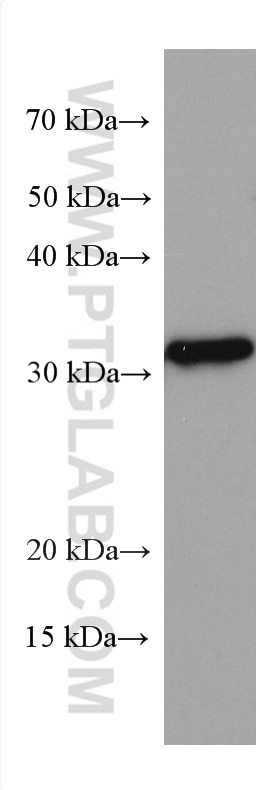

Tested Applications
| Positive WB detected in | human spleen tissue |
Recommended dilution
| Application | Dilution |
|---|---|
| Western Blot (WB) | WB : 1:1000-1:6000 |
| It is recommended that this reagent should be titrated in each testing system to obtain optimal results. | |
| Sample-dependent, Check data in validation data gallery. | |
Product Information
67537-1-Ig targets KLRB1/CD161 in WB, IHC, IF, ELISA applications and shows reactivity with human samples.
| Tested Reactivity | human |
| Cited Reactivity | human |
| Host / Isotype | Mouse / IgG1 |
| Class | Monoclonal |
| Type | Antibody |
| Immunogen |
CatNo: Ag27117 Product name: Recombinant human KLRB1,CD161 protein Source: e coli.-derived, PET28a Tag: 6*His Domain: 68-225 aa of BC114516 Sequence: KSSIEKCSVDIQQSRNKTTERPGLLNCPIYWQQLREKCLLFSHTVNPWNNSLADCSTKESSLLLIRDKDELIHTQNLIRDKAILFWIGLNFSLSEKNWKWINGSFLNSNDLEIRGDAKENSCISISQTSVYSEYCSTEIRWICQKELTPVRNKVYPDS Predict reactive species |
| Full Name | killer cell lectin-like receptor subfamily B, member 1 |
| Calculated Molecular Weight | 225 aa, 25 kDa |
| Observed Molecular Weight | 32 kDa |
| GenBank Accession Number | BC114516 |
| Gene Symbol | CD161 |
| Gene ID (NCBI) | 3820 |
| ENSEMBL Gene ID | ENSG00000111796 |
| RRID | AB_2882756 |
| Conjugate | Unconjugated |
| Form | Liquid |
| Purification Method | Protein G purification |
| UNIPROT ID | Q12918 |
| Storage Buffer | PBS with 0.02% sodium azide and 50% glycerol, pH 7.3. |
| Storage Conditions | Store at -20°C. Stable for one year after shipment. Aliquoting is unnecessary for -20oC storage. 20ul sizes contain 0.1% BSA. |
Background Information
CD161, also known as KLRB1 or NKR-P1A, is a type II transmembrane C-type lectin-like receptor and is expressed on the cell membrane as disulfide-linked homodimer (PMID: 8077657). It is expressed by the majority of NK cells and subsets of peripheral T cells, including both CD4+ and CD8+ T cells, and is expressed preferentially on adult T cells with a "memory" antigenic phenotype (PMID: 8077657; 22566826). Expression of CD161 correlates with the cytotoxic function of CD16+ NK cells, and ligation of CD161 with its ligand LLT1 inhibits NK cell cytotoxicity and cytokine secretion (PMID: 29686665).
Protocols
| Product Specific Protocols | |
|---|---|
| WB protocol for KLRB1/CD161 antibody 67537-1-Ig | Download protocol |
| Standard Protocols | |
|---|---|
| Click here to view our Standard Protocols |
Publications
What published studies show
The anti-KLRB1 (CD161/LLT1) antibody (Cat# 67537-1-Ig) has 11 citations published in journals including Cell Reports in Medicine, Frontiers in Immunology, Frontiers in Endocrinology, Journal of Pathology: Clinical Research, Frontiers in Bioscience, BMJ Open Respiratory Research, Experimental Dermatology, Journal of Thoracic Disease, and Frontiers in Medicine. Research fields span cancer immunology, immune microenvironment profiling, biomarker discovery, machine learning, psoriasis, and malignancies including lung, breast, oral, and head/neck cancers.
| Species | Application | Title |
|---|---|---|
Cell Rep Med Distinctive multicellular immunosuppressive hubs confer different intervention strategies for left- and right-sided colon cancers | ||
Front Immunol Comprehensive single-cell and bulk transcriptomic analyses to develop an NK cell-derived gene signature for prognostic assessment and precision medicine in breast cancer | ||
Front Immunol Single-cell sequencing analysis and multiple machine-learning models revealed the cellular crosstalk of dendritic cells and identified FABP5 and KLRB1 as novel biomarkers for psoriasis | ||
Front Endocrinol (Lausanne) Machine learning immune-related gene based on KLRB1 model for predicting the prognosis and immune cell infiltration of breast cancer | ||
Front Biosci (Landmark Ed) Identification of Diagnostic Biomarkers Associated With M1 Macrophage in Lung Squamous Cell Carcinoma via Machine Learning. | ||
J Pathol Clin Res Immune checkpoint CD161/LLT1-associated immunological landscape and diagnostic value in oral squamous cell carcinoma |


