




Tested Applications
| Positive WB detected in | LPS and Brefeldin A treated RAW 264.7 cells |
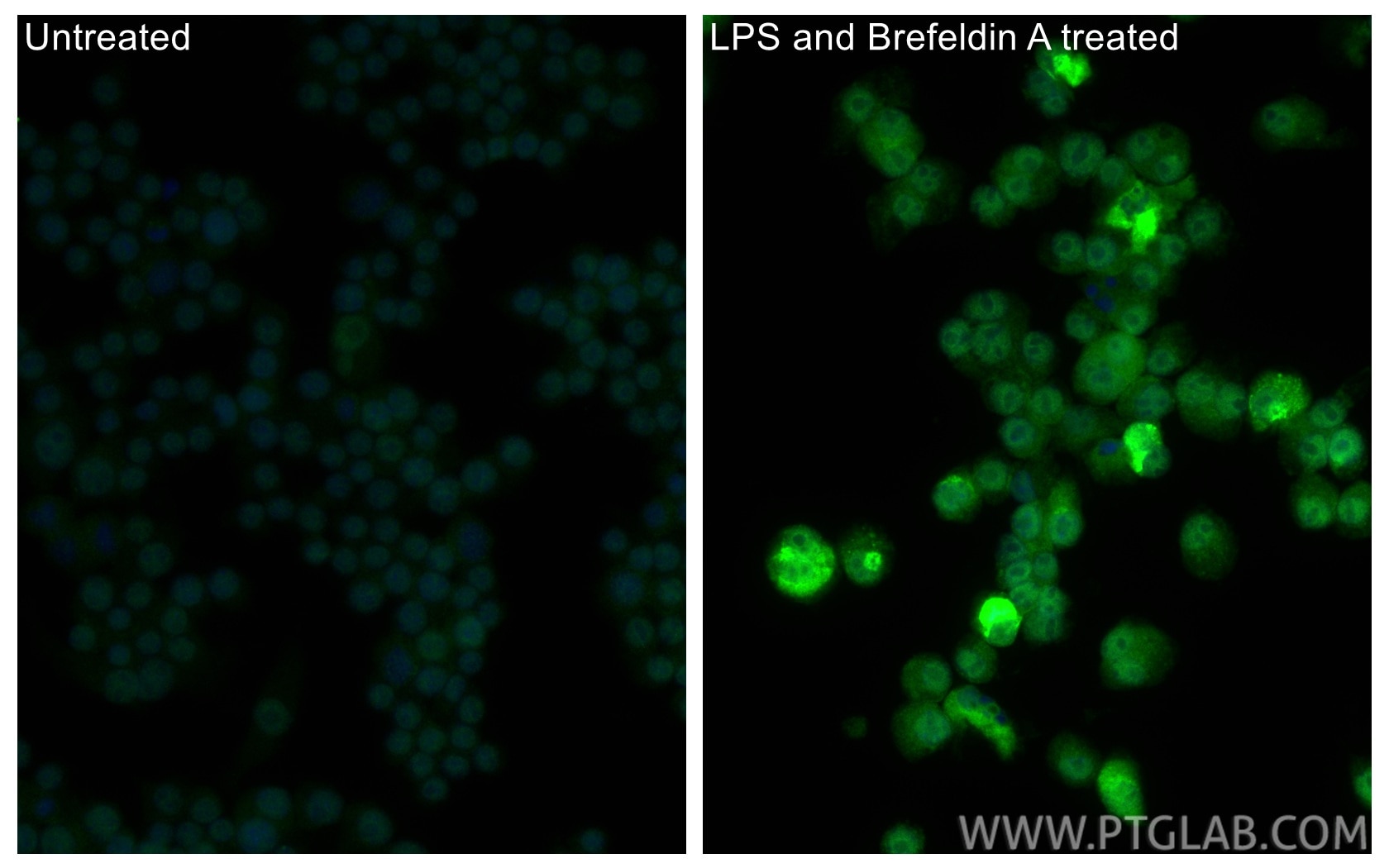
| Positive IF/ICC detected in | LPS and Brefeldin A treated RAW 264.7 cells |
| Positive FC (Intra) detected in | LPS and Brefeldin A treated RAW 264.7 cells |
Recommended dilution
| Application | Dilution |
|---|---|
| Western Blot (WB) | WB : 1:500-1:2000 |
| Immunofluorescence (IF)/ICC | IF/ICC : 1:200-1:800 |
| Flow Cytometry (FC) (INTRA) | FC (INTRA) : 0.25 ug per 10^6 cells in a 100 µl suspension |
| It is recommended that this reagent should be titrated in each testing system to obtain optimal results. | |
| Sample-dependent, Check data in validation data gallery. | |
Product Information
26161-1-AP targets MCP-1/CCL2 in WB, IHC, IF/ICC, FC (Intra), ELISA applications and shows reactivity with mouse samples.
| Tested Reactivity | mouse |
| Cited Reactivity | mouse, rat, pig, chicken, bovine |
| Host / Isotype | Rabbit / IgG |
| Class | Polyclonal |
| Type | Antibody |
| Immunogen |
CatNo: Ag24085 Product name: Recombinant mouse Mcp1 protein Source: e coli.-derived, PET28a Tag: 6*His Domain: 24-148 aa of NM-011333 Sequence: QPDAVNAPLTCCYSFTSKMIPMSRLESYKRITSSRCPKEAVVFVTKLKREVCADPKKEWVQTYIKNLDRNQMRSEPTTLFKTASALRSSAPLNVKLTRKSEANASTTFSTTTSSTSVGVTSVTVN Predict reactive species |
| Full Name | chemokine (C-C motif) ligand 2 |
| Observed Molecular Weight | 16-20 kDa |
| GenBank Accession Number | NM-011333 |
| Gene Symbol | MCP-1/CCL2 |
| Gene ID (NCBI) | 20296 |
| RRID | AB_2918100 |
| Conjugate | Unconjugated |
| Form | Liquid |
| Purification Method | Antigen affinity purification |
| UNIPROT ID | P10148 |
| Storage Buffer | PBS with 0.02% sodium azide and 50% glycerol, pH 7.3. |
| Storage Conditions | Store at -20°C. Stable for one year after shipment. Aliquoting is unnecessary for -20oC storage. 20ul sizes contain 0.1% BSA. |
Background Information
Monocyte chemoattractant protein-1 (MCP-1/CCL2) is one of the key chemokines that regulate migration and infiltration of monocytes/macrophages. Both CCL2 and its receptor CCR2 have been demonstrated to be induced and involved in various diseases. Migration of monocytes from the blood stream across the vascular endothelium is required for routine immunological surveillance of tissues, as well as in response to inflammation.
Protocols
| Product Specific Protocols | |
|---|---|
| FC protocol for MCP-1/CCL2 antibody 26161-1-AP | Download protocol |
| IF protocol for MCP-1/CCL2 antibody 26161-1-AP | Download protocol |
| WB protocol for MCP-1/CCL2 antibody 26161-1-AP | Download protocol |
| Standard Protocols | |
|---|---|
| Click here to view our Standard Protocols |
Publications
What published studies show
The MCP-1/CCL2 Polyclonal antibody (Cat# 26161-1-AP) has accumulated 111 citations published in high-impact journals including Nature Communications, Neuron, Kidney International, Cell, PNAS, Journal of Experimental Medicine, Advanced Science, Cancer Communications, and Phytomedicine. Research fields span oncology (colorectal, hepatocellular, and glioblastoma cancers), cardiology (atherosclerosis, cardiac fibrosis, heart failure), nephrology (diabetic kidney disease, renal fibrosis), neuroinflammation, immunology (macrophage polarization, immune evasion), metabolic disorders (diabetes, obesity), and wound healing. Key applications include Western blot, immunohistochemistry, and immunofluorescence across mouse, rat, human, and other species.
| Species | Application | Title |
|---|---|---|
Cancer Commun (Lond) Targeting SPHK1 in macrophages remodels the tumor microenvironment and enhances anti-PD-1 immunotherapy efficacy in colorectal cancer liver metastasis. | ||
Kidney Int Melanocortin 5 receptor signaling protects against podocyte injury in proteinuric glomerulopathies | ||
Nat Commun Tenascin C(+) myofibroblasts exacerbate vascular neointimal hyperplasia by propagation of nerve-macrophage interactions in mice. | ||
J Adv Res Podocyte TLR4 deletion alleviates diabetic kidney disease through prohibiting PKCδ/SHP-1-dependent ER stress and relieving podocyte damage and inflammation | ||
Neuron C5aR1+ microglia exacerbate neuroinflammation and cerebral edema in acute brain injury | ||
J Nanobiotechnology Epithelial cells derived exosomal miR-203a-3p facilitates stromal inflammation of type IIIA chronic prostatitis/chronic pelvic pain syndrome by targeting DUSP5 and increasing MCP-1 generation |





