
Recombinant Mouse ACE protein (rFc Tag)
Species
Mouse
Purity
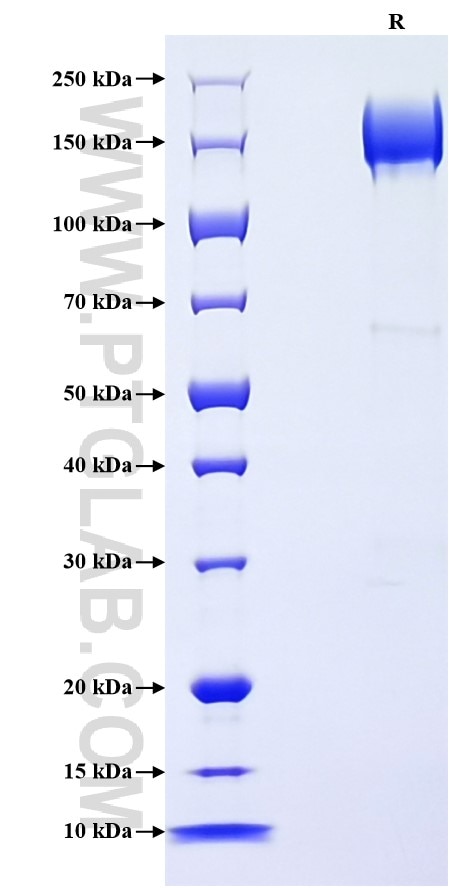
>90 %, SDS-PAGE
Tag
rFc Tag
Activity
not tested
Cat no : Eg3036
Validation Data Gallery
Product Information
| Purity | >90 %, SDS-PAGE |
| Endotoxin | <0.1 EU/μg protein, LAL method |
| Activity |
Not tested |
| Expression | HEK293-derived Mouse ACE protein Leu35-Gln1264 (Accession# P09470-1) with a rabbit IgG Fc tag at the C-terminus. |
| GeneID | 11421 |
| Accession | P09470-1 |
| PredictedSize | 167.9 kDa |
| SDS-PAGE | 140-200 kDa, reducing (R) conditions |
| Formulation | Lyophilized from 0.22 μm filtered solution in PBS, pH 7.4. Normally 5% trehalose and 5% mannitol are added as protectants before lyophilization. |
| Reconstitution | Briefly centrifuge the tube before opening. Reconstitute at 0.1-0.5 mg/mL in sterile water. |
| Storage Conditions |
It is recommended that the protein be aliquoted for optimal storage. Avoid repeated freeze-thaw cycles.
|
| Shipping | The product is shipped at ambient temperature. Upon receipt, store it immediately at the recommended temperature. |
Background
Angiotensin I Converting Enzyme (ACE) is a transmembrane zinc metallopeptidase that hydrolyzes peptide chains by removing the dipeptide from the C-terminus. ACE is a key component of the renin-angiotensin system (RAS), which plays an important role in blood pressure homeostasis through the production of the vasoconstrictor peptide angiotensin II. ACE also plays a role in fertility, immunity, hematopoiesis, and diseases such as obesity, fibrosis, and Alzheimer's disease dementia. ACE is relevant to immune regulation in that endogenous ACE has been detected in a variety of immune cell populations including macrophages and neutrophils, and its overexpression results in enhanced bactericidal and antitumor responses independent of angiotensin II.
References:
1. Oosthuizen D, et al. (2022). J Renin Angiotensin Aldosterone Syst. 2022:9028969.
2. Rahimi Z. (2012). J Nephropathol. 1(3):143-51.
3. Lubbe L,et al. (2020). Clin Sci (Lond). 134(21):2851-2871.