
Recombinant Mouse CD164 protein (rFc Tag)
Species
Mouse
Purity
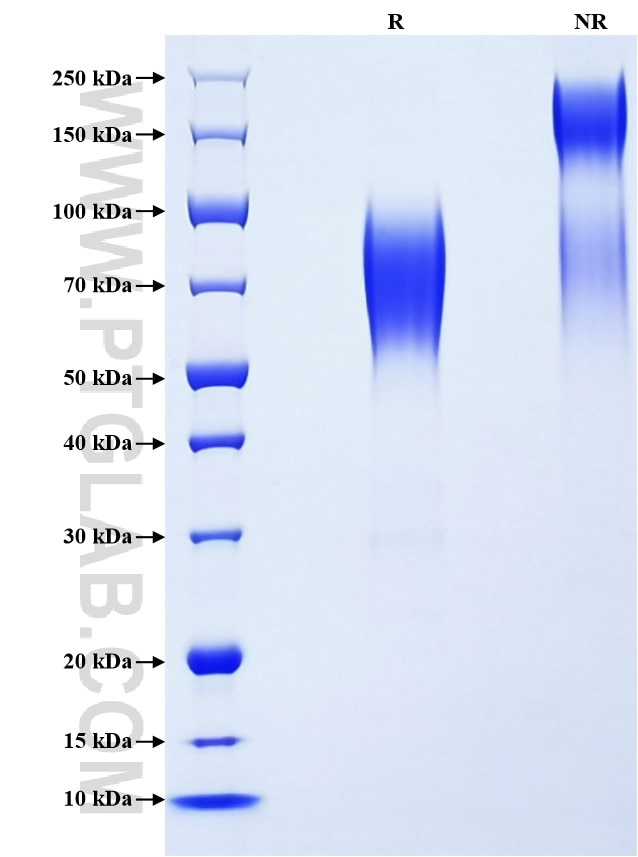
>90 %, SDS-PAGE
Tag
rFc Tag
Activity
not tested
Cat no : Eg2645
Validation Data Gallery
Product Information
| Purity | >90 %, SDS-PAGE |
| Endotoxin | <0.1 EU/μg protein, LAL method |
| Activity |
Not tested |
| Expression | HEK293-derived Mouse CD164 protein Gln24-Asp162 (Accession# Q9R0L9) with a rabbit IgG Fc tag at the C-terminus. |
| GeneID | 53599 |
| Accession | Q9R0L9 |
| PredictedSize | 40.8 kDa |
| SDS-PAGE | 52-100 kDa, reducing (R) conditions |
| Formulation | Lyophilized from 0.22 μm filtered solution in PBS, pH 7.4. Normally 5% trehalose and 5% mannitol are added as protectants before lyophilization. |
| Reconstitution | Briefly centrifuge the tube before opening. Reconstitute at 0.1-0.5 mg/mL in sterile water. |
| Storage Conditions |
It is recommended that the protein be aliquoted for optimal storage. Avoid repeated freeze-thaw cycles.
|
| Shipping | The product is shipped at ambient temperature. Upon receipt, store it immediately at the recommended temperature. |
Background
Sialomucins are a heterogeneous group of secreted or membrane-associated mucins that appear to play 2 key but opposing roles in vivo: first as cytoprotective or antiadhesive agents, and second as adhesion receptors. CD164 is a type I integral transmembrane sialomucin that functions as an adhesion receptor. Sialomucin CD164 (MUC-24), also referred to multi-glycosylated core protein 24 (MGC24), is known to function as a receptor that regulates stem cell localization to the bone marrow. CD164 may play a key role in hematopoiesis by facilitating the adhesion of CD34+ cells to the stroma and by negatively regulating CD34+CD38(lo/-) cell proliferation. Important role of CD164 in in prostate cancer metastasis, promoting myogenesis and regulating myoblast migration so far have been revealed.
References:
1.Watt SM, et al. (1998) Blood. 1;92(3):849-66.
2.Forde S, et al. (2007) Blood. 1;109(5):1825-33.
3.Zannettino AC, et al. (1998) Blood. 15;92(8):2613-28.
4.Havens AM, et al. (2006) BMC Cancer. 21;6:195.