
Recombinant Mouse CD226 protein (rFc Tag)
Species
Mouse
Purity
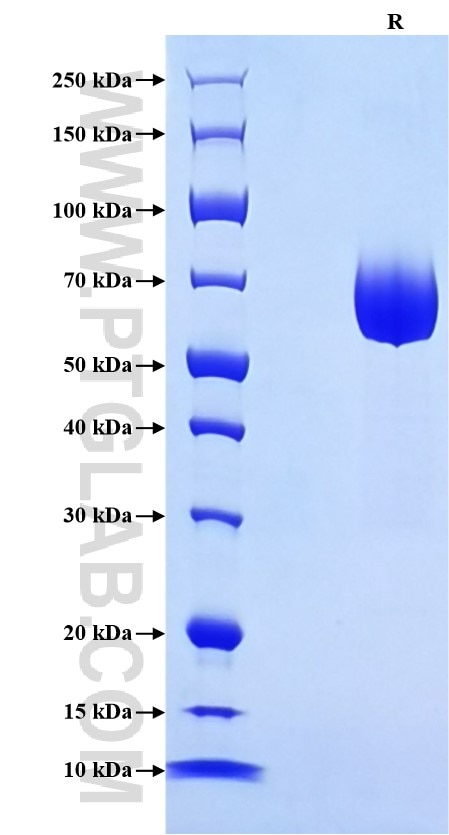
>90 %, SDS-PAGE
Tag
rFc Tag
Activity
not tested
Cat no : Eg1588
Validation Data Gallery
Product Information
| Purity | >90 %, SDS-PAGE |
| Endotoxin | <0.1 EU/μg protein, LAL method |
| Activity |
Not tested |
| Expression | HEK293-derived Mouse CD226 protein Glu19-Pro254 (Accession# Q8K4F0) with a rabbit IgG Fc tag at the C-terminus. |
| GeneID | 225825 |
| Accession | Q8K4F0 |
| PredictedSize | 53.1 kDa |
| SDS-PAGE | 55-70 kDa, reducing (R) conditions |
| Formulation | Lyophilized from 0.22 μm filtered solution in PBS, pH 7.4. Normally 5% trehalose and 5% mannitol are added as protectants before lyophilization. |
| Reconstitution | Briefly centrifuge the tube before opening. Reconstitute at 0.1-0.5 mg/mL in sterile water. |
| Storage Conditions |
It is recommended that the protein be aliquoted for optimal storage. Avoid repeated freeze-thaw cycles.
|
| Shipping | The product is shipped at ambient temperature. Upon receipt, store it immediately at the recommended temperature. |
Background
CD226 (DNAM-1) is a glycoprotein expressed on the surface of NK cells, platelets, monocytes and a subset of T cells. It is a member of the Ig-superfamily containing 2 Ig-like domains of the V-set. CD226 acts as an adhesion molecule guiding immune cells to bind to target cells and mediate the formation of immune synapses. It also mediates cytotoxicity and promotes the production of cytokines by transmitting intracellular signals. The protein also plays a role in megakaryocytic cell maturation. Interactions of CD226 and its ligands, CD155 and CD112, induce NK and T cell-mediated cytotoxicity and cytokine secretion.
References:
1. Chan CJ, et al. (2012). Curr Opin Immunol. 24(2):246-251.
2. Huang Z, et al. (2020). Front Cell Dev Biol. 8:564.
3. Tahara-Hanaoka S, et al. (2004). Int Immunol. 16(4):533-538.