
Recombinant Mouse IL-4 protein (rFc Tag)
Cat no : Eg3750
Validation Data Gallery
Product Information
| Purity | >90 %, SDS-PAGE |
| Endotoxin | <0.1 EU/μg protein, LAL method |
| Activity |
Not tested |
| Expression | HEK293-derived Mouse IL-4 protein His21-Ser140 (Accession# P07750) with a rabbit IgG Fc tag at the C-terminus. |
| GeneID | 16189 |
| Accession | P07750 |
| PredictedSize | 39.8 kDa |
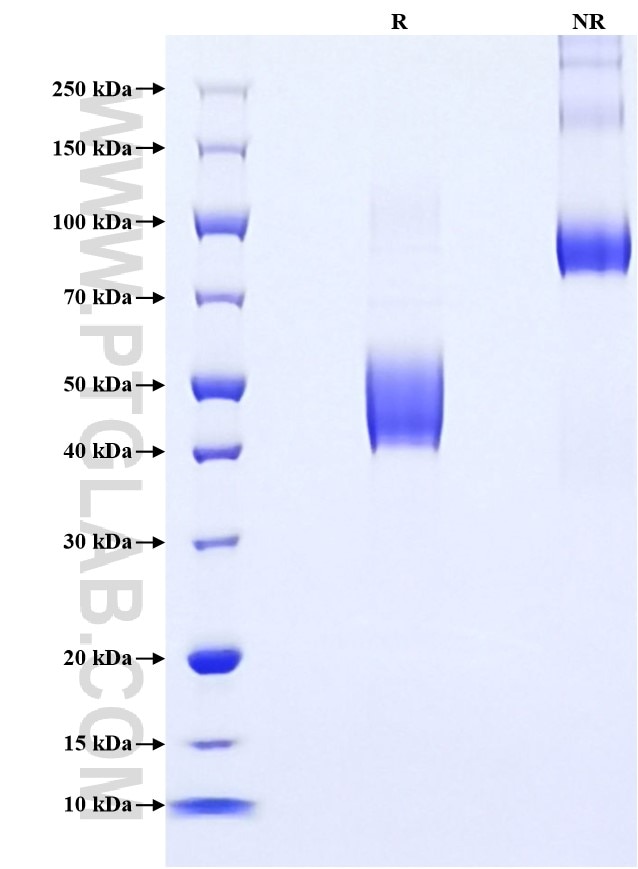
| SDS-PAGE | 40-55 kDa, reducing (R) conditions |
| Formulation | Lyophilized from 0.22 μm filtered solution in PBS, pH 7.4. Normally 5% trehalose and 5% mannitol are added as protectants before lyophilization. |
| Reconstitution | Briefly centrifuge the tube before opening. Reconstitute at 0.1-0.5 mg/mL in sterile water. |
| Storage Conditions |
It is recommended that the protein be aliquoted for optimal storage. Avoid repeated freeze-thaw cycles.
|
| Shipping | The product is shipped at ambient temperature. Upon receipt, store it immediately at the recommended temperature. |
Background
Interleukin-4 (IL-4), a member of the α-helical cytokine family, is produced by activated CD4 + T cells, basophils, and mast cells. It promotes the proliferation and differentiation of antigen presenting cells. IL-4 also plays a pivotal role in antibody isotype switching and stimulates the production of IgE. This cytokine has been applied in the treatment of autoimmune disorder like multiple myeloma, cancer, psoriasis, and arthritis. IL-4 has also been extensively applied to inhibit detrimental effect of Th1. It may promote the growth of epithelial tumors by mediating increased proliferation and survival.
References:
1. Scheller J. et al. (1988). Behring Inst Mitt. Behring Inst Mitt. (83):40-7.
2. Heinrich PC. et al. (2003). Biochem J. 374: 1-20.
3. Rose-John S. et al. (2007). Expert Opin Ther Targets. 11: 613-24.
4. Ming JE. et al. (1989). J Mol Cell Immunol. 4: 203-11.
5. Febbraio MA. et al. (2005). Exerc Sport Sci Rev. 33:114-9.
6. J Appl Physiol. et al. (2005). J Appl Physiol. 98:1154-62.
Publications
| Species | Title |
|---|---|
Cell Rep Macrophage glycine transporter supports IL-1β production by modulating the AKT1/mTOR/NLRP3 pathway. | |
Mediators Inflamm Bone Marrow-Derived Mesenchymal Stem Cells (BM-MSCs) and Small Intestinal Submucosa (SIS) Hydrogel Composite Can Meliorate TNBS-Induced Experimental Colitis Through Regulating Inhibiting Macrophage Polarization Toward the M1 Phenotype. | |
J Pharm Pharmacol Ferulic acid ameliorates metabolic dysfunction associated with fatty liver disease by regulating macrophage polarization through spermidine derived from gut microbiota. |