
Recombinant Mouse Midkine protein (mFc Tag)
Species
Mouse
Purity
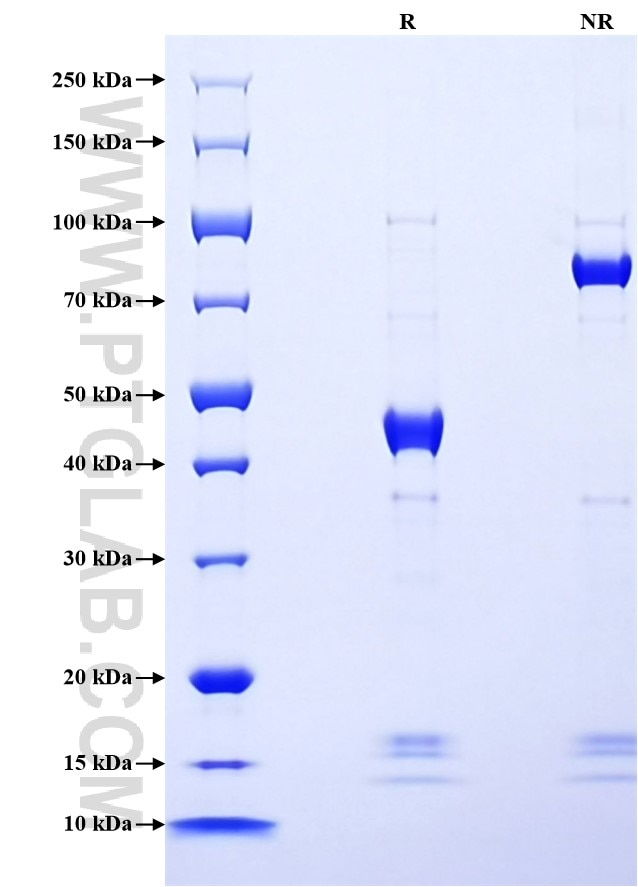
>90 %, SDS-PAGE
Tag
mFc Tag
Activity
not tested
Cat no : Eg3927
Validation Data Gallery
Product Information
| Purity | >90 %, SDS-PAGE |
| Endotoxin | <0.1 EU/μg protein, LAL method |
| Activity |
Not tested |
| Expression | HEK293-derived Mouse Mdk protein Lys23-Asp140 (Accession# P12025) with a mouse IgG Fc tag at the C-terminus. |
| GeneID | 17242 |
| Accession | P12025 |
| PredictedSize | 39.7 kDa |
| SDS-PAGE | 42-48 kDa, reducing (R) conditions |
| Formulation | Lyophilized from 0.22 μm filtered solution in PBS, pH 7.4. Normally 5% trehalose and 5% mannitol are added as protectants before lyophilization. |
| Reconstitution | Briefly centrifuge the tube before opening. Reconstitute at 0.1-0.5 mg/mL in sterile water. |
| Storage Conditions |
It is recommended that the protein be aliquoted for optimal storage. Avoid repeated freeze-thaw cycles.
|
| Shipping | The product is shipped at ambient temperature. Upon receipt, store it immediately at the recommended temperature. |
Background
Midkine (MK) is a heparin-binding growth factor and a cytokine, identified as a product of a retinoic acid-responsive gene involved in embryonic development. MK promotes cell survival, migration, differentiation, and growth, and is involved in various physiological and pathological processes such as neuronal development, tissue repair, inflammation, and malignancies. It is upregulated in numerous injured tissues and most human malignant tumors, suggesting its role in tissue repair and cancer progression. It also has been implicated in Alzheimer's disease, with increased levels in sera from patients, and is being explored as a potential biomarker and therapeutic target in various diseases.
References:
1.Muramatsu T. et al. (2010). Proc Jpn Acad Ser B Phys Biol Sci. 86(4):410-425.
2.Cai YQ. et al. (2020). Cytokine. 135:155242.
3.Weckbach LT. et al. (2011). ScientificWorldJournal. 11:2491-2505.
4.Jones DR. et al. (2014). Br J Pharmacol. 171(12):2925-2939.
5.Filippou PS. et al. (2020). Oncogene. 39(10):2040-2054.