


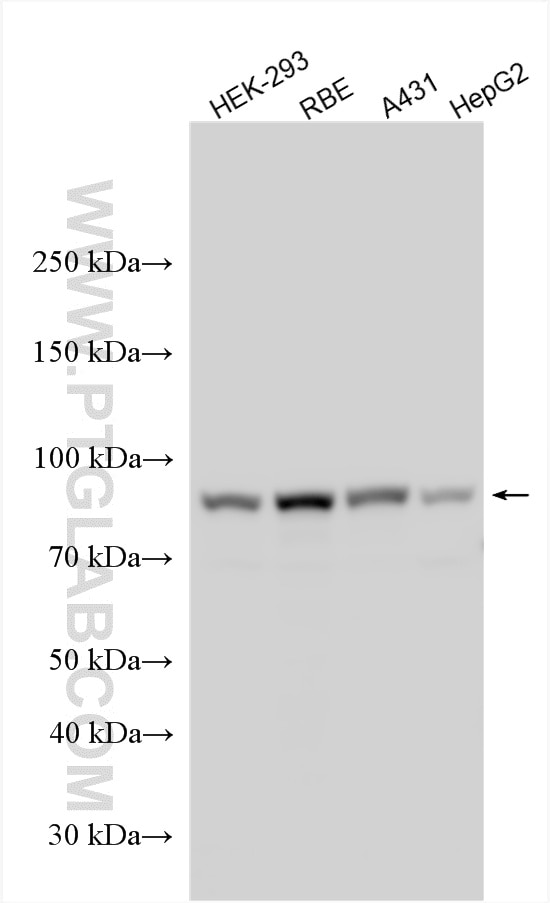



Tested Applications
| Positive WB detected in | HEK-293 cells, DU 145 cells, HeLa cells, RBE cells, A431 cells, HepG2 cells, PC-12 cells, mouse brain tissue, rat brain tissue |
| Positive IP detected in | HepG2 cells, mouse heart tissue |
| Positive IHC detected in | human prostate cancer tissue, human ovary tumor tissue Note: suggested antigen retrieval with TE buffer pH 9.0; (*) Alternatively, antigen retrieval may be performed with citrate buffer pH 6.0 |
| Positive IF/ICC detected in | HepG2 cells, A549 cells |
Recommended dilution
| Application | Dilution |
|---|---|
| Western Blot (WB) | WB : 1:5000-1:50000 |
| Immunoprecipitation (IP) | IP : 0.5-4.0 ug for 1.0-3.0 mg of total protein lysate |
| Immunohistochemistry (IHC) | IHC : 1:50-1:500 |
| Immunofluorescence (IF)/ICC | IF/ICC : 1:200-1:800 |
| It is recommended that this reagent should be titrated in each testing system to obtain optimal results. | |
| Sample-dependent, Check data in validation data gallery. | |
Product Information
24050-1-AP targets Glucocorticoid receptor in WB, IHC, IF/ICC, IP, CoIP, ChIP, IP-MS, ELISA, CUT&RUN applications and shows reactivity with human, mouse, rat samples.
| Tested Reactivity | human, mouse, rat |
| Cited Reactivity | human, mouse, rat, chicken, zebrafish, rare minnow |
| Host / Isotype | Rabbit / IgG |
| Class | Polyclonal |
| Type | Antibody |
| Immunogen |
CatNo: Ag21146 Product name: Recombinant human Glucocorticoid receptor protein Source: e coli.-derived, PGEX-4T Tag: GST Domain: 1-350 aa of BC015610 Sequence: MDSKESLTPGREENPSSVLAQERGDVMDFYKTLRGGATVKVSASSPSLAVASQSDSKQRRLLVDFPKGSVSNAQQPDLSKAVSLSMGLYMGETETKVMGNDLGFPQQGQISLSSGETDLKLLEESIANLNRSTSVPENPKSSASTAVSAAPTEKEFPKTHSDVSSEQQHLKGQTGTNGGNVKLYTTDQSTFDILQDLEFSSGSPGKETNESPWRSDLLIDENCLLSPLAGEDDSFLLEGNSNEDCKPLILPDTKPKIKDNGDLVLSSPSNVTLPQVKTEKEDFIELCTPGVIKQEKLGTVYCQASFPGANIIGNKMSAISVHGVSTSGGQMYHYDMNTASLSQQQDQKPI Predict reactive species |
| Full Name | nuclear receptor subfamily 3, group C, member 1 (glucocorticoid receptor) |
| Calculated Molecular Weight | 86 kDa |
| Observed Molecular Weight | 94-97 kDa |
| GenBank Accession Number | BC015610 |
| Gene Symbol | Glucocorticoid receptor |
| Gene ID (NCBI) | 2908 |
| RRID | AB_2813890 |
| Conjugate | Unconjugated |
| Form | Liquid |
| Purification Method | Antigen affinity purification |
| UNIPROT ID | P04150 |
| Storage Buffer | PBS with 0.02% sodium azide and 50% glycerol, pH 7.3. |
| Storage Conditions | Store at -20°C. Stable for one year after shipment. Aliquoting is unnecessary for -20oC storage. 20ul sizes contain 0.1% BSA. |
Background Information
Glucocorticoid receptor (GR, or GCR) also known as NR3C1 (nuclear receptor subfamily 3, group C, member 1) is a receptor for glucocorticoids, which owns a dual mode of action: as a transcription factor that binds to glucocorticoid response elements (GRE) and as a modulator of other transcription factors. It is involved in cell proliferation and differentiation and specifically implicated in newborn birth weight, thus providing a biological mechanism by which NR3C1 expression may influence birth weight (PMID:22810058).
Protocols
| Product Specific Protocols | |
|---|---|
| IF protocol for Glucocorticoid receptor antibody 24050-1-AP | Download protocol |
| IHC protocol for Glucocorticoid receptor antibody 24050-1-AP | Download protocol |
| IP protocol for Glucocorticoid receptor antibody 24050-1-AP | Download protocol |
| WB protocol for Glucocorticoid receptor antibody 24050-1-AP | Download protocol |
| Standard Protocols | |
|---|---|
| Click here to view our Standard Protocols |
Publications
What published studies show
The Glucocorticoid receptor Polyclonal antibody (Cat# 24050-1-AP) has 147 citations published in journals including Nature Communications, Cell Metabolism, Journal of Clinical Investigation, PNAS, Molecular Cell, Nucleic Acids Research, Science Advances, Cell Reports, and many others. Associated research fields encompass metabolism, stress and psychoneuroendocrinology, oncology, neuroscience, immunology, endocrinology, cardiovascular biology, and pharmacology, with applications spanning WB, ChIP, CoIP, IF, IHC, and IP.
| Species | Application | Title |
|---|---|---|
Cell Metab A macrophage-hepatocyte glucocorticoid receptor axis coordinates fasting ketogenesis. | ||
Cell Metab Individual-specific functional epigenomics reveals genetic determinants of adverse metabolic effects of glucocorticoids. | ||
Cell Stem Cell Vagal pathway activation links chronic stress to decline in intestinal stem cell function | ||
Bone Res Inhibition of sympathetic tone via hypothalamic descending pathway propagates glucocorticoid-induced endothelial impairment and osteonecrosis of the femoral head | ||
Nat Commun Stress during pubertal development affects female sociosexual behavior in mice | ||
Nat Commun Glucocorticoid activation of anti-inflammatory macrophages protects against insulin resistance |
Reviews
What customers say
Overall, users report positive performance for this antibody in Western Blot and Immunoprecipitation. Four out of five reviewers gave it 4–5 stars, noting a clean single band around 100 kDa in rat hippocampus and strong results in mouse brain tissue and Ac16 cell lines. One reviewer (2 stars) observed multiple non-specific bands when used on porcine brain endothelial cells, indicating cross-reactivity issues in that context. Common dilutions ranged from 1:10 to 1:500 depending on the application. In summary, the antibody performs reliably for its intended species and applications but may show non-specific binding in certain off-target cell types.
The reviews below have been submitted by verified Proteintech customers who received an incentive for providing their feedback.
Rachael (Verified Customer) (04-21-2026) | works nicely on the protein simple Abby system which a single peak around 100 kDa
|
Ping (Verified Customer) (06-04-2019) | This antibody works well for immunoprecipitation and western blot.
|
Yu Siong (Verified Customer) (04-23-2019) | Multiple bands observed - Total of 5 bands, not suitable for porcine brain endothelial cells, as non-specific binding tend to occur.Consistent in two Independent experiments
|
Praveen (Verified Customer) (02-25-2019) | WORKS VERY WELL.
|
Shubham (Verified Customer) (01-31-2019) | Antibody works great.
 |





