
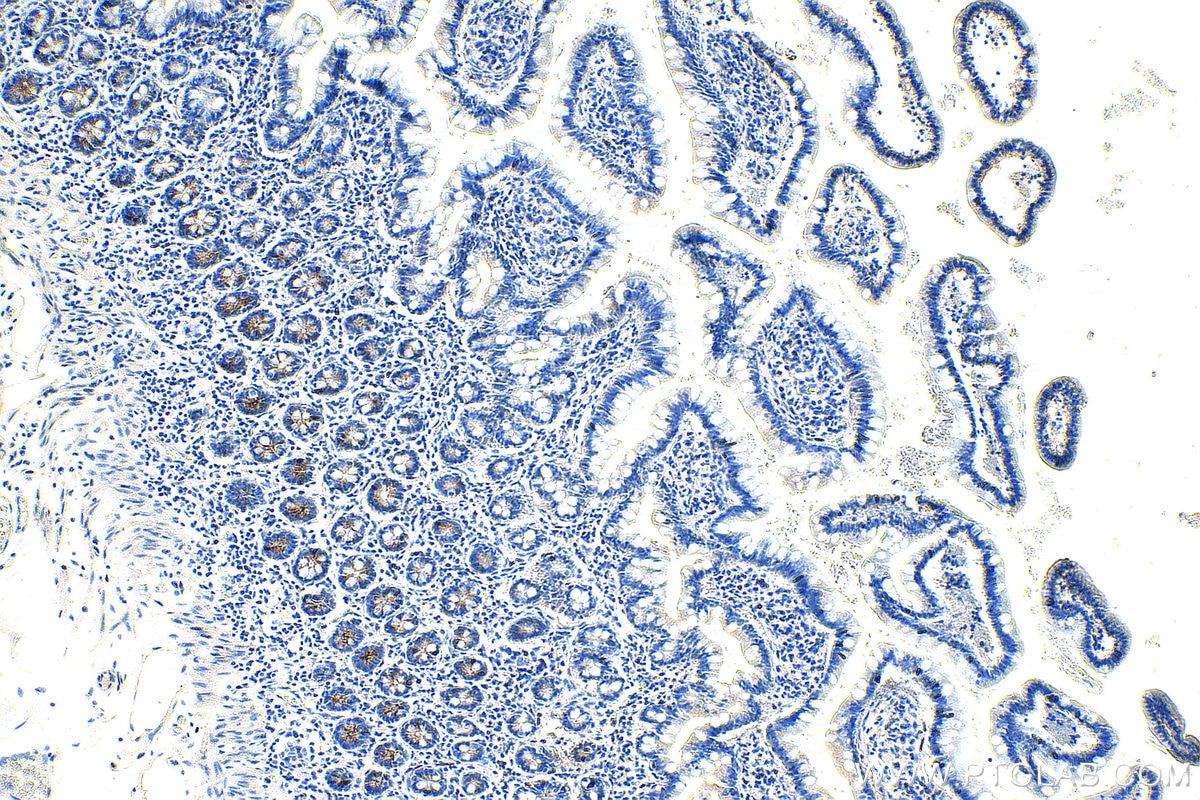
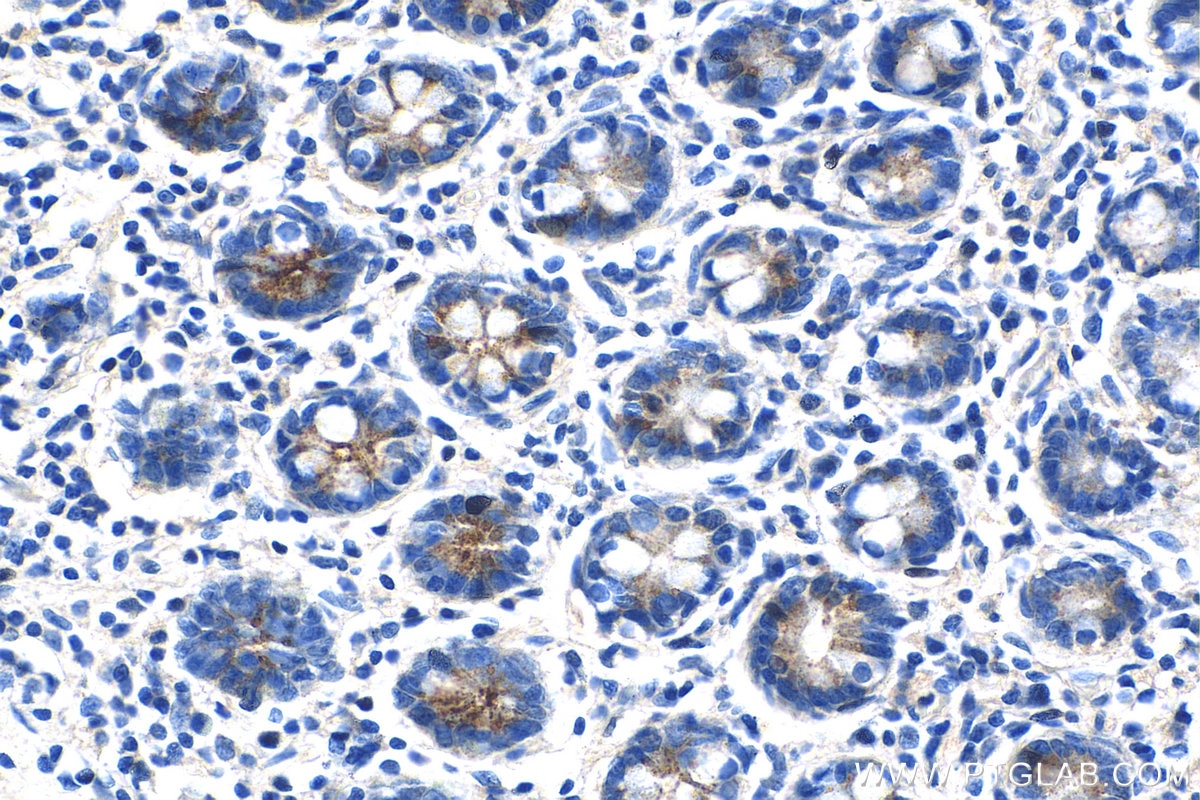

Tested Applications
| Positive IHC detected in | human small intestine tissue Note: suggested antigen retrieval with TE buffer pH 9.0; (*) Alternatively, antigen retrieval may be performed with citrate buffer pH 6.0 |
Recommended dilution
| Application | Dilution |
|---|---|
| Immunohistochemistry (IHC) | IHC : 1:500-1:2000 |
| It is recommended that this reagent should be titrated in each testing system to obtain optimal results. | |
| Sample-dependent, Check data in validation data gallery. | |
Product Information
28432-1-AP targets OLFM4 in WB, IHC, IF, ELISA applications and shows reactivity with Human samples.
| Tested Reactivity | Human |
| Cited Reactivity | human, mouse |
| Host / Isotype | Rabbit / IgG |
| Class | Polyclonal |
| Type | Antibody |
| Immunogen |
CatNo: Ag28914 Product name: Recombinant human OLFM4 protein Source: e coli.-derived, PGEX-4T Tag: GST Domain: 60-233 aa of NM_006418 Sequence: LGSGGSVSQLFSNFTGSVDDRGTCQCSVSLPDTTFPVDRVERLEFTAHVLSQKFEKELSKVREYVQLISVYEKKLLNLTVRIDIMEKDTISYTELDFELIKVEVKEMEKLVIQLKESFGGSSEIVDQLEVEIRNMTLLVEKLETLDKNNVLAIRREIVALKTKLKECEASKDQN Predict reactive species |
| Full Name | olfactomedin 4 |
| Calculated Molecular Weight | 57 kDa |
| GenBank Accession Number | NM_006418 |
| Gene Symbol | OLFM4 |
| Gene ID (NCBI) | 10562 |
| RRID | AB_2918163 |
| Conjugate | Unconjugated |
| Form | Liquid |
| Purification Method | Antigen affinity purification |
| UNIPROT ID | Q6UX06 |
| Storage Buffer | PBS with 0.02% sodium azide and 50% glycerol, pH 7.3. |
| Storage Conditions | Store at -20°C. Stable for one year after shipment. Aliquoting is unnecessary for -20oC storage. 20ul sizes contain 0.1% BSA. |
Background Information
Olfactomedin-4 (OLFM4), also named as hGC-1 (human G-CSF-stimulated clone-1) or antiapoptotic protein GW112, is a secreted glycoprotein normally expressed in bone marrow, prostate, small intestine, stomach, colon and pancreas (PMID: 11867215; PMID: 22471589). OLFM4 has been found to be up-regulated in gastrointestinal cancer and inflammatory disease including inflammatory bowel disease and H. pylori infection (PMID: 20534456). OLFM4 is involved in cellular process such as apoptosis, cell adhesion and tumor growth (PMID: 22471589; 16566923; 15059901).
Protocols
| Product Specific Protocols | |
|---|---|
| IHC protocol for OLFM4 antibody 28432-1-AP | Download protocol |
| Standard Protocols | |
|---|---|
| Click here to view our Standard Protocols |
Publications
What published studies show
The OLFM4 antibody (Cat# 28432-1-AP) has 7 total citations published in journals including Nature Communications, Journal of Nanobiotechnology, Advanced Science, Cancer Letters, Oncogene, Cell Reports, and Tissue Cell. Research fields span brown adipose tissue innervation, radioprotection via nanoparticles, N-glycosylation in colorectal cancer, ampullary adenocarcinoma classification, EMT in gallbladder carcinogenesis, PKR/RNA biology, and age-related colon mucosal changes. Applications include WB, IF, and IHC in human and mouse samples.
| Species | Application | Title |
|---|---|---|
Nat Commun Brown adipose tissue secretes OLFM4 to coordinate sensory and sympathetic innervation via Schwann cells | ||
J Nanobiotechnology Diselenide-based nanoparticles enhancing the radioprotection to the small intestine of mice. | ||
Adv Sci (Weinh) Deciphering the Metabolic Impact and Clinical Relevance of N-Glycosylation in Colorectal Cancer through Comprehensive Glycoproteomic Profiling | ||
Oncogene Olfactomedin 4 orchestrates TGF-β/CEACAM6 axis, promoting cell-autonomous epithelial to mesenchymal transition during gallbladder epithelium carcinogenesis.
| ||



