
Product Information
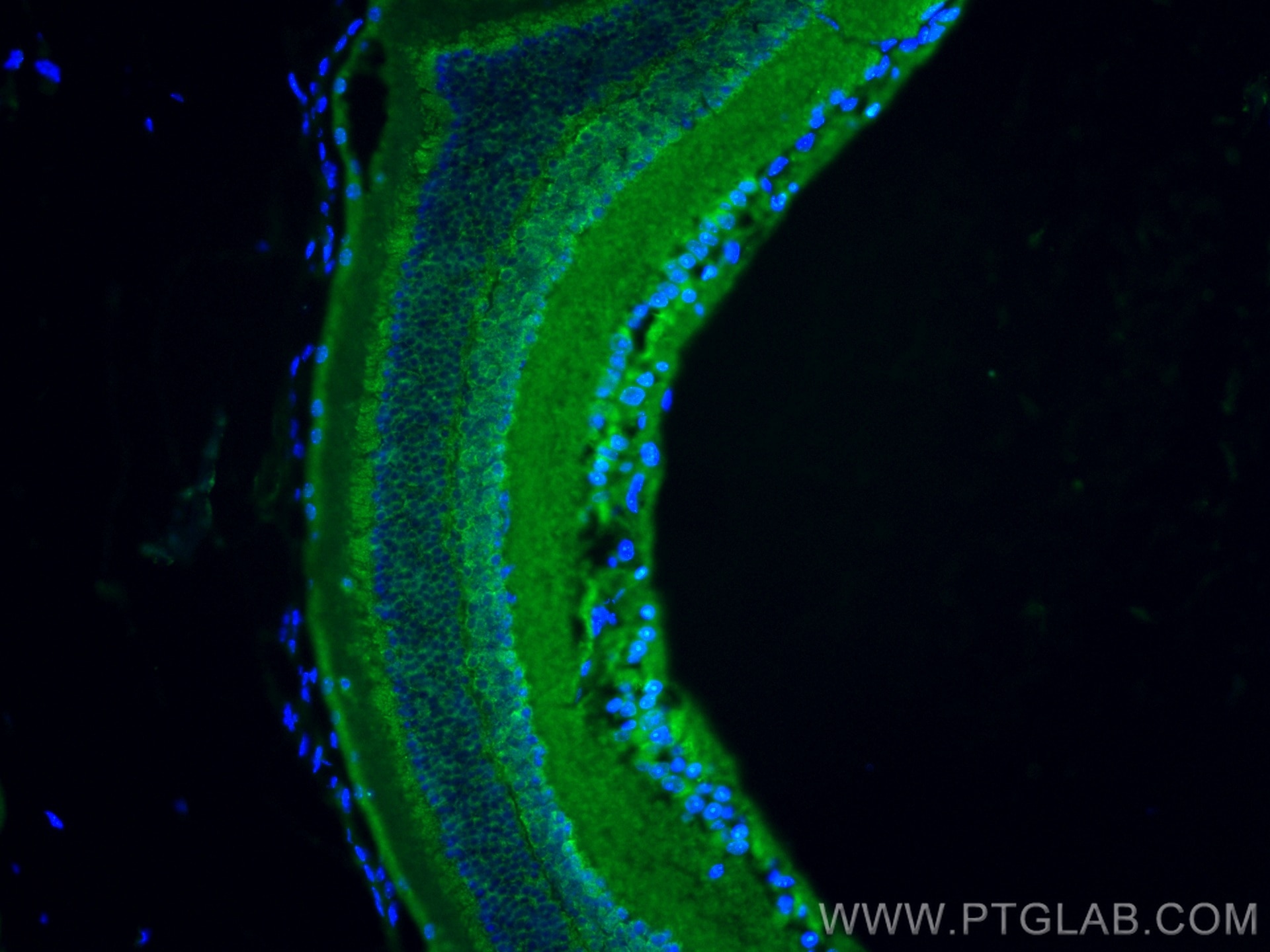
24478-1-PBS targets OPN4 in IF-P, Indirect ELISA applications and shows reactivity with human, mouse samples.
| Tested Reactivity | human, mouse |
| Host / Isotype | Rabbit / IgG |
| Class | Polyclonal |
| Type | Antibody |
| Immunogen |
CatNo: Ag21643 Product name: Recombinant human OPN4 protein Source: e coli.-derived, PGEX-4T Tag: GST Domain: 356-478 aa of BC113558 Sequence: KYRVAIAQHLPCLGVLLGVSRRHSRPYPSYRSTHRSTLTSHTSNLSWISIRRRQESLGSESEVGWTHMEAAAVWGAAQQANGRSLYGQGLEDLEAKAPPRPQGHEAETPGKTKGLIPSQDPRM Predict reactive species |
| Full Name | opsin 4 |
| Calculated Molecular Weight | 478 aa, 53 kDa |
| GenBank Accession Number | BC113558 |
| Gene Symbol | OPN4 |
| Gene ID (NCBI) | 94233 |
| RRID | AB_3085736 |
| Conjugate | Unconjugated |
| Form | Liquid |
| Purification Method | Antigen affinity purification |
| UNIPROT ID | Q9UHM6 |
| Storage Buffer | PBS only, pH 7.3. |
| Storage Conditions | Store at -80°C. |
Background Information
OPN4, an opsin that was first isolated from the skin of Xenopus laevis in 1998, belongs not to the vertebrate-type opsin family but rather to the invertebrate-type opsins, which are part of the seven-transmembrane G protein-coupled receptor (GPCR) family (PMID:31989708). In humans, OPN4 is expressed in the retinal ganglion cells in addition to part of the brain (PMID:10632589). Moreover, Opn4 functions as a photoreceptor by detecting brightness levels and discriminating visual signals (PMID:22633808). Opn4 also facilitates visual circuits to acquire optimal settings and light adaptation by measuring irradiance levels (PMID:25517373).


