
Tested Applications
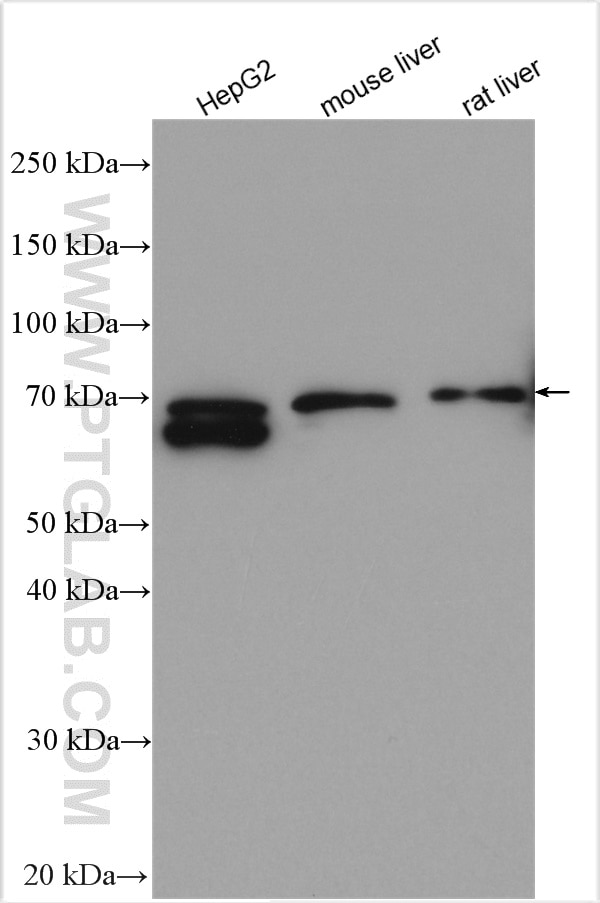
| Positive WB detected in | HepG2 cells, rat liver tissue, mouse liver tissue |
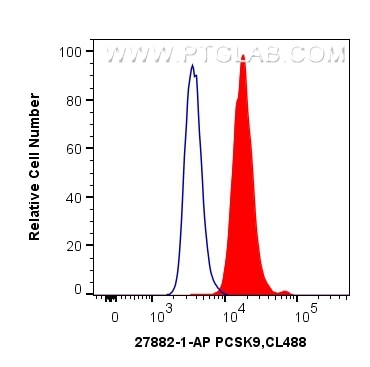
| Positive FC (Intra) detected in | HepG2 cells |
Recommended dilution
| Application | Dilution |
|---|---|
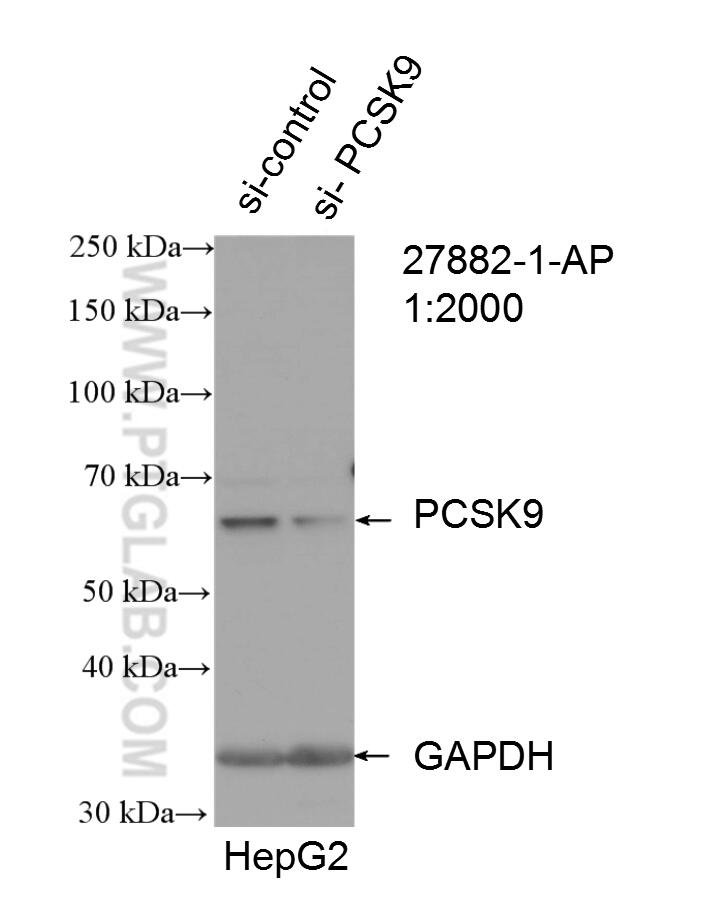
| Western Blot (WB) | WB : 1:500-1:2000 |
| Flow Cytometry (FC) (INTRA) | FC (INTRA) : 0.40 ug per 10^6 cells in a 100 µl suspension |
| It is recommended that this reagent should be titrated in each testing system to obtain optimal results. | |
| Sample-dependent, Check data in validation data gallery. | |
Published Applications
| KD/KO | See 1 publications below |
| WB | See 14 publications below |
| IHC | See 5 publications below |
| IF | See 4 publications below |
Product Information
27882-1-AP targets PCSK9 in WB, IHC, IF, FC (Intra), ELISA applications and shows reactivity with human samples.
| Tested Reactivity | human |
| Cited Reactivity | human |
| Host / Isotype | Rabbit / IgG |
| Class | Polyclonal |
| Type | Antibody |
| Immunogen |
CatNo: Ag27254 Product name: Recombinant human PCSK9 protein Source: e coli.-derived, PGEX-4T Tag: GST Domain: 476-692 aa of NM_174936.3 Sequence: MRCAPDEELLSCSSFSRSGKRRGERMEAQGGKLVCRAHNAFGGEGVYAIARCCLLPQANCSVHTAPPAEASMGTRVHCHQQGHVLTGCSSHWEVEDLGTHKPPVLRPRGQPNQCVGHREASIHASCCHAPGLECKVKEHGIPAPQEQVTVACEEGWTLTGCSALPGTSHVLGAYAVDNTCVVRSRDVSTTGSTSEGAVTAVAICCRSRHLAQASQELQ Predict reactive species |
| Full Name | proprotein convertase subtilisin/kexin type 9 |
| Calculated Molecular Weight | 74 kDa |
| Observed Molecular Weight | 72-78 kDa, 62 kDa |
| GenBank Accession Number | NM_174936.3 |
| Gene Symbol | PCSK9 |
| Gene ID (NCBI) | 255738 |
| RRID | AB_2918134 |
| Conjugate | Unconjugated |
| Form | Liquid |
| Purification Method | Antigen affinity purification |
| UNIPROT ID | Q8NBP7 |
| Storage Buffer | PBS with 0.02% sodium azide and 50% glycerol, pH 7.3. |
| Storage Conditions | Store at -20°C. Stable for one year after shipment. Aliquoting is unnecessary for -20oC storage. 20ul sizes contain 0.1% BSA. |
Background Information
Proprotein convertase subtilisin/kexin type 9 (PCSK9) is a crucial protein governing the circulating levels of low density lipoprotein-cholesterol (LDL-C), by virtue of its pivotal role in the degradation of the LDL receptor (LDLR). PCSK9 is expressed in the kidney and lung. It is synthesized as a 72 kDa immature precursor that undergoes autocatalytic cleavage in the endoplasmic reticulum to generate a 63 kDa mature protein. The cleaved N-terminal fragment remains associated with the mature protein and is necessary for its secretion, allowing it to circulate in the blood. The ability of PCSK9 to regulate a diverse group of cell-surface proteins hinted that it might also be able to influence additional membrane proteins that are important in anti-tumour immune responses. Targeting PCSK9 to treat cancer is also attractive because two neutralizing antibodies against it, evolocumab and alirocumab, have already been approved for human clinical use to lower cholesterol levels. (PMID: 30522786, PMID: 22493497)
Protocols
| Product Specific Protocols | |
|---|---|
| FC protocol for PCSK9 antibody 27882-1-AP | Download protocol |
| WB protocol for PCSK9 antibody 27882-1-AP | Download protocol |
| Standard Protocols | |
|---|---|
| Click here to view our Standard Protocols |
Publications
| Species | Application | Title |
|---|---|---|
Phytomedicine LW-213, a derivative of wogonin, triggers reticulophagy-mediated cell death in NSCLC via lysosomal damage combined with NPC1 inhibition | ||
Biochimie High-salt diet induces dyslipidemia through the SREBP2/PCSK9 pathway in dahl salt-sensitive rats | ||
bioRxiv Effect of Total Sphingomyelin Synthase Activity on Low Density Lipoprotein Catabolism in Mice | ||
Int J Mol Sci Protective Effects of Dioscin and Diosgenin on Plateau Hyperuricemia by Attenuating Renal Inflammation via EPHX2 | ||
PeerJ Serum PCSK9 is a novel serological biomarker for the diagnosis and prognosis of pancreatic cancer | ||
Biochim Biophys Acta Mol Cell Res Proprotein convertase subtilisin/kexin type 9 contributes to cisplatin-induced acute kidney injury by interacting with cyclase-associated protein 1 to promote megalin lysosomal degradation |




