
Product Information
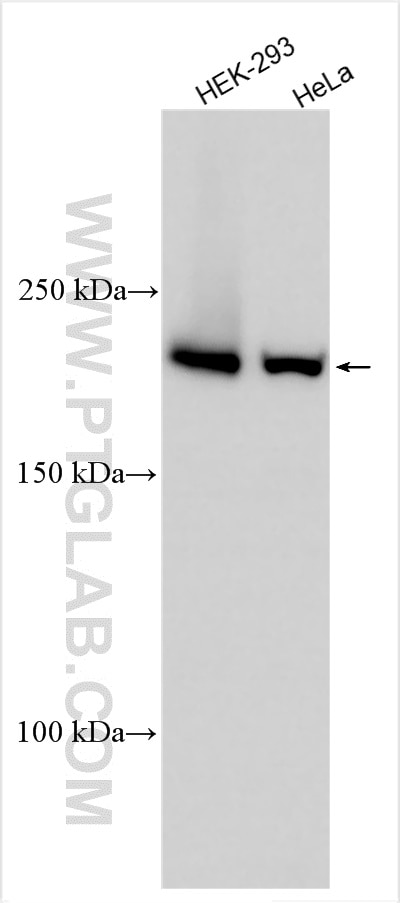
31405-1-PBS targets PDCD11 in WB, Indirect ELISA applications and shows reactivity with human samples.
| Tested Reactivity | human |
| Host / Isotype | Rabbit / IgG |
| Class | Polyclonal |
| Type | Antibody |
| Immunogen |
CatNo: Ag35402 Product name: Recombinant human PDCD11 protein Source: e coli.-derived, PGEX-4T Tag: GST Domain: 1290-1480 aa of BC049838 Sequence: DNVLTLSLRSSRTNPETKSKVEDPEINSIQDIKEGQLLRGYVGSIQPHGVFFRLGPSVVGLARYSHVSQHSPSKKALYNKHLPEGKLLTARVLRLNHQKNLVELSFLPGDTGKPDVLSASLEGQLTKQEERKTEAEERDQKGEKKNQKRNEKKNQKGQEEVEMPSKEKQQPQKPQAQKRGGRECRESGSEQ Predict reactive species |
| Full Name | programmed cell death 11 |
| Observed Molecular Weight | 209 kDa |
| GenBank Accession Number | BC049838 |
| Gene Symbol | PDCD11 |
| Gene ID (NCBI) | 22984 |
| RRID | AB_3669967 |
| Conjugate | Unconjugated |
| Form | Liquid |
| Purification Method | Antigen affinity Purification |
| UNIPROT ID | Q14690 |
| Storage Buffer | PBS only, pH 7.3. |
| Storage Conditions | Store at -80°C. |
Background Information
PDCD11, also known as ALG-4, RRP5, or NFBP, possesses a series of S1 RNA-binding domains in the N-terminus with approximately 1,400 amino acids, followed by a tetratricopeptide repeat (TPR) domain in the C-terminus. Through S1 N-terminal domains, PDCD11 interacts with pre-rRNA to coordinate rRNA processing and assembly in the nucleolus. It also binds to Exonuclease-1 and upregulates Fas to induce cell apoptosis. Recently, PDCD11 was proved to interact with NF-κB subunits to suppress the expression of inflammatory cytokines and activate the TGFβ1 pathway, thereby modulating microglia differentiation during zebrafish development.(PMID: 38062028)


