

Tested Applications
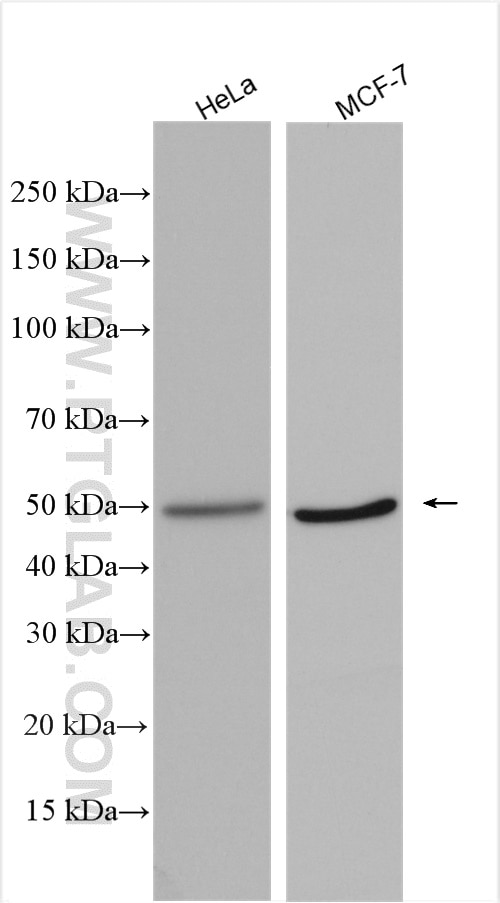
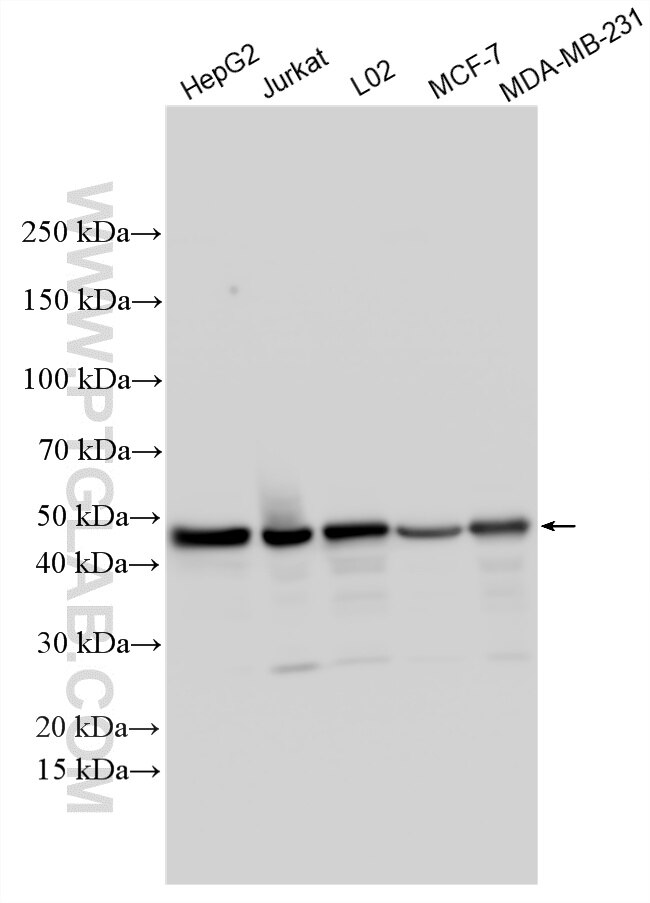
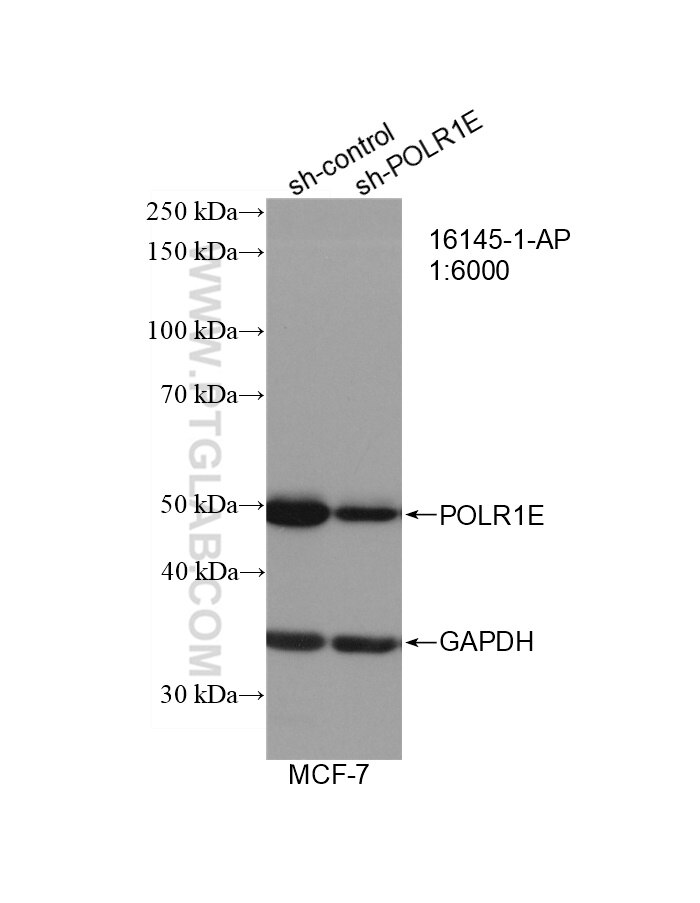
| Positive WB detected in | HepG2 cells, HeLa cells, MCF-7 cells, Jurkat cells, L02 cells, MDA-MB-231 cells |
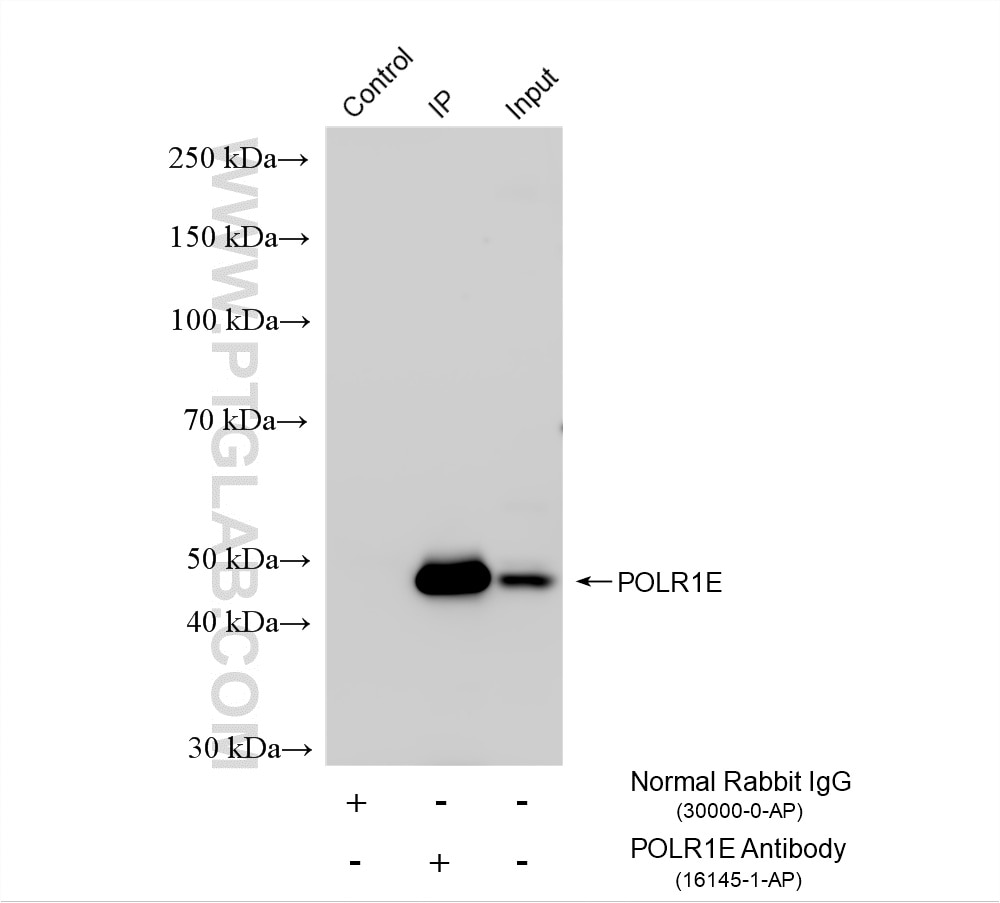
| Positive IP detected in | HepG2 cells |
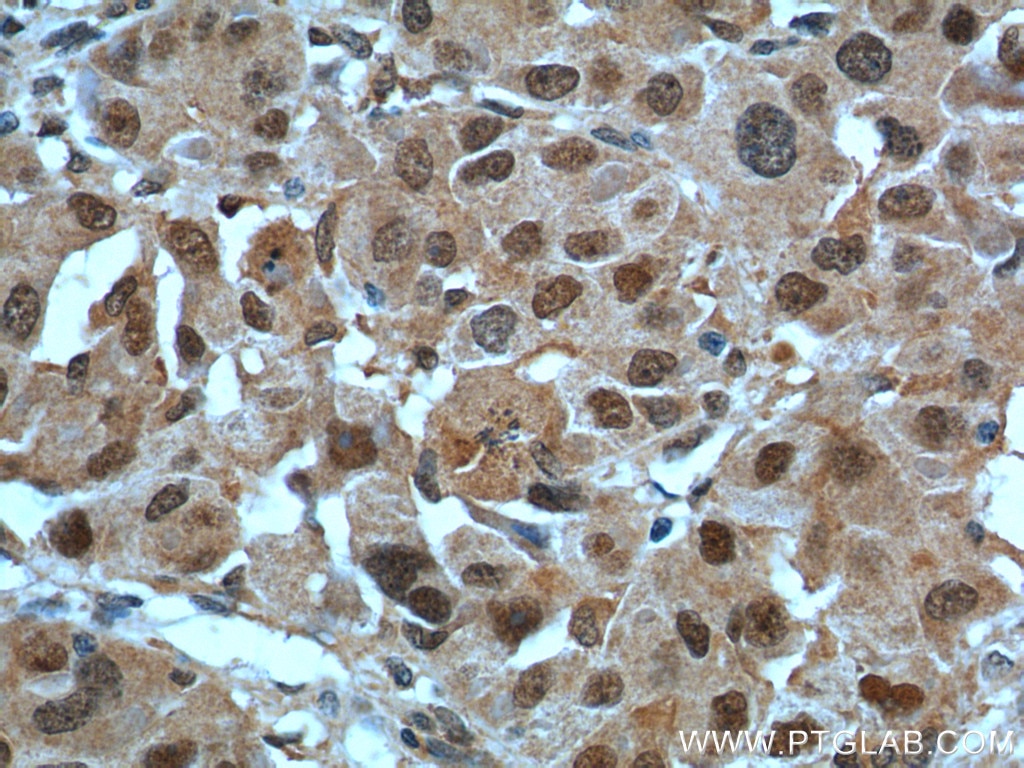
| Positive IHC detected in | human liver cancer tissue Note: suggested antigen retrieval with TE buffer pH 9.0; (*) Alternatively, antigen retrieval may be performed with citrate buffer pH 6.0 |
Recommended dilution
| Application | Dilution |
|---|---|
| Western Blot (WB) | WB : 1:5000-1:50000 |
| Immunoprecipitation (IP) | IP : 0.5-4.0 ug for 1.0-3.0 mg of total protein lysate |
| Immunohistochemistry (IHC) | IHC : 1:20-1:200 |
| It is recommended that this reagent should be titrated in each testing system to obtain optimal results. | |
| Sample-dependent, Check data in validation data gallery. | |
Product Information
16145-1-AP targets POLR1E in WB, IHC, IF, IP, ChIP, ELISA applications and shows reactivity with human, mouse, rat samples.
| Tested Reactivity | human, mouse, rat |
| Cited Reactivity | human, mouse |
| Host / Isotype | Rabbit / IgG |
| Class | Polyclonal |
| Type | Antibody |
| Immunogen |
CatNo: Ag9269 Product name: Recombinant human POLR1E protein Source: e coli.-derived, PGEX-4T Tag: GST Domain: 104-419 aa of BC014331 Sequence: AELFNMQPLFSDVSVESELALESQTKTYREKMDSCIEAFGTTKQKRALNTRRMNRVGNESLNRAVAKAAETIIDTKGVTALVSDAIHNDLQDDSLYLPPCYDDAAKPEDVYKFEDLLSPAEYEALQSPSEAFRNVTSEEILKMIEENSHCTFVIEALKSLPSDVESRDRQARCIWFLDTLIKFRAHRVVKRKSALGPGVPHIINTKLLKHFTCLTYNNGRLRNLISDSMKAKITAYVIILALHIHDFQIDLTVLQRDLKLSEKRMMEIAKAMRLKISKRKVSVAAGSEEDHKLGTLSLPLPPAQTSDRLAKRRKIT Predict reactive species |
| Full Name | polymerase (RNA) I polypeptide E, 53kDa |
| Calculated Molecular Weight | 481aa,54 kDa; 419aa,47 kDa |
| Observed Molecular Weight | 47-53 kDa |
| GenBank Accession Number | BC014331 |
| Gene Symbol | POLR1E |
| Gene ID (NCBI) | 64425 |
| RRID | AB_2167341 |
| Conjugate | Unconjugated |
| Form | Liquid |
| Purification Method | Antigen affinity purification |
| UNIPROT ID | Q9GZS1 |
| Storage Buffer | PBS with 0.02% sodium azide and 50% glycerol, pH 7.3. |
| Storage Conditions | Store at -20°C. Stable for one year after shipment. Aliquoting is unnecessary for -20oC storage. 20ul sizes contain 0.1% BSA. |
Protocols
| Product Specific Protocols | |
|---|---|
| IHC protocol for POLR1E antibody 16145-1-AP | Download protocol |
| IP protocol for POLR1E antibody 16145-1-AP | Download protocol |
| WB protocol for POLR1E antibody 16145-1-AP | Download protocol |
| Standard Protocols | |
|---|---|
| Click here to view our Standard Protocols |
Publications
What published studies show
The antibody (catalog #16145-1-AP) targets the RNA Polymerase I catalytic subunit. It has 9 total citations published in journals including Science, J Biol Chem (×3), Int J Biol Macromol, Mol Biol Cell, PLoS One, Cancer Invest, and Biol Reprod. Research fields span Pol I transcription regulation, rDNA processing, nucleolar dynamics, mitosis, cancer/leukemia, and oocyte development. Applications cited include WB, IF, and ChIP.
| Species | Application | Title |
|---|---|---|
Science lncRNA SLERT controls phase separation of FC/DFCs to facilitate Pol I transcription. | ||
Int J Biol Macromol Silencing of human RNA polymerase I subunit A34 influences multiple cellular processes including rDNA transcription and cell migration. | ||
J Biol Chem PAF49: An RNA Polymerase I subunit essential for rDNA transcription and stabilization of PAF53 | ||
J Biol Chem Identification of an E3 ligase that targets the catalytic subunit of RNA polymerase I upon transcription stress | ||
J Biol Chem Conditional depletion of the RNA polymerase I subunit PAF53 reveals that it is essential for mitosis and enables identification of functional domains. | ||
Mol Biol Cell Nucleoli and the nucleoli-centromere association are dynamic during normal development and in cancer |
Reviews
What customers say
The single review for this product reports a 5-star rating for Western Blot. The user observed a clear single band with a very strong signal at a 1:1000 dilution in B cell lines, and noted the result changed as expected following proteomics treatment. Overall, the feedback highlights strong specificity and signal intensity.
The reviews below have been submitted by verified Proteintech customers who received an incentive for providing their feedback.
Annabel (Verified Customer) (02-12-2026) | Clear single band and very strong signal, changed as expected from proteomics
|






