
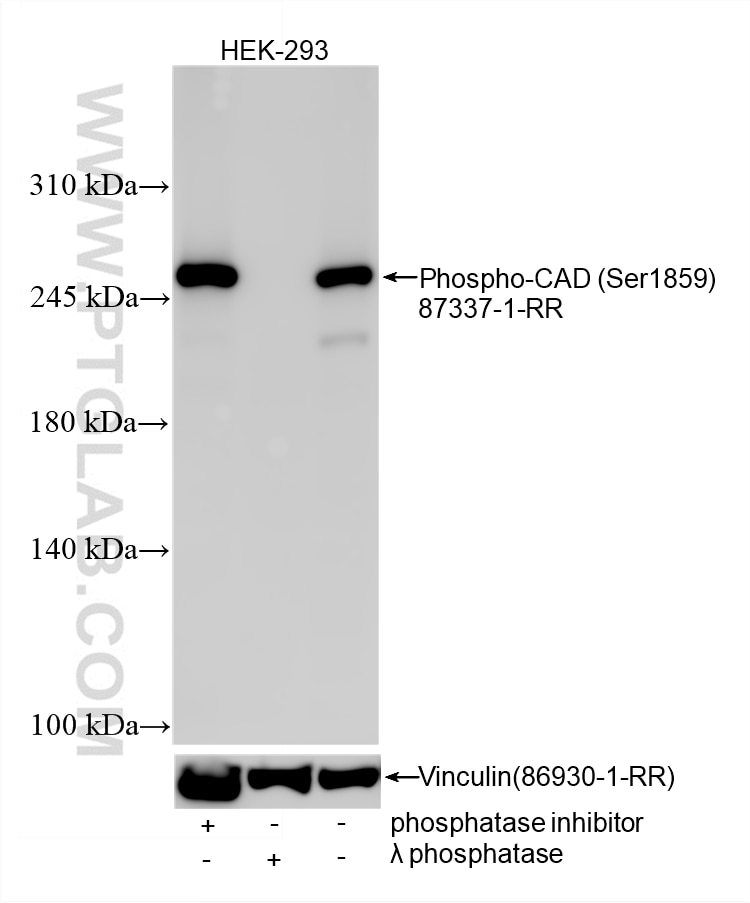
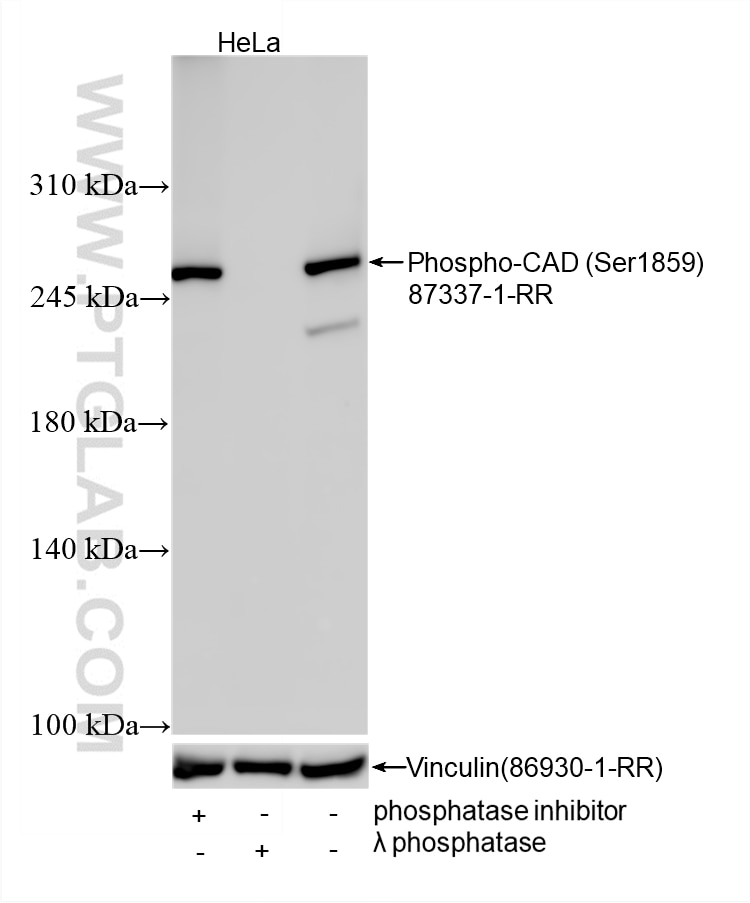
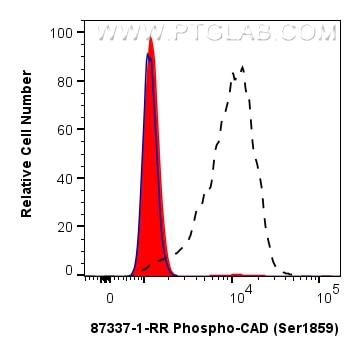

Product Information
87337-1-PBS targets Phospho-CAD (Ser1859) in WB, FC (Intra), Indirect ELISA applications and shows reactivity with human samples.
| Tested Reactivity | human |
| Host / Isotype | Rabbit / IgG |
| Class | Recombinant |
| Type | Antibody |
| Immunogen |
Peptide Predict reactive species |
| Full Name | carbamoyl-phosphate synthetase 2, aspartate transcarbamylase, and dihydroorotase |
| Calculated Molecular Weight | 2225 aa, 243 kDa |
| Observed Molecular Weight | 250 kDa |
| GenBank Accession Number | NM_004341 |
| Gene Symbol | CAD |
| Gene ID (NCBI) | 790 |
| RRID | AB_3745476 |
| Conjugate | Unconjugated |
| Form | Liquid |
| Purification Method | Protein A purification |
| UNIPROT ID | P27708 |
| Storage Buffer | PBS only, pH 7.3. |
| Storage Conditions | Store at -80°C. |
Background Information
CAD (carbamoyl-phosphate synthetase 2, aspartate transcarbamoylase, and dihydroorotase) is a multifunctional enzyme required for the de novo synthesis of pyrimidine nucleotides. Phospho-CAD (Ser1859) is a phosphorylated form of the CAD (carbamoyl-phosphate synthetase 2, aspartate transcarbamylase, and dihydroorotase) enzyme at Serine 1859. This site is specifically phosphorylated by mTOR complex 1 (mTORC1), acting through the downstream kinase S6K1, and plays a role in regulating pyrimidine biosynthesis. The phosphorylation of CAD at Ser1859 is a part of the PI3K-AKT-mTORC1-S6K1 pathway that integrates growth signals to regulate cell growth, proliferation, and homeostasis by modulating several anabolic and catabolic processes.In addition, insulin also stimulates the Ser1859 phosphorylation of CAD in a manner sensitive to rapamycin as well as phosphatase and tensin homolog (PTEN) deletion in the PI3K-AKT pathway. (PMID:25422319, PMID: 34638594)




