
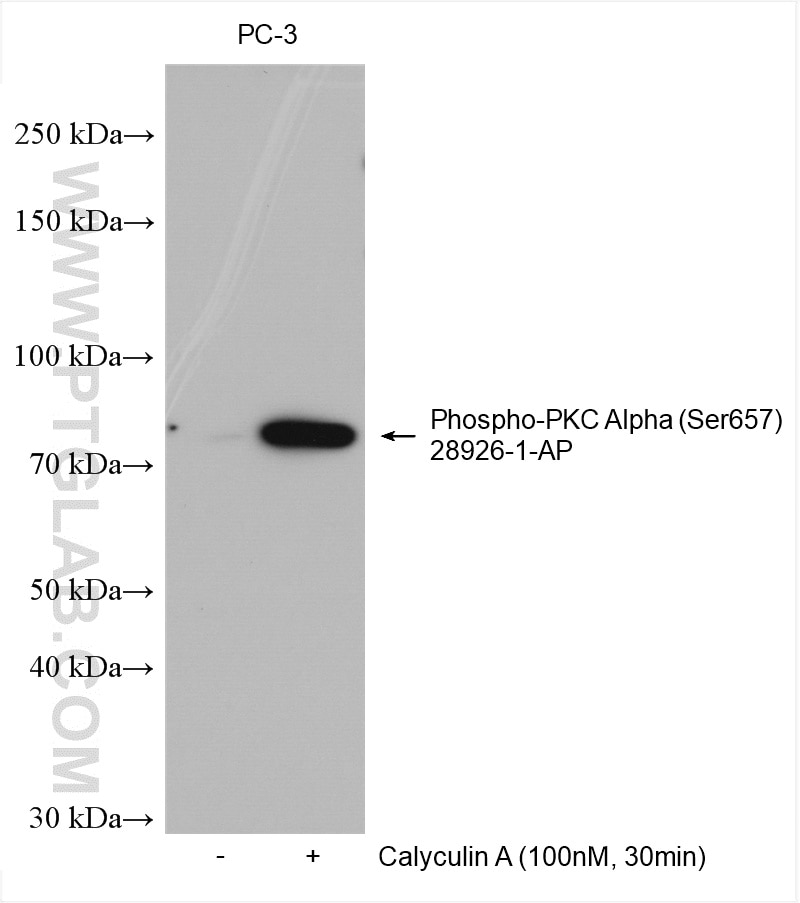
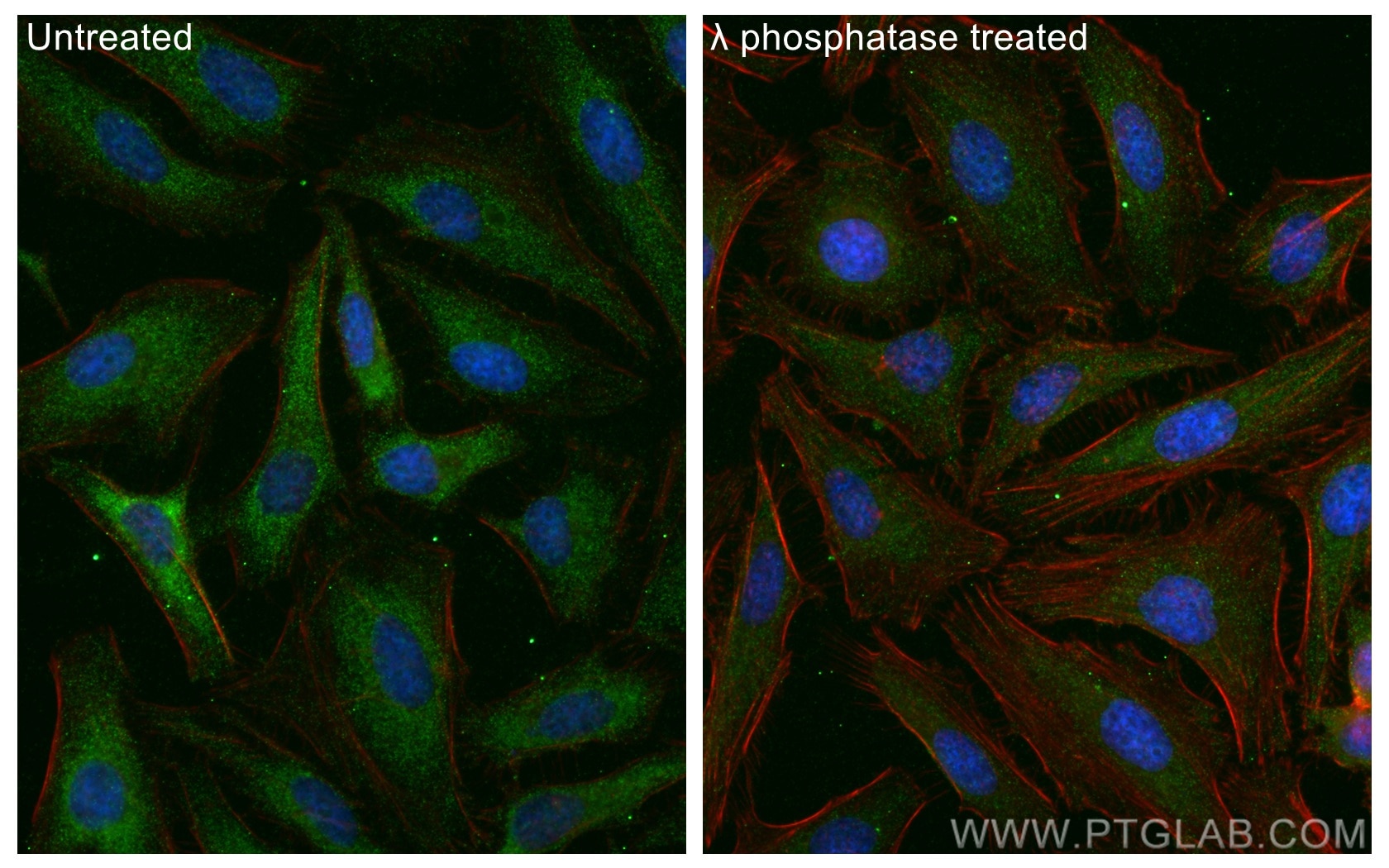

Tested Applications
| Positive WB detected in | Calyculin A treated PC-3 cells |
| Positive IF/ICC detected in | HeLa cells |
Recommended dilution
| Application | Dilution |
|---|---|
| Western Blot (WB) | WB : 1:500-1:3000 |
| Immunofluorescence (IF)/ICC | IF/ICC : 1:200-1:800 |
| It is recommended that this reagent should be titrated in each testing system to obtain optimal results. | |
| Sample-dependent, Check data in validation data gallery. | |
Product Information
28926-1-AP targets Phospho-PKC Alpha (Ser657) in WB, IF/ICC, ELISA applications and shows reactivity with human samples.
| Tested Reactivity | human |
| Cited Reactivity | human, mouse |
| Host / Isotype | Rabbit / IgG |
| Class | Polyclonal |
| Type | Antibody |
| Immunogen |
Peptide Predict reactive species |
| Full Name | protein kinase C, alpha |
| Calculated Molecular Weight | 77 kDa |
| Observed Molecular Weight | 77 kDa |
| GenBank Accession Number | AK055431 |
| Gene Symbol | PKC Alpha |
| Gene ID (NCBI) | 5578 |
| RRID | AB_2918214 |
| Conjugate | Unconjugated |
| Form | Liquid |
| Purification Method | Antigen affinity purification |
| UNIPROT ID | P17252 |
| Storage Buffer | PBS with 0.02% sodium azide and 50% glycerol, pH 7.3. |
| Storage Conditions | Store at -20°C. Stable for one year after shipment. Aliquoting is unnecessary for -20oC storage. 20ul sizes contain 0.1% BSA. |
Background Information
PKCs are a family of serine/threonine kinases involved in various processes in cells including proliferation, differentiation, cell survival, and apoptosis. PKC family is composed of three different subgroups: conventional (cPKC), the novel (nPKC) and atypical (aPKC). PKCα, β1, β2, and γ belong to cPKC, PKCδ, ε, η and θ are nPKC, whereas aPKC comprises of PKCζ and λ/ι. All PKCs consist of the N-terminal regulatory region and C-terminal catalytic region (kinase domain). PKCs are physiologically activated by various extracellular signals transduced by hormones, growth factors, cytokines or antigens. The presence of activated PKCs on internal membranes leads to the phosphorylation of various interacting proteins. (PMID: 32466765, PMID: 12417016)
Protocols
| Product Specific Protocols | |
|---|---|
| IF protocol for Phospho-PKC Alpha (Ser657) antibody 28926-1-AP | Download protocol |
| WB protocol for Phospho-PKC Alpha (Ser657) antibody 28926-1-AP | Download protocol |
| Standard Protocols | |
|---|---|
| Click here to view our Standard Protocols |
Publications
What published studies show
The Phospho-PKC Alpha (Ser657) Polyclonal antibody (Cat# 28926-1-AP) has 4 citations published in Cell Death & Disease, Apoptosis, Applied Biochemistry and Biotechnology, and Cell Reports Medicine. Research fields span prostate cancer neuroendocrine progression, hepatocellular carcinoma invasion and metastasis, Sphincter of Oddi dysfunction–induced gallstone formation, and Parkinson's disease–associated blood–brain barrier dysfunction. All cited applications are Western blot, with reactivity in human and mouse.
| Species | Application | Title |
|---|---|---|
Cell Death Dis Neurokinin-1 receptor drives PKCɑ-AURKA/N-Myc signaling to facilitate the neuroendocrine progression of prostate cancer | ||
Apoptosis The resistance to anoikis, mediated by Spp1, and the evasion of immune surveillance facilitate the invasion and metastasis of hepatocellular carcinoma | ||
Appl Biochem Biotechnol Sphincter of Oddi Dysfunction Induces Gallstone by Inhibiting the Expression of ABCB11 via PKC-α | ||
Cell Rep Med Microbiota-regulated TCDCA associates with Parkinson's disease severity and promotes BBB dysfunction through VSMC TGR5 signaling in mice. |
Reviews
What customers say
The single review for this antibody is positive. A researcher using it for Western Blot on HEK293 cells at a 1:2000 dilution rated it 5 stars, noting that it is a good antibody that works at room temperature. Overall, the feedback highlights reliable performance and convenient room-temperature use in WB applications.
The reviews below have been submitted by verified Proteintech customers who received an incentive for providing their feedback.
Gaurav (Verified Customer) (12-05-2025) | Good antibody working on room temperature
|



