





Tested Applications
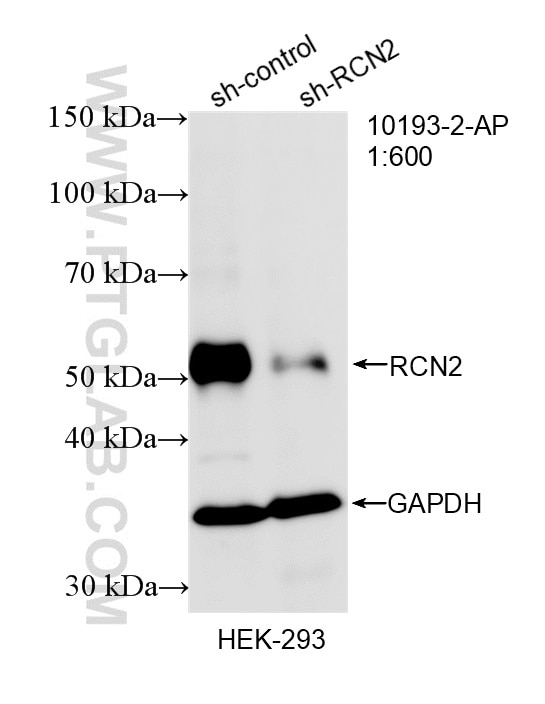
| Positive WB detected in | HEK-293 cells, human brain tissue, mouse lung tissue, HeLa cells |
| Positive IP detected in | mouse lung tissue |
| Positive IHC detected in | human gliomas tissue, human testis tissue Note: suggested antigen retrieval with TE buffer pH 9.0; (*) Alternatively, antigen retrieval may be performed with citrate buffer pH 6.0 |
| Positive IF/ICC detected in | HepG2 cells, HeLa cells |
Recommended dilution
| Application | Dilution |
|---|---|
| Western Blot (WB) | WB : 1:1000-1:4000 |
| Immunoprecipitation (IP) | IP : 0.5-4.0 ug for 1.0-3.0 mg of total protein lysate |
| Immunohistochemistry (IHC) | IHC : 1:20-1:200 |
| Immunofluorescence (IF)/ICC | IF/ICC : 1:350-1:1400 |
| It is recommended that this reagent should be titrated in each testing system to obtain optimal results. | |
| Sample-dependent, Check data in validation data gallery. | |
Product Information
10193-2-AP targets RCN2 in WB, IHC, IF/ICC, IP, CoIP, ELISA applications and shows reactivity with human, mouse, rat samples.
| Tested Reactivity | human, mouse, rat |
| Cited Reactivity | human, mouse, rat |
| Host / Isotype | Rabbit / IgG |
| Class | Polyclonal |
| Type | Antibody |
| Immunogen |
CatNo: Ag0247 Product name: Recombinant human RCN2 protein Source: e coli.-derived, PGEX-4T Tag: GST Domain: 24-209 aa of BC004892 Sequence: KAEELHYPLGERRSDYDREALLGVQEDVDEYVKLGHEEQQKRLQAIIKKIDLDSDGFLTESELSSWIQMSFKHYAMQEAKQQFVEYDKNSDDTVTWDEYNIQMYDRVIDFDENTALDDAEEESFRKLHLKDKKRFEKANQDSGPGLSLEEFIAFEHPEEVDYMTEFVIQEALEEHDKNGDGFVSLE Predict reactive species |
| Full Name | reticulocalbin 2, EF-hand calcium binding domain |
| Calculated Molecular Weight | 37 kDa |
| Observed Molecular Weight | 55 kDa |
| GenBank Accession Number | BC004892 |
| Gene Symbol | RCN2 |
| Gene ID (NCBI) | 5955 |
| RRID | AB_2180018 |
| Conjugate | Unconjugated |
| Form | Liquid |
| Purification Method | Antigen affinity purification |
| UNIPROT ID | Q14257 |
| Storage Buffer | PBS with 0.02% sodium azide and 50% glycerol, pH 7.3. |
| Storage Conditions | Store at -20°C. Stable for one year after shipment. Aliquoting is unnecessary for -20oC storage. 20ul sizes contain 0.1% BSA. |
Background Information
Reticulocalbin 2 (RCN2) is a Ca(2+)-binding protein that is specifically localized in the endoplasmic reticulum (ER). It is also termed ERC-55, i.e. ER calcium-binding protein of 55 kDa. It is a single copy gene and is encoded by an approximately 1900-base mRNA, which shows a ubiquitous expression pattern. The protein comprises an amino-terminal signal sequence followed by six copies of the EF-hand Ca2+ binding motif.
Protocols
| Product Specific Protocols | |
|---|---|
| IF protocol for RCN2 antibody 10193-2-AP | Download protocol |
| IHC protocol for RCN2 antibody 10193-2-AP | Download protocol |
| IP protocol for RCN2 antibody 10193-2-AP | Download protocol |
| WB protocol for RCN2 antibody 10193-2-AP | Download protocol |
| Standard Protocols | |
|---|---|
| Click here to view our Standard Protocols |
Publications
What published studies show
The RCN2 Polyclonal antibody (Cat# 10193-2-AP) has 21 citations across journals including Nature Medicine, Cell Metabolism, Cell Research, PNAS, eLife, Drug Resistance Updates, International Journal of Oncology, Frontiers in Immunology, and American Journal of Cancer Research. Research fields cover epilepsy, osteogenesis, appetite and obesity, esophageal and hepatocellular carcinoma, atherosclerosis, hypertension, osteoarthritis, nasopharyngeal carcinoma, colorectal cancer, stem cell differentiation, mitochondrial and ER proteomics, and cognitive function in diabetic mice.
| Species | Application | Title |
|---|---|---|
Nat Med Chemical corrector treatment ameliorates increased seizure susceptibility in a mouse model of familial epilepsy. | ||
Cell Metab A mechanosensitive lipolytic factor in the bone marrow promotes osteogenesis and lymphopoiesis. | ||
Drug Resist Updat RCN2 facilitates esophageal squamous cellular carcinoma metastasis and cisplatin resistance through UBR5-mediated PPP2CA ubiquitination and degradation.
| ||
Proc Natl Acad Sci U S A Stk40 links the pluripotency factor Oct4 to the Erk/MAPK pathway and controls extraembryonic endoderm differentiation.
| ||
Int J Oncol Phosphatidylinositol glycan anchor biosynthesis, class X containing complex promotes cancer cell proliferation through suppression of EHD2 and ZIC1, putative tumor suppressors. |





