
Recombinant Rat Cystatin C protein (rFc Tag)
Species
Rat
Purity
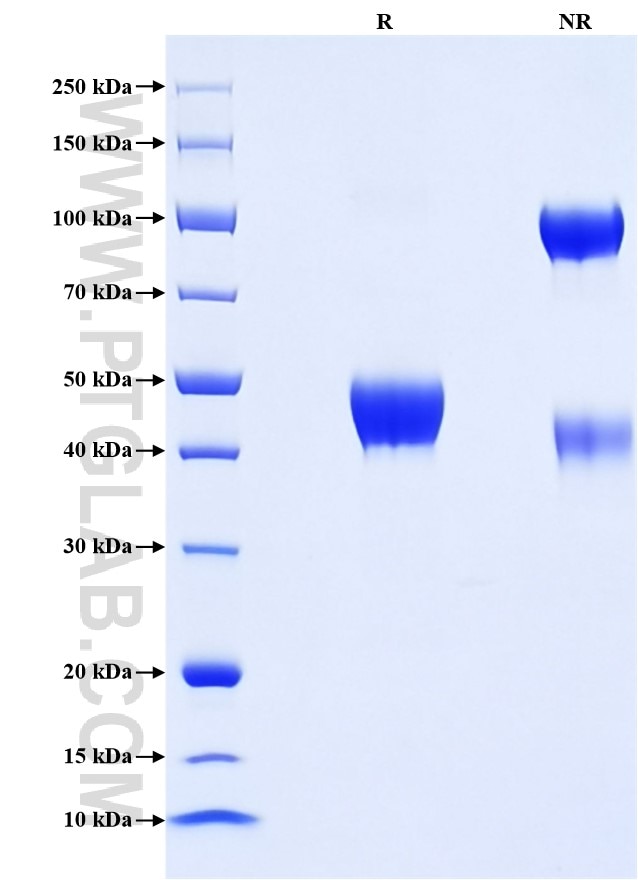
>90 %, SDS-PAGE
Tag
rFc Tag
Activity
not tested
Cat no : Eg3338
Validation Data Gallery
Product Information
| Purity | >90 %, SDS-PAGE |
| Endotoxin | <0.1 EU/μg protein, LAL method |
| Activity |
Not tested |
| Expression | HEK293-derived Rat Cystatin C protein Gly21-Ala140 (Accession# P14841) with a rabbit IgG Fc tag at the C-terminus. |
| GeneID | 25307 |
| Accession | P14841 |
| PredictedSize | 39.6 kDa |
| SDS-PAGE | 40-50 kDa, reducing (R) conditions |
| Formulation | Lyophilized from 0.22 μm filtered solution in PBS, pH 7.4. Normally 5% trehalose and 5% mannitol are added as protectants before lyophilization. |
| Reconstitution | Briefly centrifuge the tube before opening. Reconstitute at 0.1-0.5 mg/mL in sterile water. |
| Storage Conditions |
It is recommended that the protein be aliquoted for optimal storage. Avoid repeated freeze-thaw cycles.
|
| Shipping | The product is shipped at ambient temperature. Upon receipt, store it immediately at the recommended temperature. |
Background
Cystatin C is a 13-kDa inhibitor of cysteine proteinases which is secreted by all cell types and is completely cleared from the organism through glomerular filtration, shown to be an early and sensitive biomarker of renal dysfunction. It is also used as an emerging biomarker in cardiovascular disease. Cystatin C is involved in a variety of inflammatory reactions. The concentration of serum cystatin C has also been shown to be unaltered in certain inflammatory conditions or other disorders of metabolism. The plasma level of serum cystatin C can be expressed as its level of generation from cells and diet and its subsequent elimination through the gut, liver, and kidneys.
References:
1.Grubb A. et al.(1985) Acta Med Scand.218:499-503.
2.Uchida K. et al.(2002) Clin Chim Acta.323:121-128.
3.Jacobsson B.et al.(2020) Ann Clin Biochem.57:182-185.
4.Menon V. et al.(2007) Ann Intern Med.147:19.